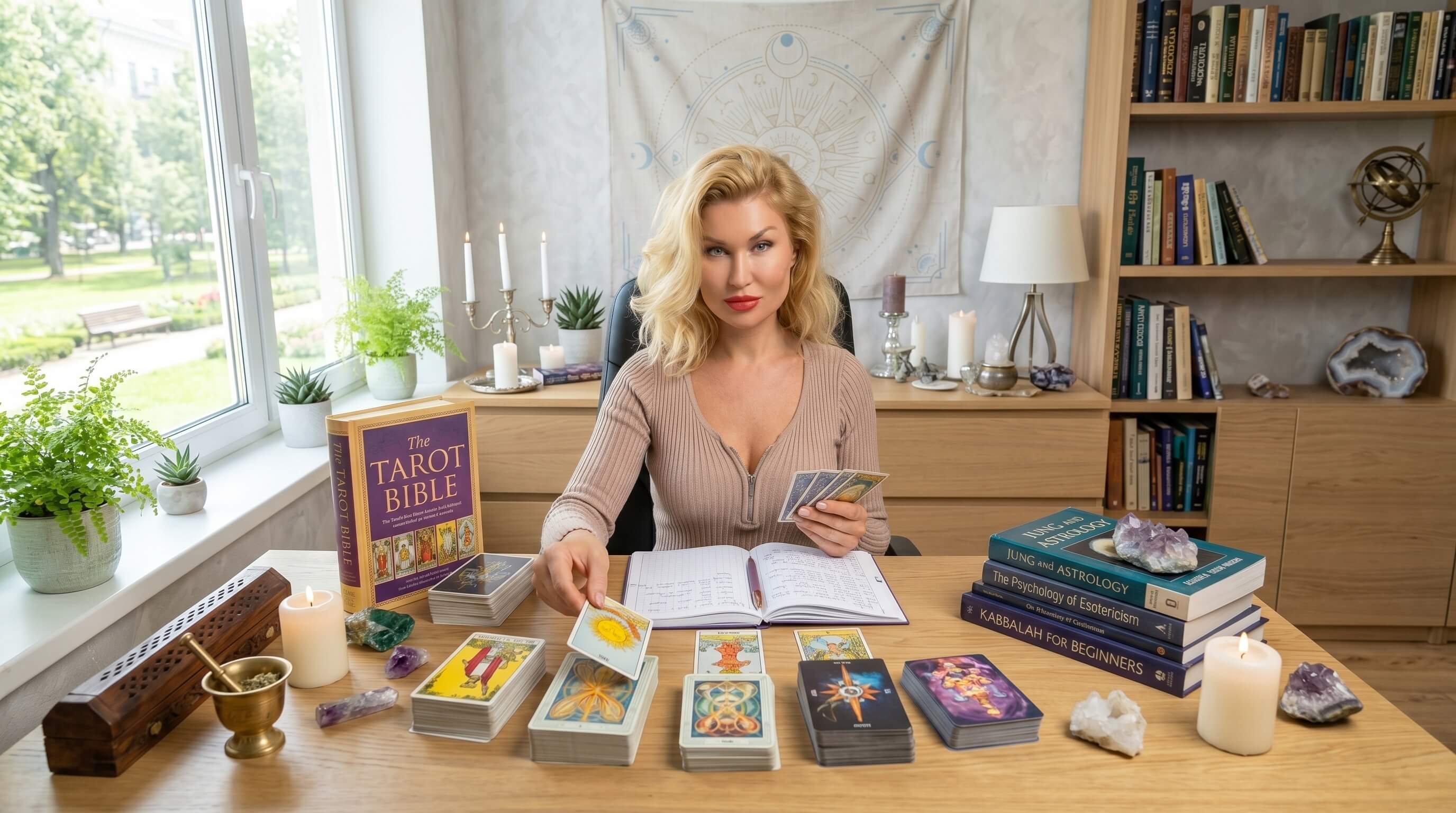
A card of the Tarot deck denoting a complete archetypal lesson or life pattern; derived from the Latin arcanum ("mystery" or "secret"). A complete deck consists of 22 Major and 56 Minor Arcana. Arthur Edward Waite in «The Pictorial Key to the Tarot» emphasized that the meaning of an Arcana is revealed only in the context of a specific spread and the querent's question.
📚
Source: Arthur Edward Waite, «The Pictorial Key to the Tarot» (1910).
The 22 primary cards from 0 (The Fool) to XXI (The World), describing the key stages of a person's spiritual and psychological life path, life periods, roles, and behavioral models. Carl Gustav Jung correlated them with the archetypes of the collective unconscious. Tarot scholar Rachel Pollack in «78 Degrees of Wisdom» describes the Major Arcana as «a map of the human soul».
📚
Source: C. G. Jung («Archetypes and the Collective Unconscious»); Rachel Pollack («78 Degrees of Wisdom»).
The 56 cards across four suits (Wands, Cups, Swords, Pentacles), reflecting everyday situations, emotions, thoughts, material manifestations, specific people, or one's own role in specific circumstances. Unlike the Major Arcana which reveal overarching life lessons, the Minor Arcana detail tangible events and the practical context of a query, helping the reader interpret the spread with nuance.
A complete set of 78 symbolic cards divided into 22 Major and 56 Minor Arcana, functioning as a system for divination, psychological analysis, and self-knowledge. Every authentic deck preserves a universal underlying symbolic structure regardless of artistic styling, though distinct deck designs can highlight unique thematic nuances in interpretation.
One of the four divisions of the Minor Arcana: Wands, Cups, Swords, or Pentacles, each corresponding to an element and a sphere of human life — action, feelings, intellect, or the physical world. The dominance of a single suit in a spread indicates to the practitioner where the core energy of the client's query is focused.
One of the four foundational elemental energies (Fire, Water, Air, Earth) embodied by the suits: Wands to Fire, Cups to Water, Swords to Air, Pentacles to Earth. Understanding the elemental balance of a spread helps uncover what is lacking or overemphasized in the client's situation.
🔄
Upright and Reversed Card Orientation
The orientation of a drawn Tarot card relative to the reader: right-side up or upside down. An upright card reflects an open, direct, and constructive expression of the archetype's meaning, while a reversed card indicates blocked, internalized, delayed, or shadow manifestations of the same Arcana.
A geometric arrangement or pattern of laid-out cards across a set number of positions. Each position carries a designated query meaning, and the entire layout reveals the systemic overview of the situation. A skilled reader interprets cards not in isolation, but in dynamic relationship to one another and the central inquiry.
One of the most famous and comprehensive classical 10-card Tarot layouts, providing a panoramic view of any complex matter: core issue, immediate obstacle, past root, near future, environment, internal hopes/fears, and eventual outcome.
A focused analytical technique examining the interpersonal dynamics between partners: conscious thoughts, genuine feelings, hidden motives, points of friction, and long-term potential. It delivers not only diagnostic clarity but practical guidance for relational harmony.
An express diagnostic technique designed to provide a decisive answer to a closed query: drawing one or three cards whose upright/reversed orientation, dignity, and symbolism provide an affirmative, negative, or qualified answer. Ideal for simple day-to-day choices.
A hybrid forecast methodology where cards are laid out in a structure aligned with a calendar timeframe (week, month) to map key upcoming themes and events. It blends Tarot archetypes with the predictive logic of astrological forecasting for a personalized timeline.
A designated card representing a specific person or inquiry in a spread. The reader selects a significator based on astrological sign, age, or psychological temperament of the querent, or lets a card emerge organically. Detailed extensively by Mary K. Greer in «Tarot for Your Self».
📚
Source: Mary K. Greer, «Tarot for Your Self» (1984).
The person asking the question and for whom the reading is conducted, whether present in person or remotely. The honesty, clarity, and precision with which the querent articulates their inquiry directly shapes the depth and accuracy of the reading.
A daily ritual of drawing a single card each morning to reveal the guiding theme, potential pitfall, or personal resource for the upcoming 24 hours. Used as a mindfulness tool to attune with daily energy and make conscious decisions without fatalistic forecasting.
🧙♀️
Tarot Reader (Tarot Practitioner)
A trained practitioner who interprets the symbols and archetypes of the 78 Tarot cards to analyze a client's life situation. Unlike a fortune teller, a professional Tarot reader relies on an integrated system of card meanings, systemic analytical principles, and depth psychology.
🎨
Rider-Waite Tarot (RWS)
One of the world's most influential and widely recognized Tarot decks, created by Arthur Edward Waite and artist Pamela Colman Smith in 1909. Its revolutionary feature was fully illustrated scenes across all 56 Minor Arcana. Masterfully analyzed by Eden Gray in «A Complete Guide to the Tarot».
📚
Source: Eden Gray, «A Complete Guide to the Tarot» (1970).
A ritual practice performed after a consultation or before a new reading to clear residual energetic impressions from previous clients and questions. Regular cleansing maintains clarity, focus, and unbiased readings.
A Tarot deck with which the reader has cultivated a stable, harmonious connection through ongoing practice and conscious care. A brand-new, unseasoned deck may initially yield less attuned readings until mutual resonance is established.
🧮
Destiny Arcana Calculator
An online calculation tool that computes an individual's personal lifetime Arcana (personality, soul mission, annual cycles) from their birth date. The calculation is based on reducing birth date numbers to values between 1 and 22.