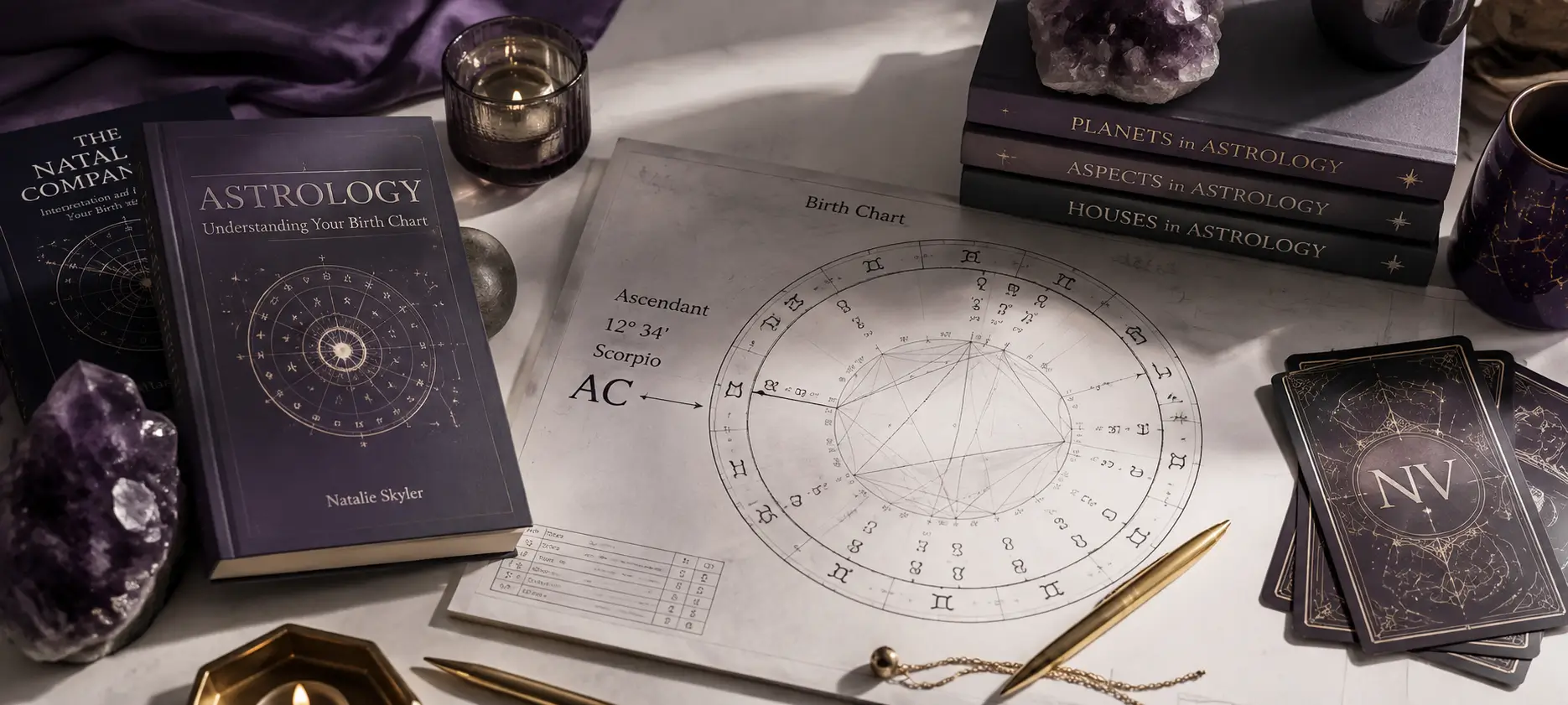
Аscendant is a point in your natal chart that shapes the first impression you make before you even utter a word. If your Sun sign is who you are on the inside, then the Ascendant is the door through which the world sees you: your posture, style, physical appearance, and spontaneous reactions in new situations. This is why many people recognize themselves in the description of their Ascendant even more accurately than in their Sun sign.
Ascendant in All 12 Signs 🔗
♈ Ascendant in Aries♉ Ascendant in Taurus
♊ Ascendant in Gemini
♋ Ascendant in Cancer
♌ Ascendant in Leo
♍ Ascendant in Virgo
♎ Ascendant in Libra
♏ Ascendant in Scorpio
♐ Ascendant in Sagittarius
♑ Ascendant in Capricorn
♒ Ascendant in Aquarius
♓ Ascendant in Pisces
Ascendant: Summary 📋
| Parameter | Meaning |
|---|---|
| What it is | The zodiac sign rising on the eastern horizon at the moment of birth ⬆️ |
| What it shows | Self-presentation, first impressions, behavior style, physical appearance, social presence |
| Required for calculation | Exact date, time, and location of birth 🕐 |
| Rate of change | Changes to a new sign approximately every 2 hours |
| Associated house | Cusp of the 1st House 🏠 |
| Opposite point | Descendant — the partner archetype 💞 |
| Next step | Full analysis — book a consultation |
What is the Ascendant in Simple Terms 🔑
The Ascendant (or Rising Sign) is the zodiac sign that was rising on the eastern horizon at the exact moment of your birth — where the sun rises. As the Earth rotates on its axis, the zodiac belt appears to rotate across the horizon over 24 hours, placing each sign at the eastern horizon in turn. This is why the Ascendant is so sensitive to time: it does not show «where the Sun was on your birthday» (that is your Sun sign), but «what exact sign was rising when you took your first breath».Why Exact Birth Time is Critical for Calculation 🕐
The Ascendant shifts to a new zodiac sign approximately every 2 hours, meaning a difference of even 20–30 minutes can alter the exact degree within a sign, while an hour or two can shift it into an entirely different sign. It is one of the few elements in a natal chart where inaccuracy leads not to a small margin of error, but to a completely different result.There is also a less obvious technical nuance: if you were born before the 1980s–1990s (the exact threshold varies by country), your time zone at birth might not align with modern rules — daylight saving time adjustments in USSR and post-Soviet countries changed irregularly. This means that even with an accurate birth time from a birth certificate, an automated online calculator might miscalculate the Ascendant if it fails to account for historical time zone adjustments for a specific date and location. In such cases, precise calculation is best left to a professional who can verify historical time zone data manually. If the exact time is completely unknown, a technique called rectification can be used, which is explained in more detail in our article on the Natal Chart.
How the Ascendant Differs from the Sun Sign 🌌
This is where most confusion arises. Your Sun sign represents the core of your personality, inner motivation, and overall life direction. The Ascendant is how that personality is packaged for the external world: first impressions, spontaneous reactions, and initial communication style. Someone might have a warm, emotional Sun in Cancer, but a cool and reserved Ascendant in Capricorn, making their initial impression vastly different from who they are once you get to know them closely.How the Ascendant Differs from the 1st House 🏠
The Ascendant is a specific point and degree in a sign; the 1st House encompasses the entire area of the chart from that point to the beginning of the 2nd House, including any planets located within it. You can think of the Ascendant as the front door, while the 1st House is the entire hallway behind it. A detailed breakdown of planets in the 1st House can be found in our article «1st House».The Chart Ruler (Ascendant Ruler): Key to a Complete Portrait 🔗
Every Ascendant has a ruling planet — the planet that rules the rising sign. The placement of this planet in your chart (by sign and house) reveals the specific area of life through which your personality expresses itself most strongly. For example, if your Ascendant is in Taurus (ruled by Venus) and Venus is placed in the 10th House, you will express your natural charm and aesthetic sense primarily through your career and public status.The Four Angles of the Chart: Where the Ascendant Stands 🧭
The Ascendant is not the only vital point in a chart; it is one of the four cardinal Angles, the most powerful and active points of the entire system:⬆️ Ascendant (ASC) — East, 1st House cusp: how you present yourself to the world
⬇️ Descendant (DSC) — West, 7th House cusp: what you seek in a partner
🔝 Midheaven (MC, Medium Coeli) — Highest point, 10th House cusp: career, status, public image
🔽 Imum Coeli (IC) — Lowest point, 4th House cusp: home, roots, inner foundation
Any planets located close to one of these four angles carry significantly more weight and visibility to others than planets positioned mid-house — a fundamental principle of chart analysis in Western astrology.
Ascendant vs Descendant: You and Who You Seek ⚖️
While the Ascendant shows how you present yourself to the world, the opposite point — the Descendant (cusp of the 7th House) — reveals the partner archetype you subconsciously seek in relationships. In practice, people are frequently drawn to partners whose Sun sign or Ascendant matches their Descendant — this is no coincidence, but the natural magnetism of opposing points in a chart. For instance, with an Ascendant in Aries, the Descendant automatically falls in Libra, drawing that individual toward diplomatic, partnership-oriented personalities who balance out their direct nature.💕 Want to learn more about your compatibility? Use our Online Compatibility Calculator by Date of Birth →
Ascendant and Physical Appearance 🩺
Beyond behavioral traits, classical astrology links the Ascendant to physical constitution and body type — not facial features directly, but the overall style of physical energy. Fire Ascendants are often associated with active, dynamic energy, while Earth Ascendants tend toward a grounded, solid constitution. Keep in mind: this is a general trend within traditional astrology, not a medical rule or absolute law.Ascendant According to Jung: More Than Just a Mask 🧠
Comparing the Ascendant to a simple «mask» oversimplifies its true nature. Psychotherapist, Jungian analyst, and astrologer Liz Greene, in her book «The Astrology of Fate» (1984), described the Ascendant as an interface between the inner psyche and the outer world. She noted that Ascendant traits are not an act or facade for others, but characteristics the individual genuinely strives to embody — an authentic direction for personal growth rather than a superficial social mask.This changes how you approach your Ascendant: whether you have the composure of Capricorn or the directness of Aries, it is not a role you have to play, but an authentic aspect of your psyche to cultivate intentionally.
Ascendant and First Impressions: Why It Matters in Real Life 💼
The Ascendant is not an abstract concept; it is a practical tool for understanding how others perceive you in interviews, first dates, or new environments. The gap between your inner self (Sun, Moon) and your outer presentation (Ascendant) explains why people often say «you aren't who I thought you were at first» — a natural manifestation of personality complexity.Transits Over the Ascendant: Significant Life Shifts 🌀
When a transiting planet crosses your natal Ascendant, it marks one of the most noticeable periods in your life, as it directly impacts the lens through which your entire chart operates.🌱 Transiting Jupiter over the Ascendant — A period of expanding opportunities, rising confidence, and new personal endeavors.
🪐 Transiting Saturn over the Ascendant — A milestone of maturity requiring greater personal responsibility and self-definition.
⚡ Transiting Uranus over the Ascendant — Sudden shifts in personal style or self-perception, pushing for breaking free from old constraints.
🌑 Transiting Pluto over the Ascendant — A deep, gradual personal transformation that alters how you feel and appear to the world.
Ascendant in Compatibility and Synastry 💞
When comparing two charts, the interaction between Ascendants plays a key role: compatible elements (e.g., both Air signs) foster effortless daily communication, whereas contrasting elements (e.g., Fire and Water) can create strong attraction through differences but may require more patience in daily life. Learn more in our section on Compatibility and Synastry →Psychologist's Advice: What to Reflect On 🧠
The Ascendant often develops as an adaptive response during early childhood — reflecting the behavior patterns that felt safest and most effective in your family environment. Ask yourself honestly: does your current self-presentation still serve you, or is it an outdated defensive strategy you can safely let go of?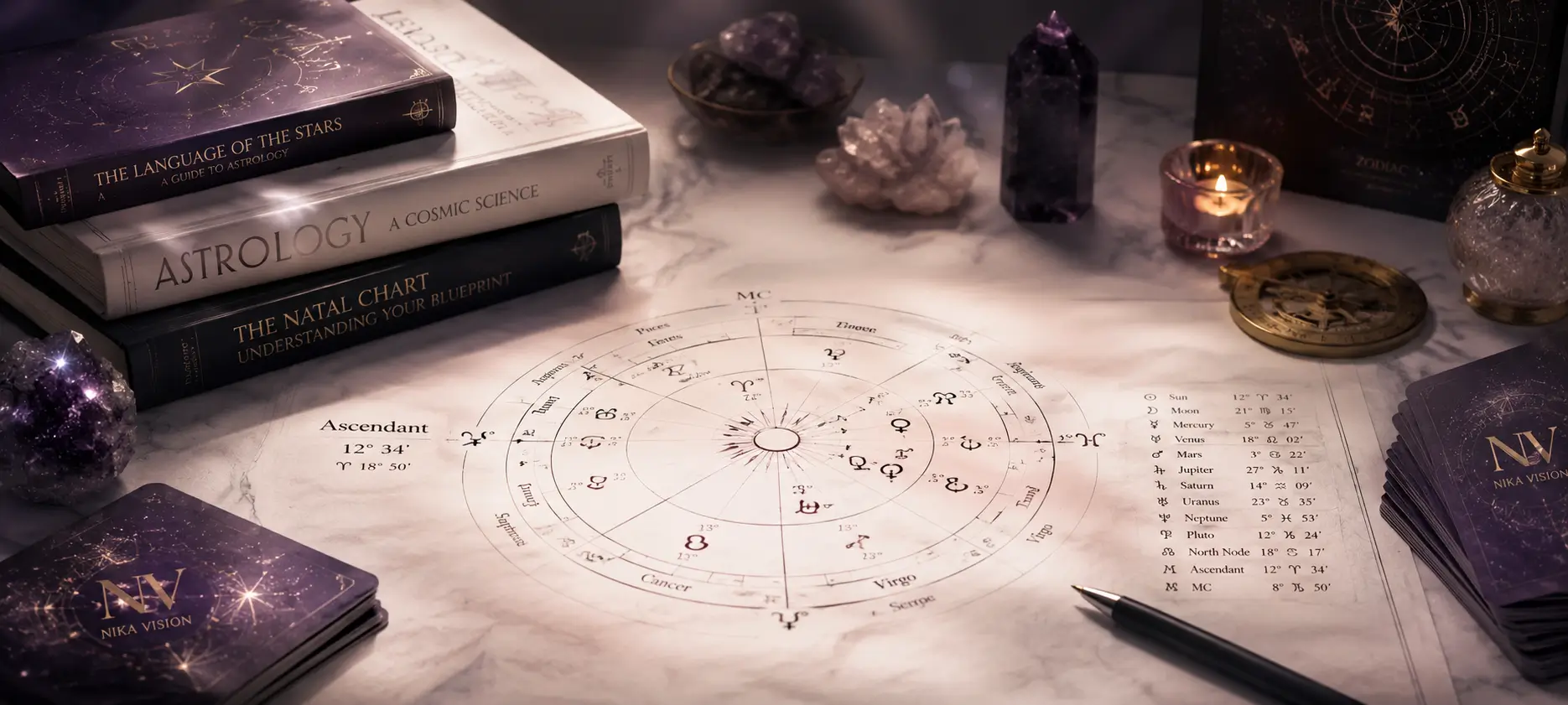
Common Misconceptions About the Ascendant ❌
«The Ascendant is the same as your zodiac sign» — No, it is a distinct element of your chart that requires an exact birth time, unlike your Sun sign.«You can estimate your Ascendant without an exact birth time» — Not accurately: even a 20–30 minute shift can change the outcome, making an estimated Ascendant unreliable.
«The Ascendant only affects physical appearance» — No, it shapes your communication style, stress response, and general behavior in new settings.
Mini Case Study 📖
A client once asked why coworkers perceived him as overly stern and reserved, despite his lighthearted nature at home. His chart revealed a Capricorn Ascendant with a Gemini Sun: reserved on the outside, but intellectually curious within. Rather than changing his entire image, he learned to consciously share his Gemini lightheartedness in comfortable settings instead of relying solely on his professional demeanor.Frequently Asked Questions ❓
How can I find my Ascendant? You need an exact calculation based on your birth date, time (accurate within 15–20 minutes), and location. This can be calculated during a personal consultation or via professional software.Can I determine my Ascendant without an exact birth time? Not directly, but rectifying your chart using major life events can help narrow down your birth time when official records are unavailable.
🗓️ Discover more about your life path by date of birth — try our Life Path Number Calculator →
Why do horoscope apps sometimes show a different Ascendant than an astrologer's calculation? This usually happens due to inaccurate birth times entered into apps or default time settings that do not account for historical time zone changes.
Which is more important overall — the Ascendant or the Sun sign? Neither is «more important» — they serve different roles. The Sun represents core identity, while the Ascendant represents outer expression. The complete picture requires considering both.
Can your Ascendant change over time? The sign and degree of your Ascendant remain fixed for life, though how consciously you express its qualities can evolve with personal growth.
How does the Ascendant affect relationships? It shapes initial impressions and day-to-day interaction styles. Deeper compatibility requires comparing complete natal charts — read more in our Synastry section →
Does the Ascendant determine physical appearance? Partially — it influences posture, style, and general presence, though overall physical appearance depends on multiple factors across the chart.
Why should I know my Ascendant if I already know my Sun sign? Because the Ascendant explains what others notice about you first, helping you understand any gaps between external impressions and who you are inside.
What are the four angles of a chart, and why are they important? The Ascendant, Descendant, Midheaven (MC), and Imum Coeli (IC) are the four primary focal points of a chart. Planets near these points express themselves far more prominently.
Why do online calculators sometimes miscalculate Ascendants for birth dates prior to the 1990s? Historical time zone shifts and daylight saving time adjustments were inconsistent in many countries, and automated calculators often miss these historical nuances.
Is the Ascendant related to physical body type? Traditional astrology links the Ascendant to general physical traits and energy levels, though it represents a general pattern rather than a medical rule.
How does the Descendant differ from the Ascendant? The Ascendant represents how you present yourself, while the Descendant (directly opposite) shows the qualities you seek in a partner.
Is the Ascendant just a social mask? No, according to psychological astrology (Liz Greene), it functions as an interface between your inner world and outer reality — traits you genuinely strive to express.
What happens when a transiting planet passes over the natal Ascendant? It marks a prominent life phase — Jupiter expands opportunities, Saturn adds responsibility, Uranus triggers sudden change, and Pluto brings deep personal transformation.
Your Ascendant is Just the First Page of Your Story 🌟
While your Ascendant sets the tone for first impressions, your full personality unfolds when combined with your Sun, Moon, and the rest of your natal chart.To discover your exact Ascendant and see how it interacts with the rest of your chart, book a personal consultation for an in-depth breakdown based on your exact birth details.

Online services tarot, astrology... →