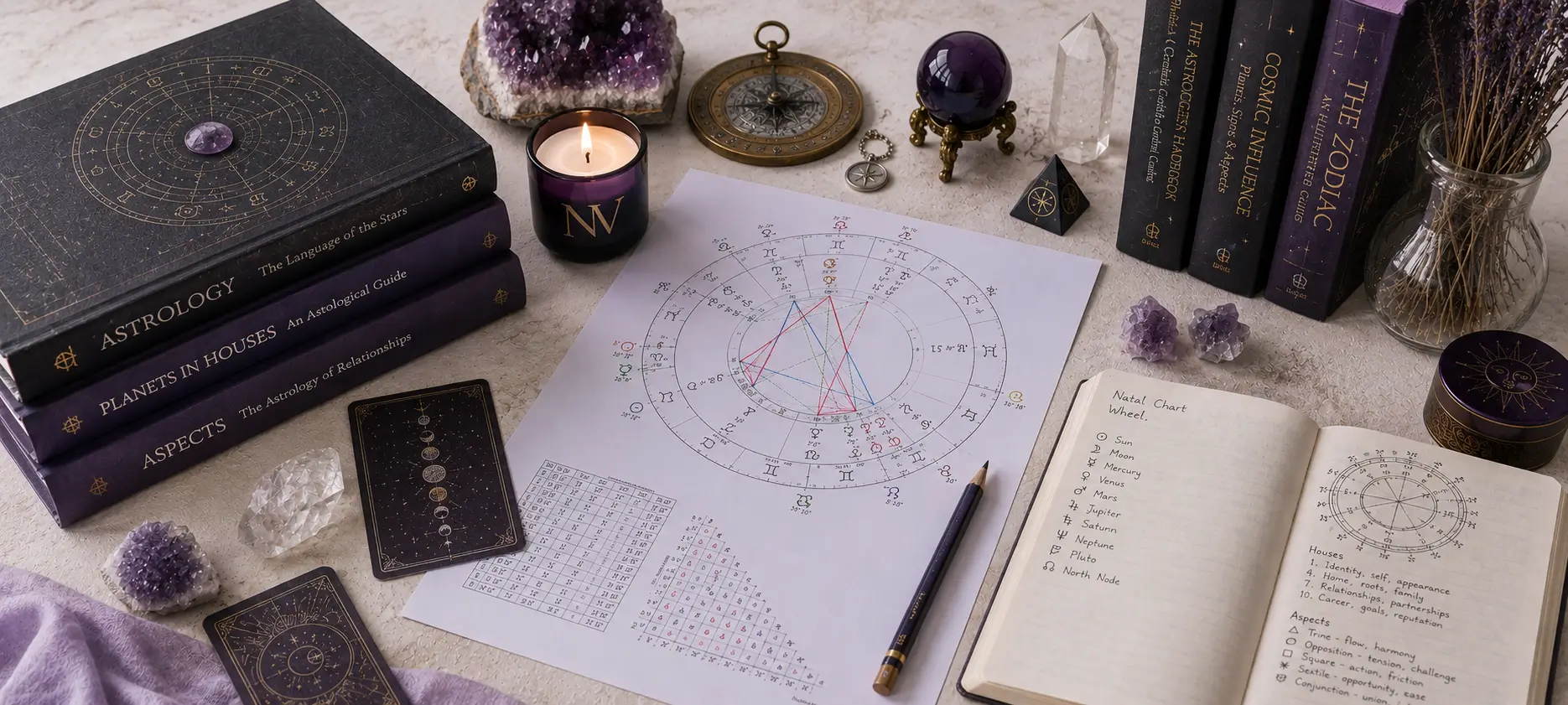
If you already know what a natal chart is, but don't understand where to start reading it — this page is for you.
We will break down step by step which elements make up the chart and how to connect them into a unified picture, rather than a set of disjointed facts.
Natal Chart: Structure and Elements 🧩
| Component | What It Represents |
|---|---|
| Sun ☀️ | The essence of personality, main life direction, your ego, «Captain of your ship» |
| Moon 🌙 | Emotions, inner desires and needs, sense of security, adaptability, woman as a mother or wife |
| Ascendant ⬆️ | Image in the outer world, first impression, social portrait, effective self-realization |
| Personal Planets ☿ | Mercury, Venus, Mars — ability to think, speak, communicate, learn, act, love, express affection, enjoy, negotiate, spend, earn, appreciate beauty, and fulfill your talents |
| Lunar points ☊ ☋ | Lilith, Selena and Lunar (Karmic) nodes — calculated points of the lunar orbit that shape a personality portrait: Lilith exposes the shadow and hidden strength, Selena highlights the light and inner resource, while the Karmic nodes outline the vector of development |
| Houses / Spheres of Life 🏠 | Which area of life unfolds the planet's theme and where significant events will occur |
| Zodiac Signs ♈ | How the energy of each planet manifests itself |
| Compatibility / Synastry 💞 | Interaction of your chart with your partner's chart, strengths and weaknesses of the couple, relationship model, love language, capacity for long-term stable relationships, karmic lessons to be experienced in partnership, purpose of the relationship |
Step 1: Start with the «Big Three» 🔑
Before diving into details, look at the three main elements of the chart — the Sun, Moon, and Ascendant. Together they form the main framework of your personality: who you are inside (Sun), what you feel (Moon), and how others see you from the outside (Ascendant). This is a convenient entry point, because three signs already provide a fairly comprehensive portrait, even before analyzing the other ten planets.Step 2: Add Personal Planets and Houses 🏠
Next come the personal planets — Mercury (how you think and speak), Venus (what and whom you love), Mars (how you act and assert yourself). Each of them resides in its own zodiac sign and house — and it is the house that indicates in which life sphere this energy manifests most strongly. For example, Venus in the house of relationships is one love scenario, while Venus in the house of career is completely different, even if the zodiac sign of Venus is the same.Astrologer Howard Sasportas in the book «The Twelve Houses» (1985) emphasized that houses do not show character itself, but specific life settings in which this character plays out — therefore, the same planet in different houses «sounds» completely differently.
Step 3: Look at Elements and Crosses overall 🔥
When you have the signs of all main planets at hand — it is useful to look at the chart from a broader perspective: which elements (fire, earth, air, water) and crosses (cardinal, fixed, mutable) are predominant in your chart. This shows your general temperament — for instance, a lot of fire and little water may mean that taking action is easier for you than feeling and talking about emotions. Detailed information about elements and crosses can be found in the article on Zodiac Signs.Where Self-Reading Ends and the Astrologer’s Work Begins ⚖️
Everything described above is the foundation that you can realistically master on your own. But a full chart reading also includes aspects — angles between planets (conjunctions, oppositions, trines, squares) that can strengthen or, conversely, weaken each other. It is aspects that most often distort independent interpretation «by a single planet» — and this is where a professional view of the whole chart is required.If you haven't read the general introductory article about the natal chart yet — definition, basic components, what science says — it is available on the blog: «What is a Natal Chart» →
And if you are interested in which specific life topics can be uncovered through a reading — love, money, life purpose, repeating mistakes — read «Key Topics of a Natal Chart Reading» →
Frequently Asked Questions ❓
Which chart element is best to start analyzing if I am a beginner? Start with the «Big Three» — Sun, Moon, and Ascendant. They provide the core, most recognizable personality portrait before diving into the other ten planets.Is it possible to fully analyze your own chart independently? A basic level — yes, but a full reading requires considering aspects between planets, which requires professional experience because the same element can be interpreted differently depending on other factors in the chart.
What should I do if one element in the chart «contradicts» another? This is a normal situation — for example, an emotional Moon in a water sign and a reserved Ascendant in an earth sign create internal tension between «what I want to show» and «what I feel». These exact contradictions are analyzed by an astrologer during a consultation.
In what order should I study the astrology sections of this website? I recommend: Zodiac signs → Big Three (Ascendant, Sun, Moon) → Personal Planets → Houses → Compatibility — this is how a cohesive picture is built. Check your couple's compatibility in the Compatibility Calculation on our website →
Is it necessary to know the exact birth time to start reading? For the Ascendant and exact house boundaries — yes, absolutely. For the Sun, Moon (in most cases), and personal planets, the exact time is not critical.
How does «step-by-step reading» differ from a full professional reading? Self-reading gives general direction and familiarity with the chart, while a professional analysis adds aspects, transits, and connects everything into a unified, personalized conclusion rather than a collection of separate fragments.
Do I need to read all 7 sections of the site to understand my chart? Not necessarily all at once — you can start with what resonates most right now (for instance, with relationships through Compatibility), and return to the rest gradually.
What if I already had a chart reading with another specialist — is this page still useful? Yes, it will help refresh the structure of the chart in your memory and practice returning to your analysis independently, rather than keeping everything solely as a recorded consultation.
Your Chart is Not a Puzzle, but a System 🌌
Each element of the chart individually is just a fragment. The real meaning emerges when all fragments unite into a single system: Sun, Moon, Ascendant, planets, houses, and aspects — together, rather than one by one. If you want to see this comprehensive reading of your chart instead of piecing it together on your own — I invite you to a consultation →
Online services tarot, astrology... →