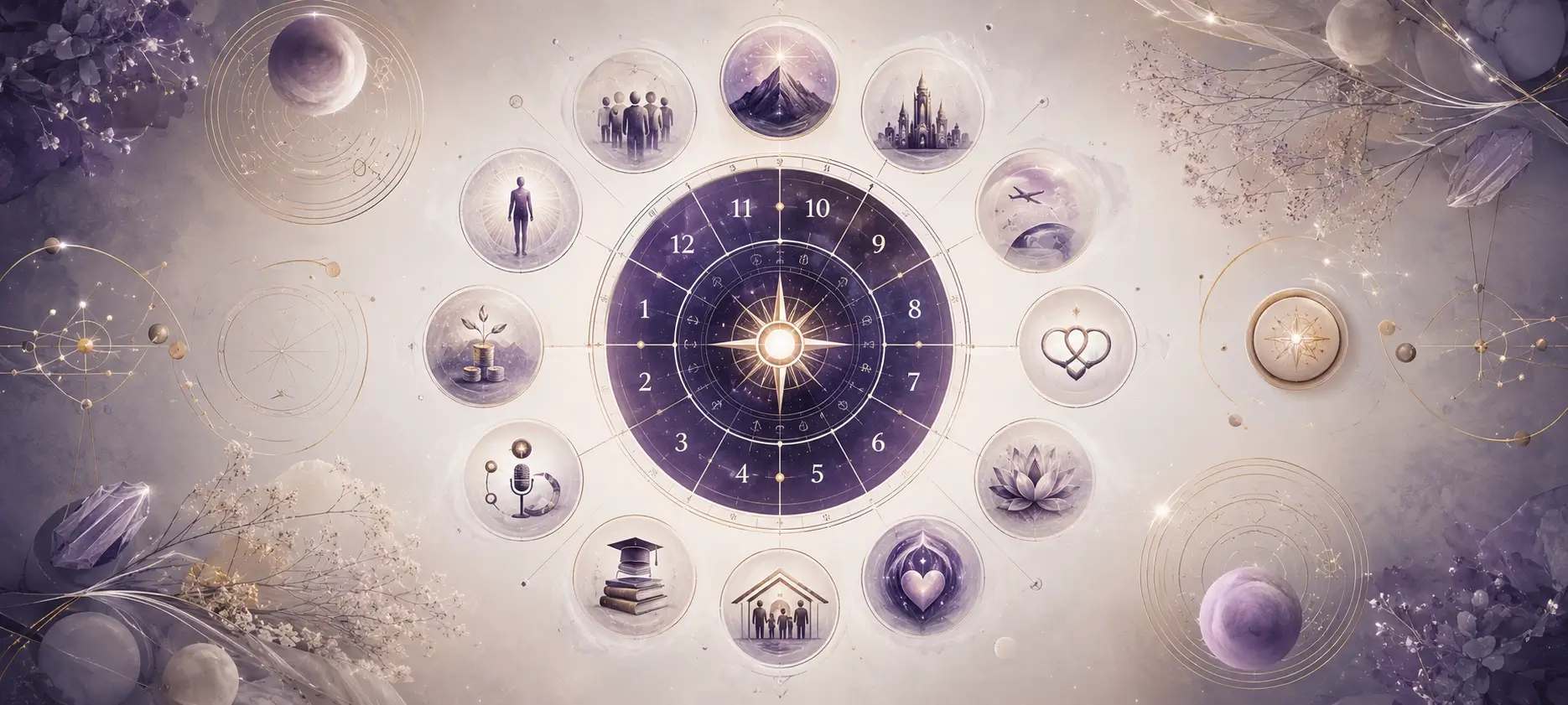
The same planet in the same sign sounds different depending on which house of the natal chart it falls into.
Astrology historian Deborah Houlding in her book «The Houses: Temples of the Sky» (2006) shows in detail that the very concept of houses was formed over centuries and different traditions interpreted the same houses differently — so minor discrepancies between modern systems are not accidental, but reflect different historical approaches to the same question.
🔺 Angular houses (1, 4, 7, 10) — the most «active», associated with direct action and initiative. Planets here manifest most noticeably to others.
🔻 Succedent houses (2, 5, 8, 11) — about accumulation and retention: of resources, creativity, deep connections, goals.
🔹 Cadent houses (3, 6, 9, 12) — about learning, adaptation, and internal processing of experience, often less noticeable externally, but no less significant.
A planet in an angular house is usually felt as a more pronounced and noticeable personality trait than the same planet in a cadent house — this is worth considering during interpretation.
📅 Want to learn more about how to decode the complete birth picture? Check out Natal Chart: how to read and where to start decoding →
🔢 Find out your Destiny Number by date of birth using the principles of numerology →
Why do I see different house boundaries in different calculation programs? Different services may use different calculation systems (Placidus, Whole Sign, etc.) — this is normal, discrepancies of 1–2 degrees are not considered errors, but reflect different mathematical approaches.
What is more important — a planet in a house or the sign on the house cusp? These are not competing, but complementary levels of analysis: the cusp sets the general tone of the life sphere, while specific planets inside the house show what exact dynamics will unfold there most actively.
Can a house be «empty», without a single planet? Yes, and this is a common situation — an empty house does not mean that the topic will be less important to you, and there is nothing wrong with it. Events will still occur in an empty house, and you will engage with it, but without intense involvement in its themes. It will unfold primarily through the sign on the cusp and through the ruler of that house.
Why are angular houses considered «stronger»? Historically, angular houses (1, 4, 7, 10) are connected to the four key points of the sky at the moment of birth (sunrise, nadir, sunset, zenith) — planets here manifest in a person's life most vividly and noticeably to others.
Can houses be determined without a birth date, only by zodiac sign? No, houses are a purely individual calculation depending on the exact time and place of birth; a zodiac sign by itself provides no information about houses.
How are houses related to forecasts and transits? When a transiting planet passes through a specific house of your natal chart, it indicates which sphere of life events are most likely to occur in during that period — houses make transit forecasts personal rather than general for everyone.
Where is it best to start studying one's houses for beginners? Start with angular houses (1, 4, 7, 10) — they are the most noticeable and understandable for interpretation, and then gradually move to succedent and cadent ones as you get comfortable with the basic logic of the system.
Want to understand how houses manifest specifically in your natal chart? Start with the section Natal Chart: how to read and where to start decoding →, and if you want to get straight to the point — I invite you to a consultation, where we will analyze your specific chart rather than general patterns.

Online services tarot, astrology... →
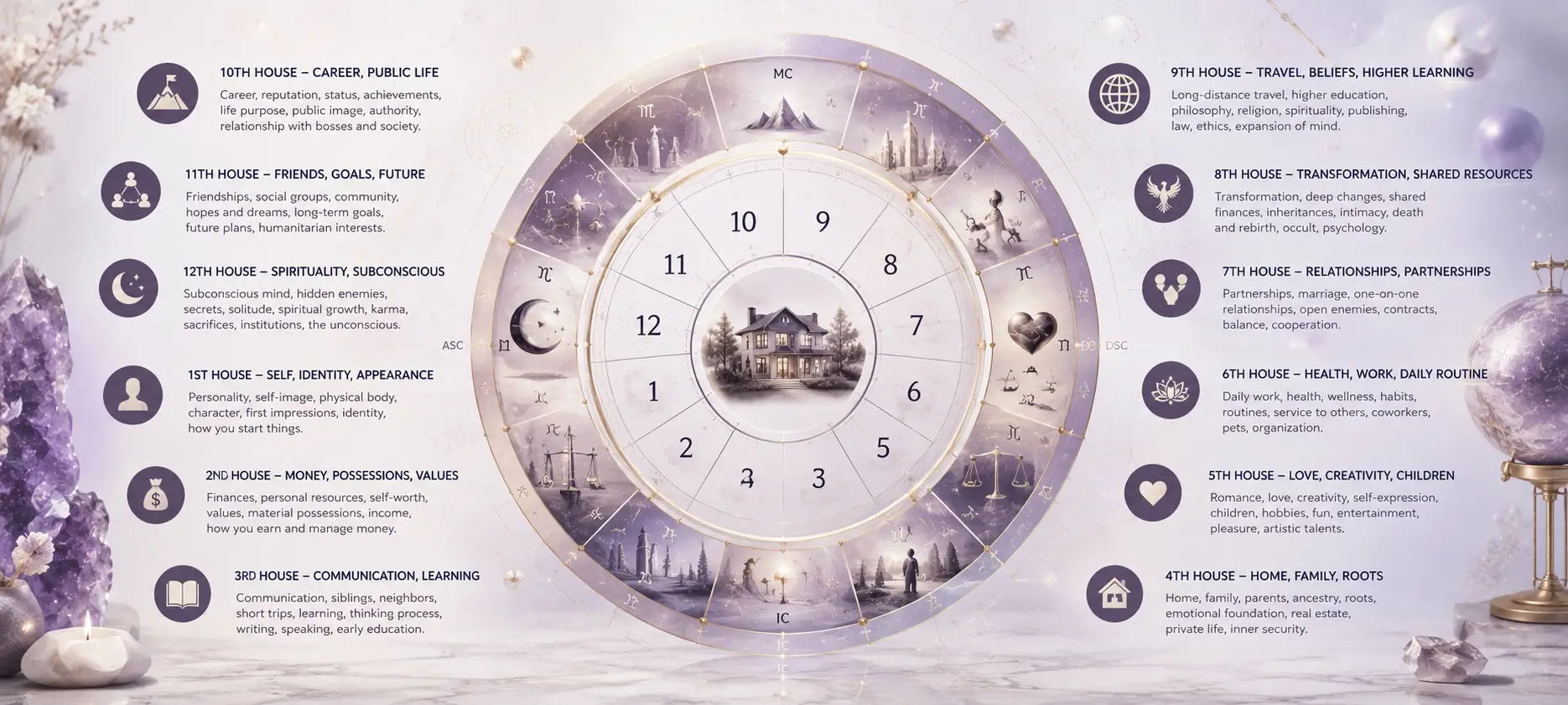
Houses are the spheres of our life (parenting, partnership, learning, money, career…). If personal planets or a stellium (several planets) are located in a certain house / sphere, it means these topics will be the most relevant and important for a person throughout their life.
12 houses and the spheres of life they describe 📋
| House | Sphere of Life | ||
|---|---|---|---|
| 1st house | ♈ Aries | ♂ Mars | Appearance, body, self-presentation, first impression |
| 2nd house | ♉ Taurus | ♀ Venus | Finances, talents, resources, self-esteem through material values |
| 3rd house | ♊ Gemini | ☿ Mercury | Communication, learning, close environment, sales, gadgets, trips |
| 4th house | ♋ Cancer | ☽ Moon | Home, family, roots, real estate, intuition |
| 5th house | ♌ Leo | ☉ Sun | Romance, creativity, children, hobbies, self-expression |
| 6th house | ♍ Virgo | ☿ Mercury | Work, routine, health, colleagues, pets |
| 7th house | ♎ Libra | ♀ Venus | Marriage, partnership, competitors, clients |
| 8th house | ♏ Scorpio | ♇ Pluto | Transformation, intimacy, crises, other people's money, esoterics |
| 9th house | ♐ Sagittarius | ♃ Jupiter | Philosophy, travel, higher education, faith, law |
| 10th house | ♑ Capricorn | ♄ Saturn | Career, status, reputation |
| 11th house | ♒ Aquarius | ♅ Uranus | Internet, technologies, communities, dreams, big money |
| 12th house | ♓ Pisces | ♆ Neptune | Subconscious, solitude, the hidden, dependencies, completion of cycles |
What is a house in a natal chart in simple terms 🌌
Imagine a natal chart as a round clock face divided into 12 sectors — these are the houses. Unlike zodiac signs, which are fixed and the same for everyone (the sky belt is always divided into the same 12 sections), houses are calculated individually: their position depends on the exact time and place of your birth. That is why exact birth time is so crucial for calculating reliable houses. With a difference of even 20–30 minutes, house boundaries can shift noticeably.How a house differs from a zodiac sign ♈
This is one of the most common sources of confusion for beginners. A zodiac sign shows «how» energy manifests (for example, Mars in Aries acts pushy, impulsively, and quickly), while a house shows «where» exactly this energy unfolds (Mars in the 10th house — this pushiness will manifest primarily in career, while Mars in the 7th house — in partnership or open conflicts with others). The sign is the style, presentation, «costume», while the house is the stage where the action itself takes place.House calculation systems: why it is not as simple as it seems 📐
Here lies a technical subtlety rarely written about on popular websites: there is no single way to divide the sky into 12 houses — several mathematical systems are used, and different calculation software can give slightly different boundaries. The most common are the Placidus system (takes into account the time of day and latitude of the birth location, most popular in Western astrology) and the Whole Sign system, where each house simply coincides with one entire zodiac sign — an approach used as far back as Hellenistic astrology.Astrology historian Deborah Houlding in her book «The Houses: Temples of the Sky» (2006) shows in detail that the very concept of houses was formed over centuries and different traditions interpreted the same houses differently — so minor discrepancies between modern systems are not accidental, but reflect different historical approaches to the same question.
Angular, succedent, and cadent houses: three levels of «strength» 🔑
All 12 houses are divided into three groups according to the nature of energy manifestation, and this is a separate, independent layer of chart analysis:🔺 Angular houses (1, 4, 7, 10) — the most «active», associated with direct action and initiative. Planets here manifest most noticeably to others.
🔻 Succedent houses (2, 5, 8, 11) — about accumulation and retention: of resources, creativity, deep connections, goals.
🔹 Cadent houses (3, 6, 9, 12) — about learning, adaptation, and internal processing of experience, often less noticeable externally, but no less significant.
A planet in an angular house is usually felt as a more pronounced and noticeable personality trait than the same planet in a cadent house — this is worth considering during interpretation.
House cusp: what it is and why it matters ⚖️
A cusp is the boundary, the beginning of each house, and a specific zodiac sign falls on it as well. The sign on the house cusp sets the «tone» for the entire sphere of life that this house is responsible for: for example, a 7th house cusp (partnership) in Scorpio will tend toward deeper, more intense relationships than a 7th house cusp in light, airy Gemini. This is another level of chart personalization, independent of whether there are planets in the house itself.House ruler: the hidden connection between houses 🔗
Every house has a ruler — a planet that rules the sign on its cusp. For example, if the 2nd house cusp (money) falls in Aries — Mars becomes the ruler of this house, and where Mars is located in your chart (in which sign and house) will show additional information about your financial strategies. This is one of the most powerful, yet most complex analysis tools — it is the house rulers that connect different spheres of life into a single system, rather than leaving them isolated from one another.Psychologist's advice: why look at houses at all 🧠
From a psychological point of view, houses are not just an astrological technique, but a convenient way to see where your energy and attention actually flow in reality, and where they do not. Sometimes a person sincerely believes that relationships (7th house) are most important to them, while in fact most of their planets are concentrated in the career house (10th) — and that is where the real, often unconscious drama of their life unfolds. A useful practice is to compare what the chart says about house distribution with where your time and effort actually go over the past year: coincidences and discrepancies are equally informative.📅 Want to learn more about how to decode the complete birth picture? Check out Natal Chart: how to read and where to start decoding →
🔢 Find out your Destiny Number by date of birth using the principles of numerology →
Frequently Asked Questions ❓
Is it mandatory to know the exact birth time to calculate houses? Yes, it is critically important. Without exact time, house cusps and especially the Ascendant can shift by a whole sign, distorting the entire interpretation.Why do I see different house boundaries in different calculation programs? Different services may use different calculation systems (Placidus, Whole Sign, etc.) — this is normal, discrepancies of 1–2 degrees are not considered errors, but reflect different mathematical approaches.
What is more important — a planet in a house or the sign on the house cusp? These are not competing, but complementary levels of analysis: the cusp sets the general tone of the life sphere, while specific planets inside the house show what exact dynamics will unfold there most actively.
Can a house be «empty», without a single planet? Yes, and this is a common situation — an empty house does not mean that the topic will be less important to you, and there is nothing wrong with it. Events will still occur in an empty house, and you will engage with it, but without intense involvement in its themes. It will unfold primarily through the sign on the cusp and through the ruler of that house.
Why are angular houses considered «stronger»? Historically, angular houses (1, 4, 7, 10) are connected to the four key points of the sky at the moment of birth (sunrise, nadir, sunset, zenith) — planets here manifest in a person's life most vividly and noticeably to others.
Can houses be determined without a birth date, only by zodiac sign? No, houses are a purely individual calculation depending on the exact time and place of birth; a zodiac sign by itself provides no information about houses.
How are houses related to forecasts and transits? When a transiting planet passes through a specific house of your natal chart, it indicates which sphere of life events are most likely to occur in during that period — houses make transit forecasts personal rather than general for everyone.
Where is it best to start studying one's houses for beginners? Start with angular houses (1, 4, 7, 10) — they are the most noticeable and understandable for interpretation, and then gradually move to succedent and cadent ones as you get comfortable with the basic logic of the system.
Your life is not 12 separate topics, but a single chart 🌟
Houses do not just show «what is where», but how your whole life is connected into a single system — through rulers, cusps, and planetary distribution. You can figure this out on your own at a basic level, but seeing the full, interconnected picture — considering your unique combination of houses, signs, and planets — is only possible through a personal reading.Want to understand how houses manifest specifically in your natal chart? Start with the section Natal Chart: how to read and where to start decoding →, and if you want to get straight to the point — I invite you to a consultation, where we will analyze your specific chart rather than general patterns.
Online services tarot, astrology... →