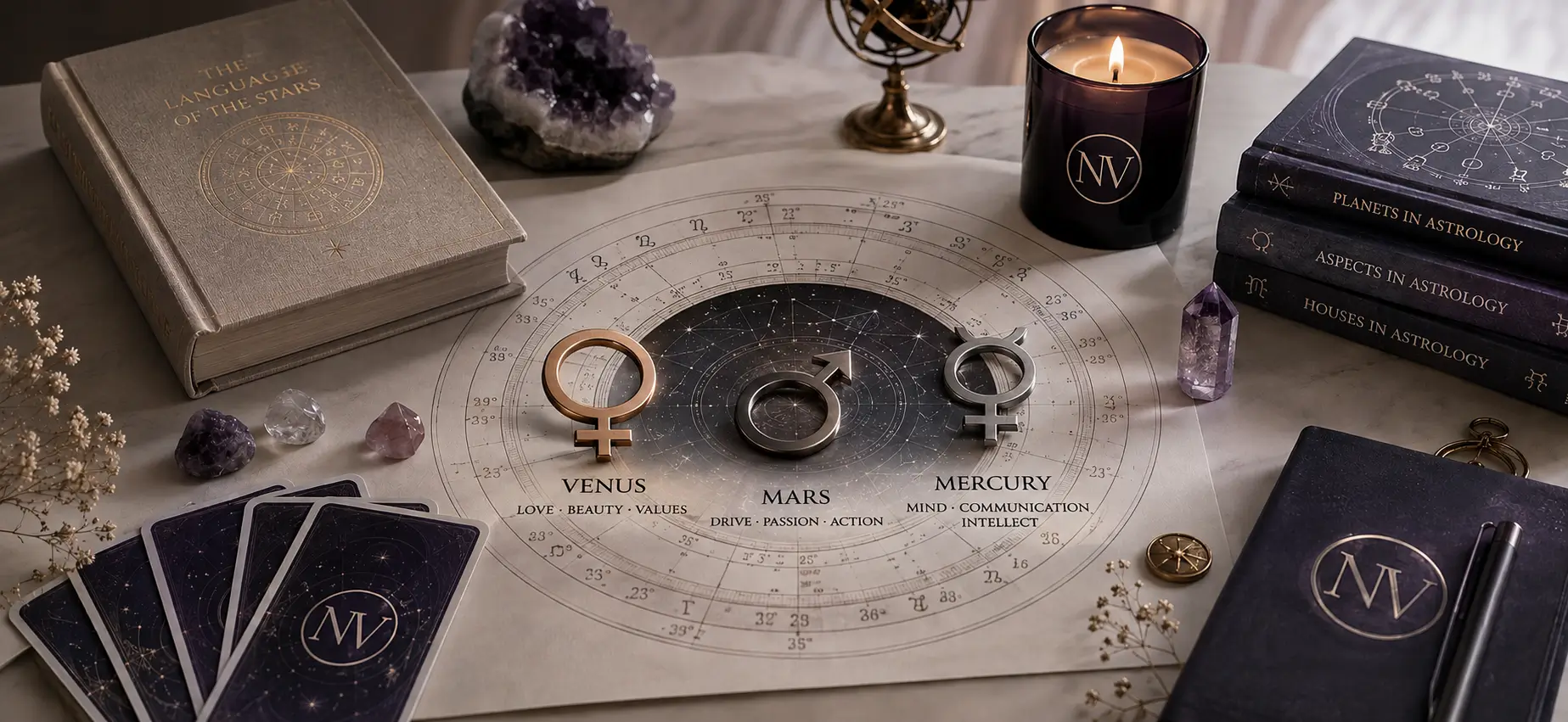
Venus, Mars, Mercury are the closest, «fastest», and most personal planets in your natal chart. They change signs every few weeks, which means they do not show general generational traits and influence on society (as outer planets do), but specifically your individual style of thinking, communication, love, and action.
We have already covered the Sun and Moon (also personal planets) separately — here we will focus on the remaining trio.
♀️ Venus — what and whom you love, how you express your love and care, your charm, what kind of beauty attracts you, and how you find compromises in relationships with others →
♂️ Mars — how you act, stand up for yourself, express your will, desire, passion, achieve your goals, handle conflict, and compete →
☿️ Mercury ↔ I — The Magician — mastery of tools, the ability to transform an idea into words and action
♀️ Venus ↔ III — The Empress — abundance, sensuality, creative and magnetic power
♂️ Mars ↔ XVI — The Tower — sudden, destructive release of energy, breaking down old structures
For more details on how this correspondence works in spreads, see the Tarot section, while detailed breakdowns of each connection can be found in the dedicated pillar article for each planet.
All three in the same element — creates wholeness and internal harmony: you think, love, and act «in the same language».
All three in different, especially opposing elements (for example, fire–water–earth) — creates internal diversity and sometimes inconsistency: what you think does not always align with what you feel or how you act.
A predominance of one element with a total absence of another — a signal of where you might lack balance (for example, without water in this trio, it might be harder to realize the emotional layer of your thoughts, desires, and attractions).
In the first two years of life, the Moon comes to the forefront — the need for basic safety and care. From around age two to four, as a child learns to walk and speak, asserting autonomy, the Sun and Mars manifest more actively. Although exact age frameworks for Mercury and Venus are less rigid in this model, the same principle applies to them: Mercury unfolds more brightly during the period of active speech acquisition and school age, while Venus emerges in adolescence, when initial concepts of beauty and attraction take shape.
For instance, transiting Mercury in a familiar sign can heighten interest in studying, travel, or negotiations for a couple of weeks, while transiting Mars can bring more energy and decisiveness to a specific area of life. This is a separate, more changeable topic — unlike the enduring, «lifelong» traits of natal personal planets.
Want to peek into your daily spread of thought — feeling — action today? Try the Tarot Spread: Thoughts — Feelings — Actions →
Why are Mercury, Venus, and Mars specifically considered «personal», rather than, for example, Jupiter? Because they move quickly and change signs individually for each person, unlike slow social and generational planets, which can stay in the same sign for entire groups of people.
Which is more important — the planet's sign or the house it resides in? These are complementary levels: the sign shows «how» the planet's energy manifests, while the house shows «where» in life it unfolds.
Do I need to know the exact birth time to find out the signs of these planets? For the signs of Mercury, Venus, and Mars, the exact time is usually not critical — the birth date is more important, though in rare cases a planet may change signs within a single day.
What does it mean if Mercury, Venus, and Mars are in the same element? It can create wholeness and internal harmony in how a person thinks, loves, and acts — all three spheres «speak the same language».
What if they are in different, even opposing elements? It creates internal diversity and sometimes contradiction — for instance, an air Mercury might logically analyze what a water Mars feels entirely differently on an impulse level.
How does retrogradation affect these planets? A retrograde planet manifests more through internal processing rather than direct, immediate outward action — details differ for each of the three planets and are explained in their dedicated articles.
Where is best to start studying one's personal planets? Start with the topic that matters most right now: Mercury — if interested in thinking style, Venus — if love, Mars — if you want to understand action energy.
Which Tarot cards correspond to personal planets? Mercury corresponds to The Magician, Venus to The Empress, Mars to The Tower; each arcana symbolically reflects the core action of the corresponding planet.
At what age does each personal planet manifest most actively? Psychological astrologers observe that the Moon is most active in the first two years of life, the Sun and Mars — roughly from age two to four during the assertion of autonomy; Mercury opens up brighter during speech acquisition, and Venus — in adolescence.
How do transiting personal planets differ from natal ones? Natal planets are fixed once and for all at birth and describe enduring traits, while transiting planets continue to move daily, temporarily coloring mood and motivation for weeks or months.

Online services tarot, astrology... →
Mercury, Venus, and Mars are three different languages that your personality speaks: the language of thought, the language of love, and the language of action.
Personal Planets: Key Points 📋
| Planet | Responsible for | Movement Cycle Through a Sign |
|---|---|---|
| Mercury ☿️ | Thinking, speech, learning, communication, driving, messaging | ~2–3 weeks |
| Venus ♀️ | Love, beauty, pleasure, values, attractiveness, ability to care and receive care from a partner | ~3–4 weeks |
| Mars ♂️ | Action, will, sexuality, passion, conflicts, competition, activity | ~6–7 weeks |
What Unites Mercury, Venus, and Mars 🔑
In astrology, planets are typically divided into several groups based on their speed of movement and scope of influence. Personal planets (Sun, Moon, Mercury, Venus, Mars) move quickly and show the individual, recognizable traits of a specific person. Social planets (Jupiter, Saturn) move slower and connect the personality with society. Outer (generational) planets (Uranus, Neptune, Pluto) move so slowly that almost an entire generation of people shares the same sign — thus telling less about individuality and more about the spirit of the times.💡 Important: when a planet is located in your 1st house, it always affects the person's personality: appearance, character, gait, behavior, regardless of whether it is personal, social, or outer.
Psychologist and astrologer Liz Greene, co-authoring with Howard Sasportas, dedicated a separate book to this trio — «The Inner Planets: Building Blocks of Personal Reality» (1993). According to their observations, Venus, Mars, and Mercury form the foundation of what psychology calls the ego: personal characteristics, needs, feelings, and qualities that are often underestimated precisely because they seem too «private» and insignificant to the outside world.We have already covered the Sun and Moon (also personal planets) separately — here we will focus on the remaining trio.
Mercury, Venus, and Mars: Three Pages, Three Themes 🔗
☿️ Mercury — how you think, speak, write, communicate, learn, and absorb new information →♀️ Venus — what and whom you love, how you express your love and care, your charm, what kind of beauty attracts you, and how you find compromises in relationships with others →
♂️ Mars — how you act, stand up for yourself, express your will, desire, passion, achieve your goals, handle conflict, and compete →
How Personal Planets Differ from the Sun Sign and Ascendant 🌌
The Sun sign shows the core of the personality as a whole, the Ascendant shows the manner of presenting oneself to the world, while personal planets are more specific, focused «tools» through which this personality operates in various areas of life. If the Sun is «who you are», then Mercury, Venus, and Mars are «how exactly you think, love, and act».Personal Planets and Houses: Where to Find Depth 🏠
Each of these three planets falls into a specific house of your natal chart, and it is the house that reveals in which sphere of life this planetary energy is expressed most actively. We have already detailed what each personal planet means in each of the 12 houses in our articles on Houses and Spheres of Life. Here, however, we focus on another level: how the planet itself manifests through the zodiac sign, regardless of the house.Personal Planets and Tarot: Three Archetypes 🃏
Each of the three planets is traditionally linked to its corresponding Major Arcana card in Tarot:☿️ Mercury ↔ I — The Magician — mastery of tools, the ability to transform an idea into words and action
♀️ Venus ↔ III — The Empress — abundance, sensuality, creative and magnetic power
♂️ Mars ↔ XVI — The Tower — sudden, destructive release of energy, breaking down old structures
For more details on how this correspondence works in spreads, see the Tarot section, while detailed breakdowns of each connection can be found in the dedicated pillar article for each planet.
Elemental Balance of the Three Planets: Practice 🔥🌍💨💧
Look at which elements your Mercury, Venus, and Mars are in, and count how many times each element repeats:All three in the same element — creates wholeness and internal harmony: you think, love, and act «in the same language».
All three in different, especially opposing elements (for example, fire–water–earth) — creates internal diversity and sometimes inconsistency: what you think does not always align with what you feel or how you act.
A predominance of one element with a total absence of another — a signal of where you might lack balance (for example, without water in this trio, it might be harder to realize the emotional layer of your thoughts, desires, and attractions).
Personal Planets and Age: When Things «Turn On» 🕐
According to observations by Liz Greene and Howard Sasportas in «The Development of Personality» (1987), different elements of the chart become especially active at different ages.In the first two years of life, the Moon comes to the forefront — the need for basic safety and care. From around age two to four, as a child learns to walk and speak, asserting autonomy, the Sun and Mars manifest more actively. Although exact age frameworks for Mercury and Venus are less rigid in this model, the same principle applies to them: Mercury unfolds more brightly during the period of active speech acquisition and school age, while Venus emerges in adolescence, when initial concepts of beauty and attraction take shape.
Transiting Personal Planets: Daily Influence 🌀
Unlike natal planets, which are fixed once and for all at the moment of birth, transiting Mercury, Venus, and Mars continue moving across the sky every day — and as they pass through different signs and houses of your chart, they temporarily color your mood, communication, and motivation.For instance, transiting Mercury in a familiar sign can heighten interest in studying, travel, or negotiations for a couple of weeks, while transiting Mars can bring more energy and decisiveness to a specific area of life. This is a separate, more changeable topic — unlike the enduring, «lifelong» traits of natal personal planets.
Want to peek into your daily spread of thought — feeling — action today? Try the Tarot Spread: Thoughts — Feelings — Actions →
Psychologist's Advice: Three Personal Tools, Not Three Different People 🧠
It is helpful to perceive Mercury, Venus, and Mars not as scattered, independent parts of the personality, but as three tools of the very same person — you. Sometimes they sound in unison, and sometimes they conflict with each other (a rational Mercury in Virgo versus a passionate Mars in Scorpio) — and it is precisely this internal tension that often explains contradictory reactions that are hard to comprehend by looking at the Sun sign alone.Frequently Asked Questions ❓
How do personal planets differ from the Sun sign? The Sun shows the essence of the personality as a whole, while personal planets show specific, narrower spheres: how you think (Mercury), love (Venus), and act (Mars).Why are Mercury, Venus, and Mars specifically considered «personal», rather than, for example, Jupiter? Because they move quickly and change signs individually for each person, unlike slow social and generational planets, which can stay in the same sign for entire groups of people.
Which is more important — the planet's sign or the house it resides in? These are complementary levels: the sign shows «how» the planet's energy manifests, while the house shows «where» in life it unfolds.
Do I need to know the exact birth time to find out the signs of these planets? For the signs of Mercury, Venus, and Mars, the exact time is usually not critical — the birth date is more important, though in rare cases a planet may change signs within a single day.
What does it mean if Mercury, Venus, and Mars are in the same element? It can create wholeness and internal harmony in how a person thinks, loves, and acts — all three spheres «speak the same language».
What if they are in different, even opposing elements? It creates internal diversity and sometimes contradiction — for instance, an air Mercury might logically analyze what a water Mars feels entirely differently on an impulse level.
How does retrogradation affect these planets? A retrograde planet manifests more through internal processing rather than direct, immediate outward action — details differ for each of the three planets and are explained in their dedicated articles.
Where is best to start studying one's personal planets? Start with the topic that matters most right now: Mercury — if interested in thinking style, Venus — if love, Mars — if you want to understand action energy.
Which Tarot cards correspond to personal planets? Mercury corresponds to The Magician, Venus to The Empress, Mars to The Tower; each arcana symbolically reflects the core action of the corresponding planet.
At what age does each personal planet manifest most actively? Psychological astrologers observe that the Moon is most active in the first two years of life, the Sun and Mars — roughly from age two to four during the assertion of autonomy; Mercury opens up brighter during speech acquisition, and Venus — in adolescence.
How do transiting personal planets differ from natal ones? Natal planets are fixed once and for all at birth and describe enduring traits, while transiting planets continue to move daily, temporarily coloring mood and motivation for weeks or months.
Three Tools of One Personality 🌟
Mercury, Venus, and Mars are three different yet equally important languages that your personality speaks: the language of thought, the language of love, and the language of action. Understanding each separately is a good step, but seeing how they combine with each other and the rest of your chart can only be done through a full analysis. I invite you to a consultation, where we will explore this individually based on your unique chart.
Online services tarot, astrology... →