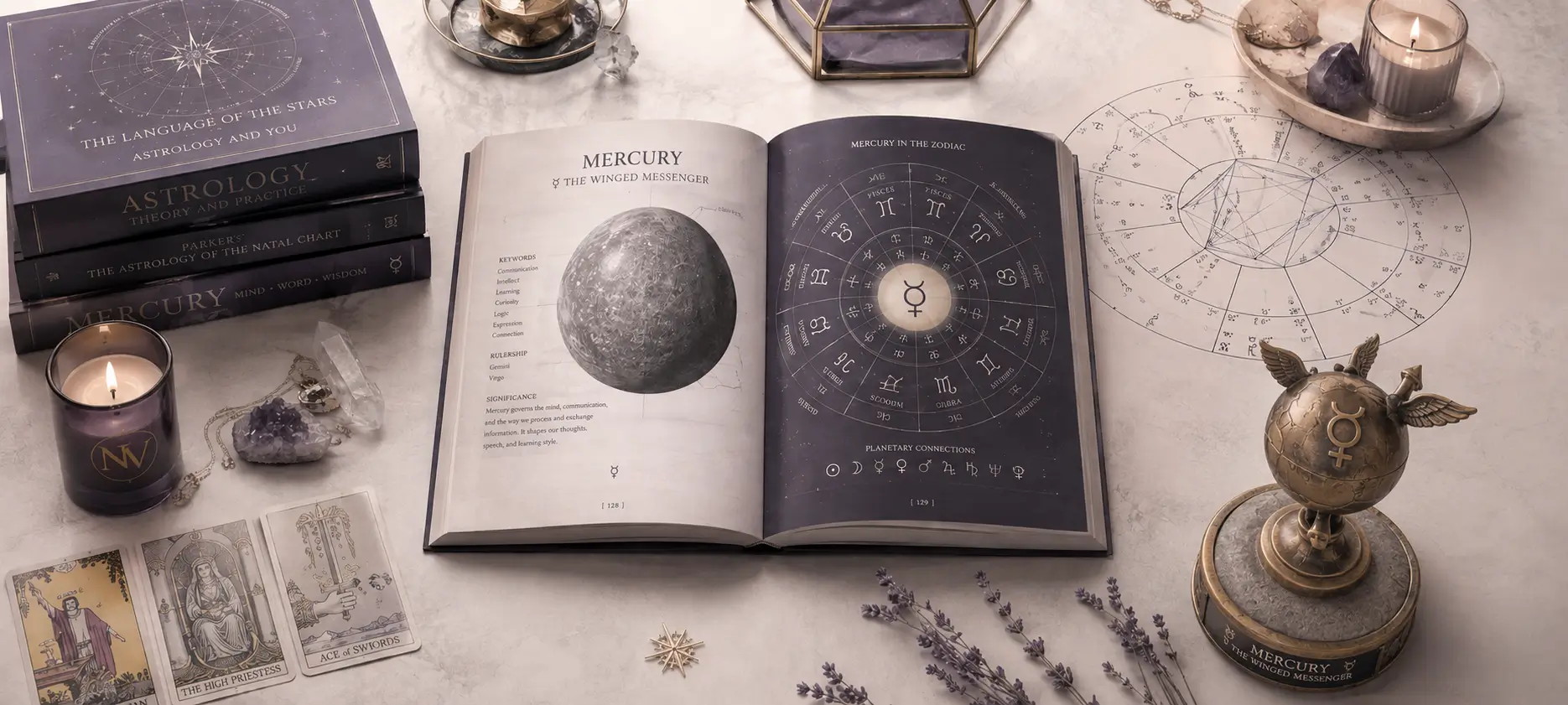
Mercury shows your attitude toward ground transport (bicycle, car, train). It is also responsible for: consulting, public speaking, writing, analytics, accounting, advisory services, quick deals, trade, logistics, advertising, marketing, manual work, basic education, workshops, and courses.
Mercury: Quick Profile 📋
| Parameter | Value |
|---|---|
| Key Domain | Thinking, speech, learning, communication 💬 |
| Rules Signs | Gemini ♊ and Virgo ♍ |
| Exaltation | Virgo ♍ (strongest placement) |
| Detriment | Sagittarius ♐ and Pisces ♓ |
| Fall | Pisces ♓ (weakest placement) |
| Sign Transit Cycle | ~2–3 weeks |
| Retrograde Motion | ~3–4 times a year, for ~3 weeks |
| Tarot Major Arcana | I — The Magician 🃏 |
What Mercury Means in a Natal Chart 🔑
Mercury shows not "how much you know", but exactly how your mind processes information: quickly or thoughtfully, broadly or deeply, aloud or internally, precisely or figuratively. It is a planet of logic, but also a planet of exchange — no wonder in mythology Mercury (Hermes) was the messenger between gods, and his role in the chart is similar: he transfers information from your internal world into the external, and vice versa. He is also the god of commerce.💡 Important: Jungian psychotherapist Rafael López-Pedraza in his book «Hermes and His Children» (1977) described Hermes as an archetype of psychic movement — that which helps the psyche not get stuck in place, but find connections between disparate parts of experience. According to his observation, where Hermes is present in full measure, a person gains the ability to see unexpected connections between things and find a way out where others see a dead end — a quality that accurately describes the essence of a strong, harmonious Mercury in the chart.
Mercury in Zodiac Signs ♈
Mercury never strays further than one sign away from the Sun, so its placement often coincides with or is adjacent to the Sun sign. Briefly — how Mercury manifests in each sign:♈ Aries — fast, direct speech, instant decisions, impatience with long explanations, sharpness, bluntness, or honesty.
♉ Taurus — slow but thorough thinking, trust only in verified facts, practical application of knowledge.
♊ Gemini — home sign of Mercury: lively mind, ease in conversing on any topic, sociability, may exaggerate, flirt, quickly shift topics.
♋ Cancer — thinking through the lens of emotions and memory, intuitive rather than strictly logical, decisions depend on safety and emotional comfort.
♌ Leo — confident, vivid, sometimes arrogant speaking style, persuasion through charisma, leadership, personal example.
♍ Virgo — exaltation of Mercury: analytical mind, precise down to the smallest detail, prone to perfectionism, criticism, monotony. Excellent executor, can reproduce and replicate accurately.
♎ Libra — diplomatic thinking, weighing all sides of an issue, charm in conversation, but may doubt for a long time, hesitate, embellish facts, beautiful voice.
♏ Scorpio — insightful mind of a detective getting to the core, brevity, suspiciousness, words like a scalpel — can heal or hurt deeply.
♐ Sagittarius — broad, philosophical thinking, desire to know more, tendency toward generalizations, ability to motivate and inspire.
♑ Capricorn — structured, practical thinking, devoid of emotionality, oriented toward facts and results.
♒ Aquarius — original, unconventional train of thought, interest in new ideas, technologies, independent mindset, dislikes boundaries.
♓ Pisces — fall of Mercury: intuitive, non-linear thinking, vague or image-rich speech, melodic voice, sensitivity to atmosphere while learning.
Mercury in Houses: Where to Find Details 🏠
We have already covered what Mercury means in each of the 12 houses in our articles on Houses and Life Spheres. The sign shows how you think and speak, while the house shows in which sphere of life this is most actively expressed.Mercury and the Sun: Combustion and Cazimi ☀️
Here lies a technical nuance rarely explained in simple terms. Since Mercury never strays further than 28° from the Sun, it often finds itself very close to it — and this distance matters.If Mercury is within approximately 8.5° of the Sun, it is called "combust" — it is believed that the planet's energy gets lost in the solar glare, thinking becomes more subjective, fused with ego, making it harder to look at ideas objectively or accept another person's viewpoint, leading to an "I am always right" mindset.
However, if Mercury comes extremely close — within approximately 17 arc minutes of an exact conjunction with the Sun — it enters the state of "cazimi", literally "in the heart of the Sun": in this narrow window, according to many practicing astrologers, the planet does not weaken, but gains extraordinary clarity and power, as if thought and personal will become one. This is often associated with heightened intelligence at a genius level.
Mercury Aspects to Other Planets 🔗
Mercury rarely acts alone — it is strongly colored by aspects (angles) to other planets in the chart:Mercury — Venus (a common aspect since these planets stay close) — gentle, diplomatic, aesthetic manner of speaking, talent for persuading through charm.
Mercury — Mars — sharp, fast, sometimes harsh speaking style, inclination toward arguments and direct, uncompromising phrasing.
Mercury — Jupiter — broad, optimistic thinking, tendency toward exaggeration and generalization, but also a natural gift for persuasion.
Mercury — Saturn — structured, serious thinking, occasionally self-critical statements, but highly reliable, well-thought-out speech, accountability for words.
Mercury — Neptune — imaginative, intuitive thinking, speech with a risk of confusing facts with imagination without conscious checking, ability to create effects, illusions, mystery, and "fairytales".
Mercury and Career 💼
The position of Mercury in the chart is one of the key factors when choosing a career field linked to intellect, speech, and information processing: consulting, writing, teaching, translation, analytics, sales, journalism, IT, transportation services.💡 Important: Judith Hill in her book «Vocational Astrology» emphasizes that for career guidance, not only Mercury's sign is important, but also the house it occupies and the aspects it forms with other planets — this exact combination shows in what specific form intellectual and communication talents can turn into a sustainable profession rather than remaining a general ability.
Mercury and Childhood Learning Style 🎓
It is especially helpful for parents to pay attention to the sign and house of a child's Mercury — this suggests their cognitive style, how they process information, and what educational format will feel most natural.A child with Mercury in earth signs (Taurus, Virgo, Capricorn) usually learns easiest through practice, repetition, charts, and diagrams; with Mercury in air signs (Gemini, Libra, Aquarius) — through discussion and exchanging ideas; with Mercury in fire signs (Aries, Leo, Sagittarius) — through active, passionate action and games; and with Mercury in water signs (Cancer, Scorpio, Pisces) — through emotional involvement, visuals, and personal connection to the material.
Knowing this does not replace a teacher's individual approach, but explains why the same teaching method works for one child and completely fails for another.
Mercury Retrograde: Facts and Myths 🔄
Mercury Retrograde is the most widely publicized topic in popular astrology, and a lot of exaggerations have accumulated around it.❌ Myth: belief in the destructive influence of Mercury retrograde has turned into one of the most recognizable elements of modern pop-culture spirituality — people literally plan important decisions based on ephemerides. It has even become a subject of distinct academic interest: a study in the scientific journal Correspondences (2018) describes this phenomenon. Reality is calmer than dramatic headlines: Mercury goes retrograde about 3–4 times a year, for 2.5–3 weeks each time, and during this period it is better to double-check, review, and renegotiate rather than start fundamentally new endeavors.
During the retrograde period, all Mercury-related themes can behave unpredictably: schedule changes, flight delays, document errors, work hiccups, client drop-offs, thinking «glitches», or equipment breakdowns. Therefore, it is considered logical not to launch major new projects, sign contracts, or purchase new machinery, vehicles, or educational courses.This period is ideal for preparation, improvement, review, or completing what was previously started, as well as selling things that are no longer relevant to you.
An important technical nuance that is rarely explained: retrogradation itself is not an abrupt on/off switch, but a process with «shadows». There is a pre-shadow period (a few days before the backward motion starts, when Mercury is already slowing down and approaching the same zodiac zone) and a post-shadow period (a few days after Mercury goes direct again, until it passes the degree where it first «turned around»). The effects are often felt during the shadow period — meaning slightly earlier and later than the official retrograde dates listed in calendars.
🪐 Read more about Mercury Retrograde here →
📅 Exact dates for Mercury Retrograde can be found here →
Natal Mercury Retrograde: A Consistent Trait, Not a Bug 🧠
If Mercury was retrograde at the moment of your birth, it is not a one-time event, but a lifelong cognitive characteristic. According to practicing astrologers, about 18–25% of people are born with natally retrograde Mercury — meaning it is far from rare, but rather a widespread way of thinking.Frances Sakoian and Louis Acker explained the general principle of retrogradation in their classic textbook «The Astrologer's Handbook»: the planet's energy turns inward and is processed at a deep, often subconscious psychological level rather than manifesting immediately and directly outward. Applied to Mercury, this means that such a person tends to think to themselves before formulating an idea for others — their thought process is more layered and unhurried, even if the final result is in no way inferior in depth or precision to those who formulate thoughts out loud right away.
💡 Important: practicing astrologer Bernie Ashman notes a positive side to this placement: natal retrograde Mercury often leads over time to an exceptionally deep and refined communication skill — precisely because such a person is used to «digesting» an idea internally many times before expressing it, they often manage to formulate thoughts more thoughtfully and precisely than those who speak on first impulse.
How It Feels in Practice 💭
Natally Retrograde Mercury can manifest differently depending on the sign and house, but there are common traits: a tendency to mentally re-play a conversation several times after it has ended, a preference for written communication over oral (easier to formulate precisely when given time), and a feeling that your thinking speed «does not align» with those around you in live conversation.This is not a flaw or a reason to consider yourself «slow» — it is simply a different, more introverted way of processing information, which is often underrated precisely because popular culture values speed of reaction over depth of processing.
Want to see how your own name sounds in the language of numbers? Try Name Number: Online Calculator →
Mercury and Tarot: The Archetype Card 🃏
Mercury corresponds to Major Arcana I — The Magician. The card depicts a figure with tools of all four elements on a table — a symbol of mastering tools and turning an idea into words, words into action, and action into matter. This is an accurate reflection of Mercury: the connecting link between intent and implementation through speech and thought. Read more about this Arcana in the Tarot section.Mercury in Compatibility and Synastry 💞
When overlaying partner charts, the position of one person's Mercury relative to the other's chart shows the quality of intellectual connection in the pair.Partner's Mercury conjunct your Mercury — easy communication, often matching speech tempo and thinking style.
Partner's Mercury in a hard aspect to your Mercury — misunderstandings and differing views happen more often, but with awareness, this can spark engaging discussions rather than just conflicts.
Partner's Mercury conjunct your Venus — intellectual attraction complements romantic bond; you enjoy talking together about shared interests.
Read more in the Compatibility and Synastry section →
Psychologist's Advice: What to Reflect On 🧠
Mercury often reveals not only how you think, but also how you speak to yourself — your internal dialogue. It is worth asking yourself honestly: is the voice commenting on your thoughts and decisions supportive or critical? Conscious work on this internal dialogue often yields greater changes than trying to control external speech.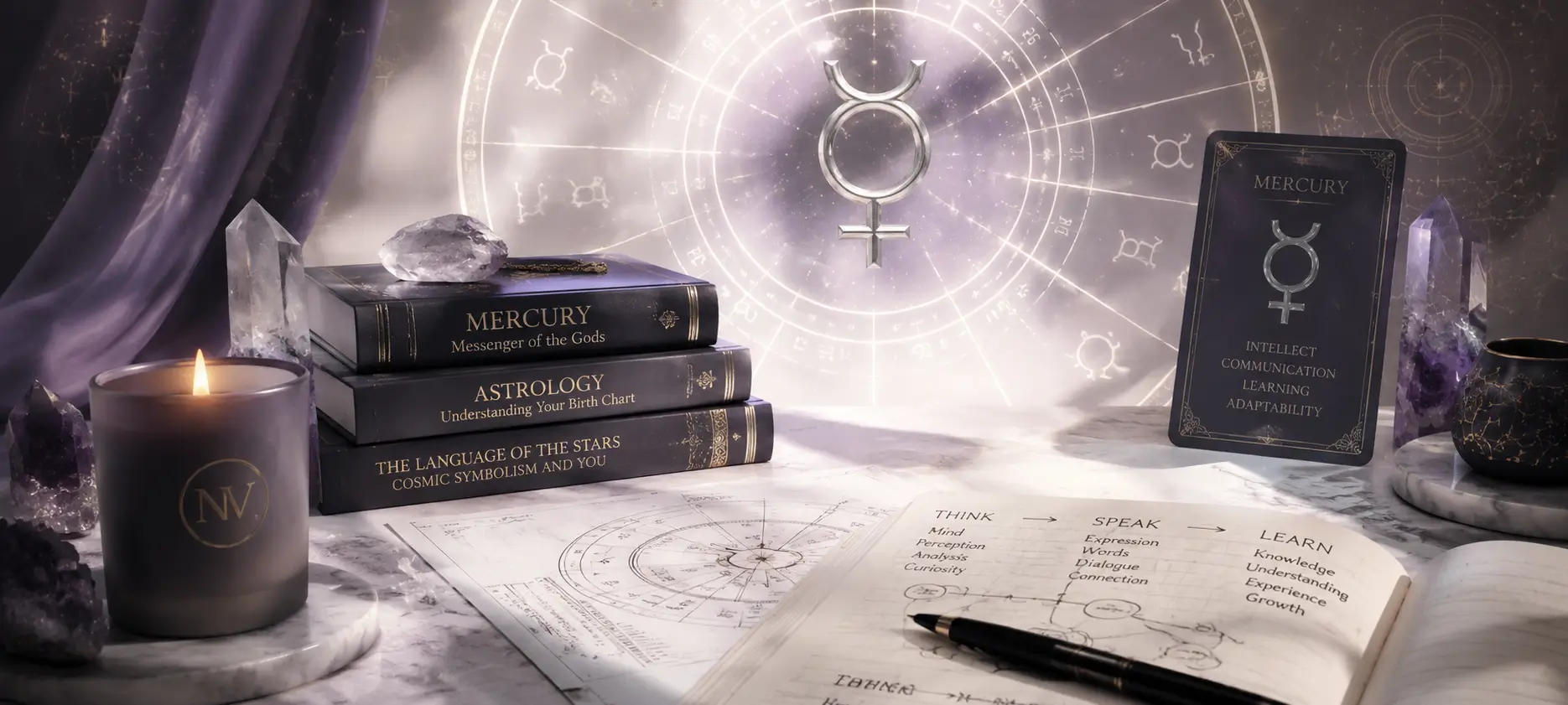
Frequently Asked Questions ❓
How does Mercury differ from the Sun sign when describing thinking style? The Sun shows core identity and motivation, while Mercury specifically governs cognitive style, speech, and information processing — it is a more focused, specific tool.Is it true that retrograde Mercury always brings problems? No, this is pop culture exaggeration — retrograde periods are better suited for reviewing and refining rather than being guaranteed times of failure.
What is the difference between natal and transit retrograde Mercury? Natal retrograde Mercury (at birth) is a lifelong personality trait, whereas transit retrograde Mercury is a temporary status occurring several times a year.
What are retrograde Mercury "shadow periods"? These are several days before and after official retrograde dates when Mercury slows down or has not fully exited its turning area — effects are often felt during these phases.
How common is natal retrograde Mercury? Astrologers estimate that roughly 18–25% of people are born with retrograde Mercury in their natal chart — it is a common cognitive style.
Does natal retrograde Mercury have strengths, not just quirks? Yes — such individuals often formulate thoughts more carefully and precisely because they process ideas internally before speaking.
Can Mercury be weak in a chart? Mercury has stronger (dignity, exaltation) and weaker (detriment, fall) sign placements — but this is not a sentence; it simply means the planet's energy flows less conventionally.
How do I find out which sign my Mercury was in at birth? Calculation requires your birth date — you can find out during a consultation or via a specialized natal chart calculation tool.
What matters more for communication style — Mercury or Ascendant? Both matter differently: the Ascendant shapes first impressions, while Mercury dictates content, logic, and phrasing.
How does a partner's Mercury impact a relationship in synastry? Aspects between two people's Mercuries show how easily they understand each other intellectually.
What if Mercury in my chart is in its fall sign (Pisces)? It is not a weakness, but an intuitive, image-based thinking style rather than a linear-logical one; trusting intuition alongside facts is key.
What does a "combust" Mercury near the Sun mean? When Mercury is very close to the Sun (within ~8.5°), it is combust — thinking becomes more subjective and ego-bound.
What is Mercury cazimi? It is when Mercury is in an exact conjunction with the Sun (within 17 arc minutes) — in this narrow window, the planet gains exceptional clarity and strength.
How do aspects to other planets alter Mercury? Each aspect adds a flavor: Venus adds gentleness, Mars adds sharpness, Jupiter adds breadth, and Saturn adds structure.
How do I choose a career based on Mercury? Look at Mercury's sign, house, and aspects together — this combination reveals how thinking and communication talents best translate into a career.
How does a child's Mercury sign affect learning style? The element suggests the best format: Earth learns through practice, Air through discussion, Fire through action, and Water through emotional connection.
Your Mercury is Only Part of the Full Picture 🌟
Mercury shows your thinking style, but the complete picture only appears when combined with the rest of your chart — especially the Sun, Moon, and Ascendant. If you want to discover the exact position of your Mercury and understand how it connects with your entire natal chart — I invite you to a consultation where we will analyze it individually based on your exact birth data.
Online services tarot, astrology... →