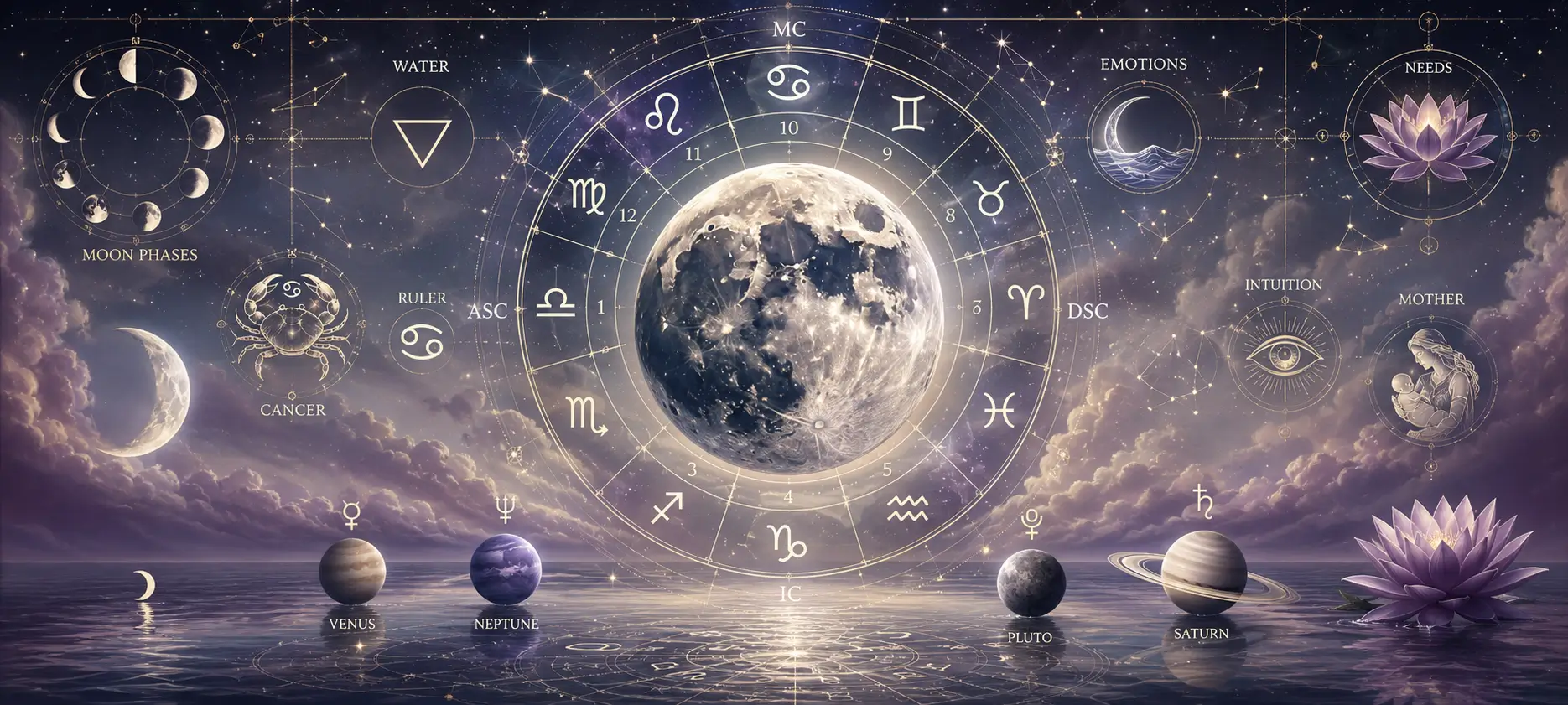
The Moon reveals your emotions, needs, inner world, and intuition. It is also responsible for: instincts, understanding care, perception of mother (and in a man's chart — how he envisions his wife, the mother of his children), as well as changes and adaptability throughout life.
The Moon: A Quick Dossier 📋
| Parameter | Value |
|---|---|
| Governs / Represents | Emotions, needs, inner world, intuition, perception of care, instincts 🌙 Shows how we perceive our mother. In a man's chart — how he envisions his wife and the mother of his children |
| Ruler of | Cancer ♋ |
| Exaltation | Taurus ♉ (strongest position) |
| Detriment | Capricorn ♑ |
| Fall | Scorpio ♏ (weakest position) |
| Transit cycle through a sign | ~2.5 days |
| Full orbit around the chart | ~27.3 days |
| Retrograde status | Never — the Moon is never retrograde |
| Tarot Major Arcana (Planet) | II — The High Priestess 🃏 |
What the Moon Means in a Natal Chart 🔑
The Moon is your emotional compass: how you react to stress, what provides a sense of safety, and what your deep, often unconscious needs are. Unlike the Sun, which is linked to conscious identity, the Moon is closer to instinct — it reacts before the mind has time to process everything.💡 Important: Dane Rudhyar, whom we already know from the article about the Sun, devoted a separate work to the lunar cycle — «The Lunation Cycle» (1967), showing that the Moon phase at the moment of birth (the angular distance between the Sun and the Moon) is no less important than its sign. According to his theory, each of the eight phases — from the New Moon to the Waning Crescent — defines a distinct psychological personality type and its role in the cycle of renewal experienced by every generation.
Also, the Moon in a natal chart represents change and adaptability. The Moon in the houses indicates the life areas / themes where changes will occur, while the sign of your natal Moon shows how you adapt to them.For example, the Moon in the 1st house in Scorpio may indicate that throughout life you will undergo external changes and leave different impressions on people through inner transformational processes, cosmetic surgeries, or a new phase of your personality.
The Moon in Zodiac Signs ♈
| Moon Sign | Brief Overview |
|---|---|
| ♈ Moon in Aries | Fast, impulsive emotional responses, a need for leadership, and an urge to act immediately when feeling anxious |
| ♉ Moon in Taurus | Exaltation of the Moon — stable, calm emotions, a need for physical and material comfort, a drive for stability |
| ♊ Moon in Gemini | Fluctuating emotions, a need for communication, travel, and absorbing new information |
| ♋ Moon in Cancer | The Moon's home sign — deep emotionality, a strong need for home, care, and security |
| ♌ Moon in Leo | Vibrant, warm emotions, a need for recognition and admiration from loved ones and society |
| ♍ Moon in Virgo | Restrained emotions, a need for order, and a sense of being useful |
| ♎ Moon in Libra | Emotions seeking harmony, a need for partnership, balance, and freedom from conflict |
| ♏ Moon in Scorpio | Fall of the Moon — intense, deeply hidden emotions, a pull toward drama, a need for absolute trust and influence |
| ♐ Moon in Sagittarius | Optimistic, freedom-loving emotions, a need for space, travel, expanding horizons, new experiences, and authority |
| ♑ Moon in Capricorn | Detriment of the Moon — guarded emotions, a need for control, achievement, and status as a source of security |
| ♒ Moon in Aquarius | Detached, rational emotions, a need for independence, progressiveness, and belonging to a community |
| ♓ Moon in Pisces | Subtle, compassionate emotions, a need for a spiritual connection and creative emotional expression |
The Moon in Houses: Where to Look for Details 🏠
We have already covered what the Moon means in each of the 12 houses of the chart in our articles on Houses and Spheres of Life. The sign shows how you feel, while the house shows in which sphere of life your emotional needs manifest most actively.Dignities of the Moon: Strong and Weak Positions 📐
The Moon unfolds most harmoniously in its home sign (Cancer) and its exaltation sign (Taurus), where emotionality finds a natural, grounded foundation. In detriment (Capricorn) and fall (Scorpio), it is harder for that same energy to express itself openly: Capricorn tends to control feelings rather than trust them, while Scorpio hides emotional vulnerability behind intensity and defense. This is not a flaw, but a more complex path toward emotional security that demands conscious awareness.Moon Phases at Birth: Eight Psychological Types 🌗
According to Dane Rudhyar's theory, the distance between the Sun and the Moon at birth (the lunar phase) creates eight basic psychological types:🌑 New Moon — an instinctive, subjective start to a new cycle, acting before full awareness.
🌒 Crescent Moon — a struggle to assert one's vision despite external resistance.
🌓 First Quarter — a crisis of action, the necessity to make decisions and overcome obstacles.
🌔 Gibbous Moon — a drive to refine and develop what was started, an analytical approach.
🌕 Full Moon — the peak of awareness, objectivity, a need for relationships as a mirror of self.
🌖 Disseminating Moon — sharing accumulated wisdom with others, orientation toward purpose.
🌗 Last Quarter — a crisis of consciousness, re-evaluating and transforming established structures.
🌘 Balsamic Moon — the completion of a cycle, wisdom, and preparing the ground for a new beginning.
Why the Moon Is Never Retrograde 🌙
Like the Sun, the Moon physically cannot appear to move backward when observed from Earth — this is one of the few astronomical constants that often confuses beginners who are used to hearing about «retrograde Mercury» and assume the same can happen to any planet.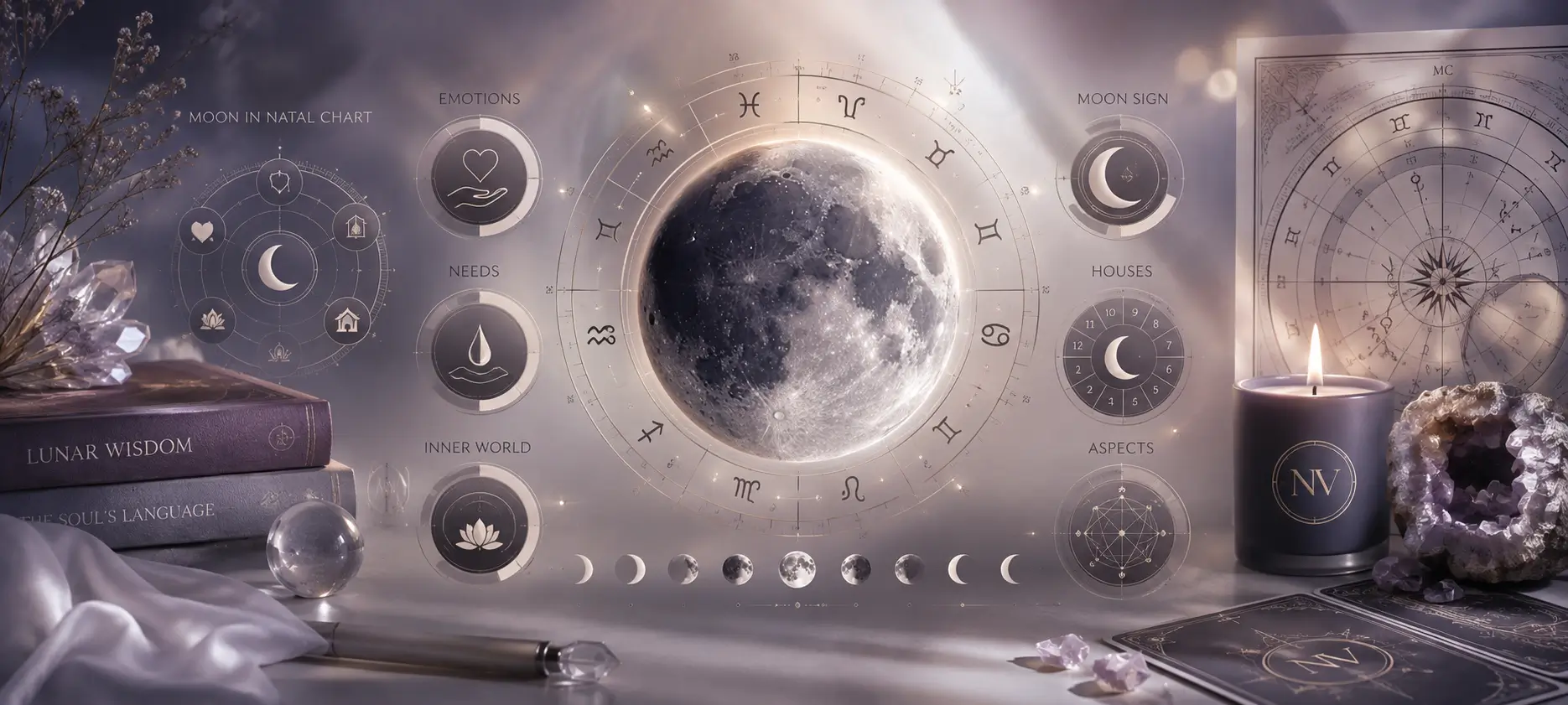
Aspects of the Moon to Other Planets 🔗
Moon — Venus — gentle, harmonious emotions, a natural affinity for beauty and comfort.Moon — Saturn — emotional restraint, sometimes a perceived lack of care in childhood that eventually matures into deep emotional wisdom.
Moon — Pluto — highly intense, profound emotions, strong intuition, and a need for psychological honesty.
Moon — Neptune — subtle, almost telepathic emotional sensitivity, with a risk of dissolving boundaries between your feelings and those of others.
Moon — Uranus — unpredictable, independent emotional reactions, a need for emotional freedom.
The Moon and Tarot: An Important Clarification About Two «Moons» 🃏
It is worth clarifying a common point of confusion here. In Tarot, there is Major Arcana XVIII — The Moon, but in the classical system of astrological correspondences, it is linked to the sign of Pisces, not the planet Moon. The astrological planet Moon traditionally corresponds to another Arcana — II — The High Priestess, symbolizing intuitive knowledge hidden behind a veil of mystery — an archetype far closer to the essence of the Moon as the planet of the subconscious and instinctive knowing. Read more in the Tarot section.Mythology: Hecate and the Triple Goddess 🏺
In Ancient Greek tradition, the Moon is closely linked to the archetype of the Triple Goddess — Hecate, who unites the Maiden, the Mother, and the Crone. This symbolically corresponds to the three primary lunar phases: Waxing, Full, and Waning. Jungian analyst Jules Cashford, in her extensive study «The Moon: Myth and Image» (2003), demonstrates that across almost all ancient cultures, the Moon was associated with this exact cycle of renewal — birth, peak, and decay, inevitably followed by rebirth. She notes that the lunar cycle is one of the oldest metaphors for the human psyche, showing that decline and vulnerability are as natural to life as growth and fullness.The Moon in Compatibility and Synastry 💞
The Moon is one of the most critical indicators of emotional compatibility when comparing charts.Partner's Moon conjunct your Sun — deep emotional recognition, a feeling that this person truly «sees» you.
Partner's Moon in a harmonious aspect to your Moon — effortless mutual understanding of each other's emotional needs.
Partner's Moon in a hard aspect to your Saturn — the relationship may feel emotionally restricted or demand that you prove your right to care and affection.
Want to understand how well your emotional worlds align with your partner? Check out our Online Compatibility Calculator by Date of Birth → — it factors in these planetary interactions.
Learn more in the Compatibility and Synastry → section.
Psychologist's Advice: The Moon and Attachment Theory 🧠
The position of the Moon in a chart aligns closely with what psychology calls an attachment style — a persistent pattern of how a person seeks and establishes emotional security in close relationships (a concept originally developed by psychologist John Bowlby). It is helpful to ask yourself honestly: is the way I currently seek comfort and safety in relationships a conscious choice, or an automatic pattern learned in early childhood that I have never questioned?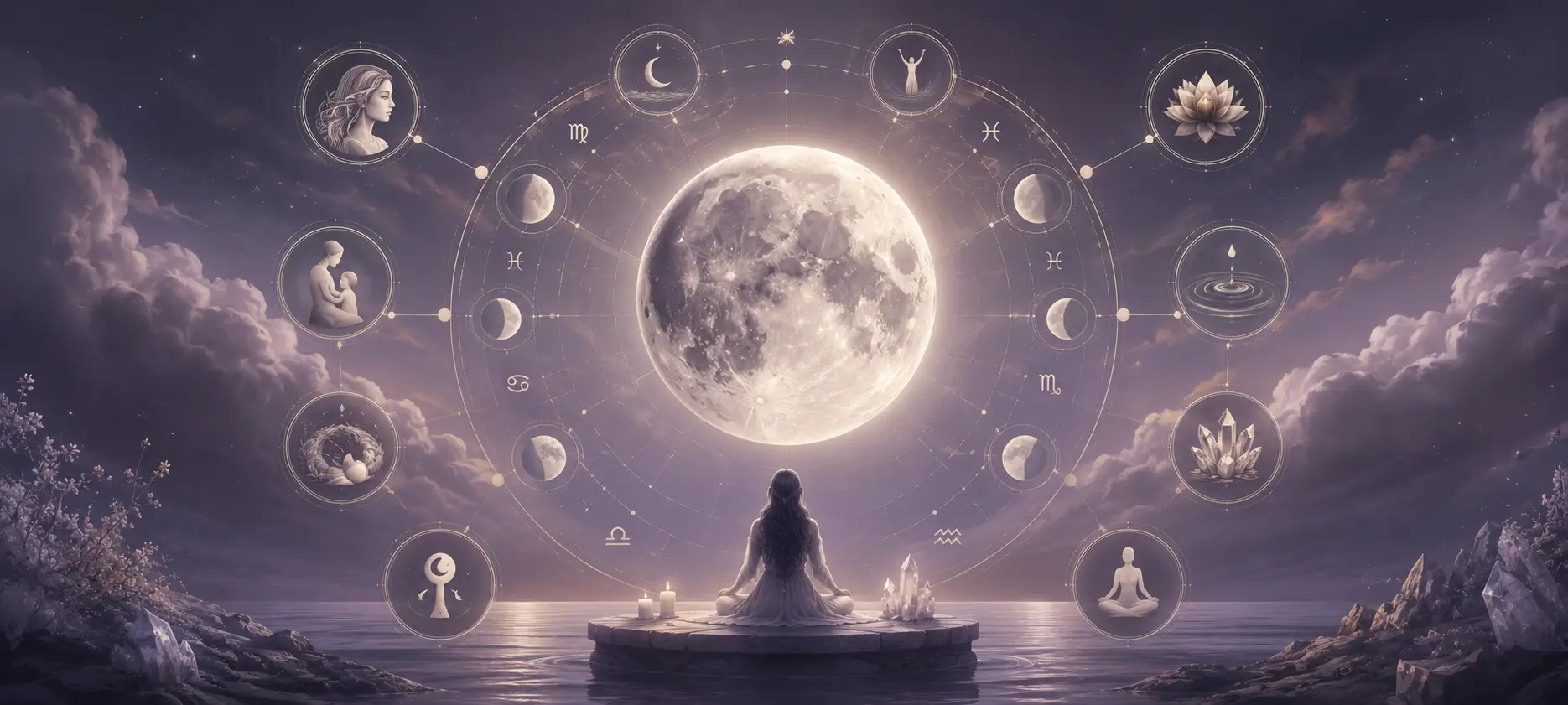
The Moon Today: Two Services to Track the Lunar Rhythm 🌙
Your natal Moon remains fixed from the moment of your birth, but transiting Moon travels through the entire zodiac roughly every 27 days, changing signs every two to three days. Consequently, your emotional background and needs fluctuate noticeably throughout the month. To help you align with this rhythm, I have created two online tools.Lunar Day Today: Moon Phase and Online Calendar displays:
🌕 The current lunar day number and its start/end times (lunar days are measured from moonrise to moonrise, so they do not align with standard calendar days)
🌕 The current Moon phase and illumination percentage
🌕 The Zodiac sign and element the Moon is transiting today
🌕 Daily recommendations, a candle ritual, and a Tarot Arcana insight
Void-of-Course Moon Online Calendar helps you identify periods when the Moon has completed its final major aspect in its current sign before entering the next. These periods can last from a few minutes to a full day or more. In traditional astrology, this time is considered less predictable for new ventures; therefore, major contract signings and significant purchases are best scheduled outside these windows, reserving Void-of-Course Moon hours for routine tasks and rest.
Both services reflect the general lunar atmosphere applicable to everyone. How you personally experience it depends on your natal Moon's sign, house, and aspects. First, determine your natal Moon placement, then cross-reference it with the lunar calendar to turn general insights into personalized guidance.
Frequently Asked Questions ❓
How does the Moon differ from the Sun sign? The Sun represents core identity and life purpose, whereas the Moon governs your emotional world, instinctive responses, and sense of safety; they reflect distinct, complementary layers of your chart.Can the Moon be retrograde? No, never — like the Sun, the Moon physically cannot appear to move backward when viewed from Earth.
What is a birth Moon phase and why does it matter? It is the angular distance between the Sun and Moon at the moment you were born, defining one of eight psychological types according to Dane Rudhyar's theory — from the instinctual New Moon to the wise Balsamic phase.
Do I need an exact birth time to find my Moon sign? Often yes — the Moon changes signs approximately every 2.5 days. If you were born near a sign boundary, an accurate birth time is vital.
Can the Moon be weak in a chart? The Moon has stronger (Cancer, Taurus) and weaker (Capricorn, Scorpio) sign placements — this is not a deficiency, but a more complex journey toward emotional security that requires self-awareness.
Which Tarot Arcana actually corresponds to the planet Moon? Not «The Moon» Arcana (which corresponds to Pisces), but Arcana II — The High Priestess, symbolizing intuitive, hidden knowledge — a common distinction worth remembering.
How does a partner's Moon influence a synastry reading? A conjunction between one partner's Moon and the other's Sun is one of the strongest indicators of mutual emotional recognition and deep attraction.
What does a Moon-Saturn aspect indicate? Emotional restraint or a sense of emotional lack in childhood, which over time often matures into deep emotional stability, responsibility, and reliability.
How is the Moon connected to psychological attachment theory? The Moon's placement mirrors an individual's enduring style of seeking emotional security in close relationships — a concept founded by psychologist John Bowlby.
Why is the Moon so frequently associated with the Triple Goddess archetype (Maiden-Mother-Crone)? Because the three major lunar phases — Waxing, Full, and Waning — symbolically mirror these three life stages, reflecting the natural cycle of growth, fruition, and decline.
What is the difference between a natal Moon and a transiting Moon? The natal Moon is fixed at birth and describes lifelong emotional needs, whereas the transiting Moon moves rapidly (about 2.5 days per sign) and influences daily, temporary moods.
Where should I start when studying my Moon? Start with your Moon sign to understand your baseline emotional style, then explore its house placement, aspects, and birth phase for a complete picture.
Where can I check today's Moon sign and phase? Use the «Lunar Day Today» service: it tracks the active lunar day, phase percentage, current zodiac sign, element, daily recommendations, and Tarot guidance.
What is a Void-of-Course Moon and where can I track it? It is the timeframe after the Moon makes its final major aspect in a sign before moving into the next. It is traditionally considered an uncertain period for initiating important projects. You can view upcoming windows on our «Void-of-Course Moon» calendar.
How do lunar days differ from lunar phases? Lunar days are calculated from moonrise to moonrise and change daily, whereas lunar phases (New Moon, Waxing, Full, Waning) describe the geometric angle between the Sun and Moon, shifting gradually over the course of a month.
Why don't lunar calendar recommendations always match how I feel? The calendar describes general atmospheric conditions, while your individual experience is filtered through your natal Moon's sign, house, and aspects. A personalized reading requires analyzing your unique chart.
Your Moon Is Only Part of the Story 🌟
While the Moon reveals your emotional inner world, the complete picture emerges only when viewed alongside other chart factors — especially the Sun, which governs your conscious self.If you want to discover your exact Moon placement and explore how it interacts with the rest of your natal chart, I invite you to book a personal consultation where we will analyze your exact birth data in detail.
Online services tarot, astrology... →