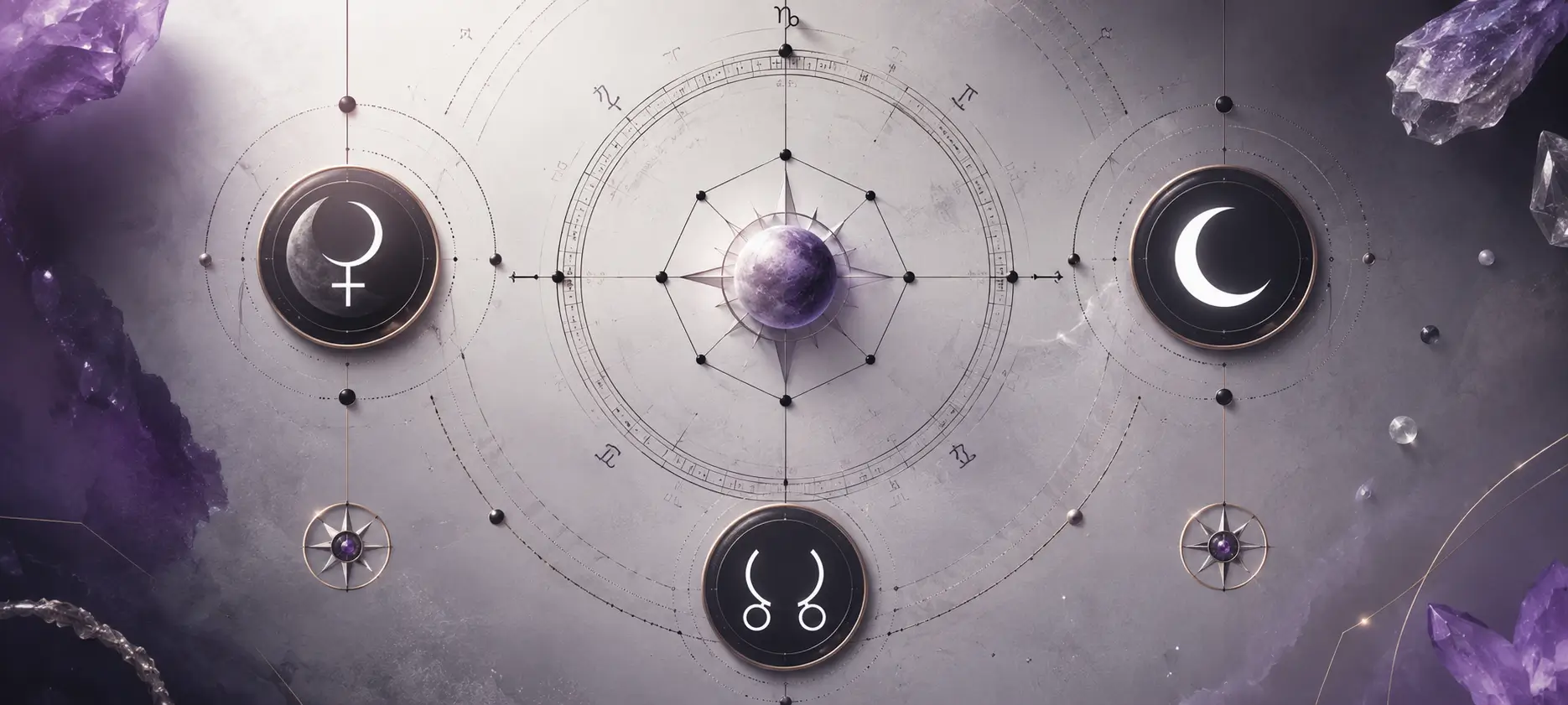
These three points are rarely analyzed together, although it is precisely in combination that they provide the most complete picture: what a person hides within (Lilith), what they can already rely on (Selena), and where they need to move next (Lunar Nodes). Below is a detailed breakdown of each of them and how to read them together.
Lunar Points: Key Takeaways 📋
| Point | What It Is | What It Reveals |
|---|---|---|
| Lilith (Black Moon) 🌑 | Apogee — the furthest point from Earth in the lunar orbit | Shadow side of personality, unaccepted strength, distorted perception/understanding, or subconscious craving towards the house topics where it resides natally or transits. Acts like a «magnet» |
| Selena (White Moon) 🌕 | A point with debatable origin (orbital perigee or a distinct ~7-year cycle) | Luminous qualities, accumulated positive resource, inner support, Higher Power guidance, avoidance of trouble, and fortunate synchronicities in the house topics where it resides natally or transits. «Effortless luck» |
| Lunar / Karmic Nodes ☊☋ | Intersection points of the Moon's orbit with the ecliptic (the Sun's path) | Karmic journey: accumulated past experience and comfort zone (South Node), new territory and growth path (North Node) |
What Does a «Point» Mean If It Is Not a Planet 🔑
Neither Lilith, Selena, nor the Lunar (Karmic) Nodes are physical celestial bodies — they are mathematical, calculated coordinates defined by the geometry of the Moon's orbit relative to Earth and the Sun. This does not make them any less significant: in astrology, what matters is not the physical mass of an object, but the symbolic role it plays in the overall system of the chart.💡 Important: Psychologist and astrological historian Demetra George noted in her book «Mysteries of the Dark Moon» (1992) that fictitious points like Lilith often highlight the most uncomfortable topics repressed from conscious attention — those that do not fit into the neat portrait painted by the planets.
How Lilith, Selena, and Lunar Nodes Differ 🌑🌕☊
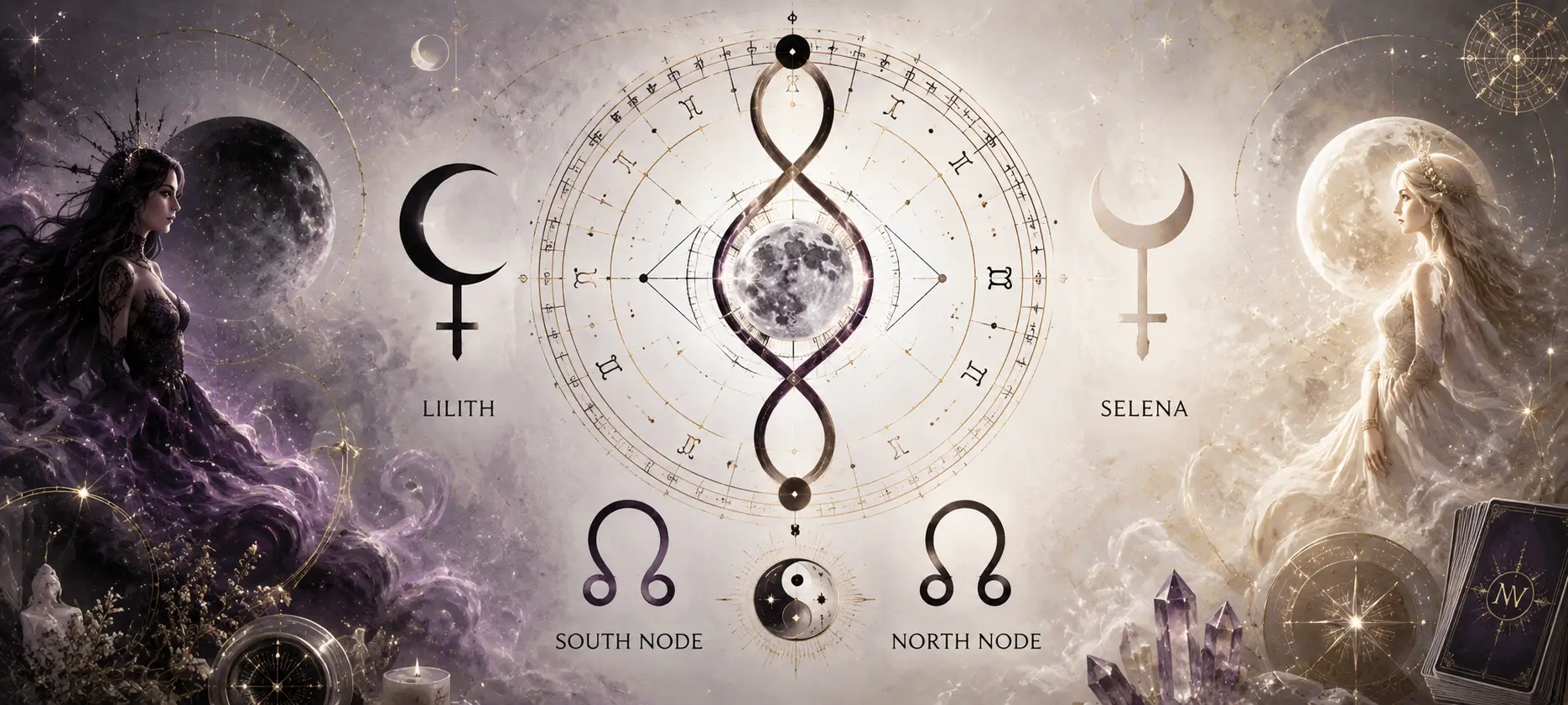
These are distinct layers of interpretation, and it is easy to confuse them:Lilith — speaks to the individual, personal shadow: what is suppressed or deemed shameful to admit, yet serves as a source of genuine personal power once integrated.
Selena — speaks to the already accessible luminous resource: accumulated positive qualities and a foundational support system that one must learn to consciously utilize.
Lunar or Karmic Nodes — speak to the progression through time: not a static character trait, but a developmental vector, moving from the familiar (South Node) to what is yet to be mastered (North Node).
In simple terms: Lilith answers «what am I hiding inside», Selena — «what can I already rely on», and the Nodes — «where am I headed next».
Lunar Points and Houses: Where to Look for Details 🏠
All three points, just like planets, fall into a specific house of the natal chart — revealing the exact life sphere where their themes unfold. We have already covered the general principle of houses in the Houses and Spheres of Life section; in dedicated articles for each point, this connection is explored in greater detail.History and Origins of the Techniques 📜
The Lunar Nodes have been known to astrologers since antiquity — in Vedic and Hellenistic traditions, they were calculated and interpreted as critical indicators of destiny long before the discovery of outer planets. Lilith gained widespread use in Western astrology much later — in the early 20th century, largely due to the astrologer Sepharial, who first published her ephemeris. Selena is the youngest and most localized technique among the three: introduced by Pavel Globa via the Avestan School of Astrology based on ancient Zoroastrian concepts, this point is predominantly utilized in Eastern European astrology rather than global international practices.The Dragon's Head and Tail: Origins of the Nodal Names 🐉
In medieval astrology, the North Node was called Caput Draconis («Dragon's Head»), and the South Node was known as Cauda Draconis («Dragon's Tail»). The terminology stems from ancient astronomical observations: eclipses occur precisely near the nodes of the lunar orbit — and folk myths across various cultures explained an eclipse as a mythical dragon momentarily «swallowing» the luminary.💡 Important: Astrological classic Martin Schulman uses these terms synonymously with the North and South Nodes in his seminal book «Karmic Astrology: The Moon's Nodes and Reincarnation».
Important Clarification: Which Exact «Lilith» ⚠️
It is vital to set the record straight, as confusion exists even on professional websites. Under the name «Lilith», astrology actually references several distinct points:Black Moon (True or Mean) — the apogee of the Moon's orbit, a calculated mathematical point; this is the primary point explored in this section.
Asteroid Lilith (№1181) — an actual celestial body located in the asteroid belt, a physical object with its own orbit.
Dark Moon (Waldemath's Lilith) — a hypothetical second moon of Earth whose existence remains unproven scientifically; used only in specialized, niche astrological systems.
Whenever you encounter the term «Lilith» on different websites or in calculation software — always verify which version is being referenced, as their chart placements do not coincide. A similar situation applies to Selena — due to a lack of a single calculation standard, different sources may display varying positions.
Other Calculated Chart Points 🔮
Apart from Lilith, Selena, and the Lunar (Karmic) Nodes, astrology utilizes several other hypothetical mathematical points beyond the scope of this article: the Part of Fortune — a classical point with a standardized formula traditionally linked to prosperity and luck, and the Vertex — a lesser-known point associated by some astrologers with karmic, seemingly destined encounters and life events.How to Read All Three Points Together: Shadow, Light, and Path 🧩
Individually, each point answers its own specific question, but together they formulate a cohesive psychological narrative of an individual:Lilith highlights what is suppressed or hidden, manifesting subconsciously.
Selena identifies the positive, accessible inner resource that is evident even to outsiders.
Lunar (Karmic) Nodes indicate where to direct this total energy — moving from established comfort zones (South Node) toward necessary evolution through mastering new lessons (North Node).
Practical reading framework: first, evaluate hidden aspects honestly (Lilith); second, identify the available inner grounding resource (Selena); and finally, direct the combined focus toward growth (the axis of the Nodes). Skipping any step leaves the synthesis incomplete: without Lilith, one remains blind to internal blocks slowing North Node progress; without Selena, one overlooks natural gifts ready to support the journey.
A Comprehensive Mini Case Study: How the Three Points Function Together 📖
A client sought an online consultation expressing feeling «stuck in place despite doing everything right». Chart synthesis revealed: Lilith in Virgo in the 6th house (suppressed permission to be imperfect, habitual pleasing through constant utility), Selena in Scorpio in the 8th house (an accessible yet underutilized resource of deep transformative wisdom), and South Node in Pisces in the 12th house with North Node in Virgo in the 6th house (a comfortable pattern of dissolving into care for others instead of structured, practical real-world movement).The three points together revealed a unified story: the client remained for years within the South Node comfort zone (dissolving, pleasing) due to fear of accepting imperfection (Lilith), failing to tap into the inherent strength of depth and transformation (Selena). Addressing all three points simultaneously brought a major breakthrough that isolated analysis could not achieve.
Different Astrological Traditions: What to Use ⚖️
If you encounter a chart analysis mentioning only Lilith and the Lunar Nodes without Selena — this typically aligns with classical Western psychological astrology, where Selena is not standard methodology. Conversely, if a source includes all three, it reflects an expanded Eastern European tradition incorporating Avestan school practices from Pavel Globa. Neither approach is superior; it depends on the practitioner's methodology, which is beneficial to understand in advance.If you'd like to explore another layer of symbolic calculations in your life, try our Life Path Number Calculator by Birth Date →
Frequently Asked Questions ❓
Is it true that Lilith, Selena, and Lunar Nodes do not exist physically? Yes, all three points are calculated mathematical coordinates based on the orbital geometry of the Moon rather than physical celestial bodies, but this does not lessen their interpretive significance.Which point is most important to study first — Lilith, Selena, or the Nodes? It depends on your objective: if exploring repressed desires or shadow power, start with Lilith; if seeking active positive resources, start with Selena; if focusing on overarching life path and purpose, begin with the Lunar Nodes.
Is it possible to lack Lilith, Selena, or Nodes in a natal chart? Lilith and the Nodes are calculated for every natal chart without exception. Selena, given its unique origin status, is not utilized by every astrological school, so its inclusion depends on the specific practitioner.
Are these three points directly connected to each other? Not directly, though all three technically derive from the Moon's orbital geometry — symbolically, they describe different aspects of a unified theme: shadow, light, and evolutionary growth.
How long have these techniques been used in astrology? The Lunar Nodes date back to antiquity; Lilith entered Western practices in the early 20th century; Selena is a modern technique developed within the Avestan astrological framework.
Why are Lunar Nodes called the «Dragon's Head» and «Dragon's Tail»? This medieval terminology stems from eclipses occurring near the nodes, historically mythologized as a dragon temporarily consuming the luminary.
Is there truly only one «Lilith» in astrology? No, several distinct entities share the name — the Black Moon (orbital apogee), Asteroid Lilith №1181, and the hypothetical Dark Moon of Waldemath; verifying the exact point being referenced is key. Read more in the Lilith Section →
What other calculated points exist in a chart besides Lilith, Selena, and the Nodes? Notable examples include the Part of Fortune (linked to prosperity via a standardized formula) and the Vertex (linked to turning-point events and meetings).
Are «Karmic Nodes» and «Lunar Nodes» the same thing? Yes, «Karmic Nodes» is a widely used synonym emphasizing the axis's connection to destiny and evolution; both terms are used interchangeably in literature.
What is the recommended sequence for analyzing all three points together? The most logical order starts with Lilith (repressed patterns), followed by Selena (available supportive strengths), and culminates with the Nodes (directing growth).
Why do some platforms list only Lilith and Nodes while others include Selena? Classical Western systems usually exclude Selena, whereas expanded Eastern European systems utilize all three points simultaneously.
Can these points be interpreted individually rather than as a system? Yes, but synthesizing all three provides a clearer, actionable overview of your shadow, light, and life path trajectory.
Dive Deeper 🌟
Each topic offers rich insight: Lilith uncovers your hidden shadow power, Selena highlights accessible inner gifts, and the Lunar Nodes point toward your developmental path. To explore how these placements interact within your personal chart, book an online consultation tailored to your birth details.If you want to check relationship dynamics through birth dates, try our Online Birth Date Compatibility Calculator →, or explore insights with an Online Tarot Reading →
Online services tarot, astrology... →