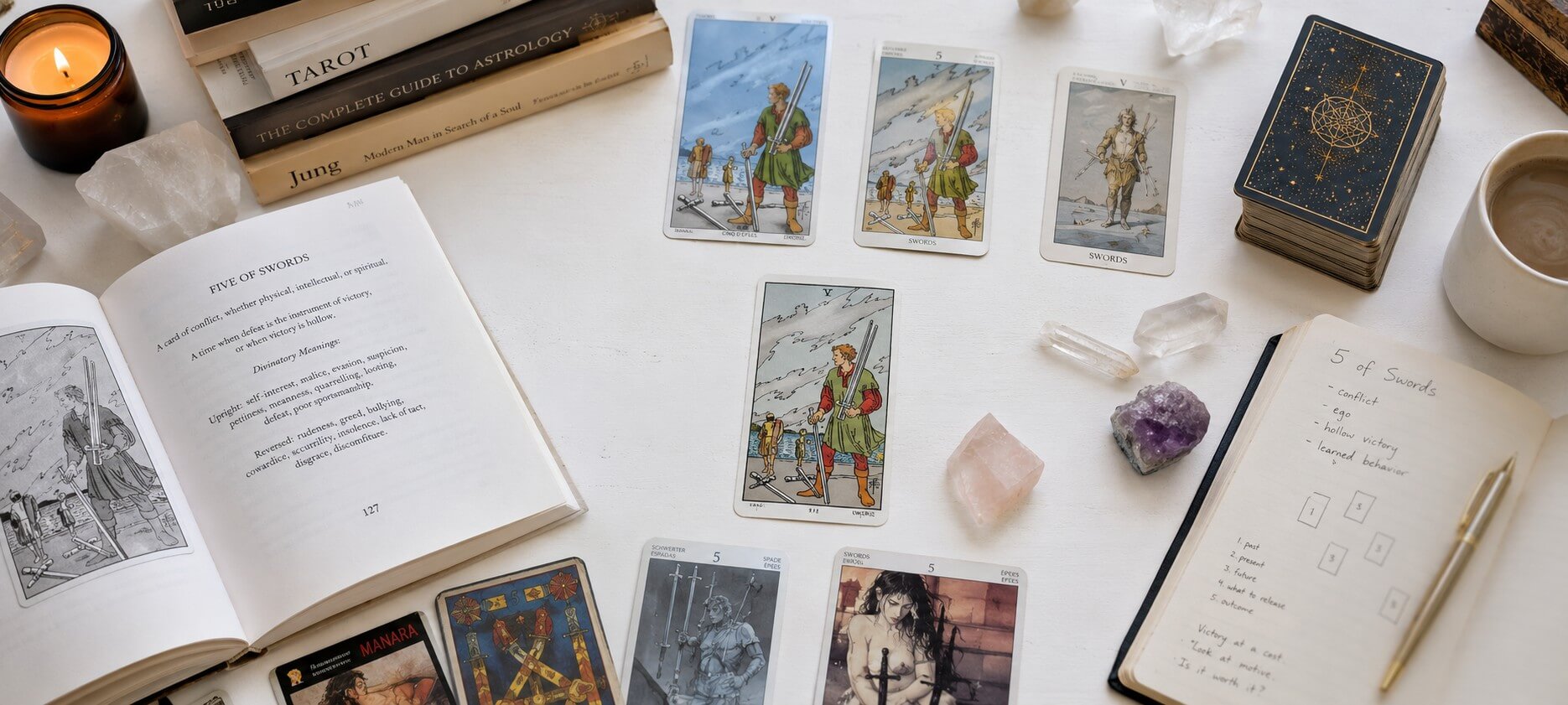
Five of Swords — the fifth card of the suit of Swords. At first glance, it is a victory. But look closer: the winner smirks, the defeated walk away with bowed heads, the sky is stormy. This is a card of a Pyrrhic victory: when you won the battle but lost something more important.
You can win an argument. But lose a relationship. Was it worth it?
The Card in Numbers 📋
| Parameter | Value |
|---|---|
| Name | Five of Swords / Lord of Defeat / Degradation / Five of Swords |
| Group | Minor Arcana, Suit of Swords |
| Position | Fifth card of the suit of Swords |
| Element | Air |
| Planet in Sign | Venus in Aquarius |
| Keywords (Upright) | Conflict, Pyrrhic victory, discord, winning an argument, resolving an issue through conflict, getting your way without joy |
| Keywords (Reversed) | Reconciliation, moving away from conflict, regret, attempt to repair, resolving an issue without conflict |
Symbolism and Imagery of the Card 🖼️
On the card, a man stands holding three swords in his hands, smirking. Two more swords lie on the ground before him. In the distance, two figures walk away with bowed heads. The sky is stormy and troubled. The man has clearly won this battle. ⚡️Arthur Edward Waite ("Pictorial Key to the Tarot", 1910) described the winner's smirk as a key detail: this is not a magnanimous victor. This is a person who enjoys the fact that others have lost. He collected all the swords and left his opponents with nothing. Formally, he won. But what exactly did he win?
Two swords on the ground represent the discarded weapons of the defeated: they surrendered. Or they retreated. This is an important distinction. Rachel Pollack noted: we do not know whether they left because they admitted defeat, or because they refused to continue this battle as unworthy.
The stormy sky signifies torn relationships: even nature reflects that something here is broken. The conflict has ended, but peace has not arrived.
Rachel Pollack ("Seventy-Eight Degrees of Wisdom", 1980) called the Five of Swords "a card of loss for all participants": the winner got the swords but lost respect, trust, and possibly the relationship. The defeated lost the battle but kept their dignity by leaving. No one truly won in this conflict. ☝🏽
Paul Foster Case ("The Tarot: A Key to the Wisdom of the Ages", 1947) linked the card to Venus in Aquarius — a desire for harmony (Venus) blocked by cold detachment (Aquarius). This is a conflict where no one wants to yield because everyone is convinced of their righteousness at the level of principles. 🏛️
Upright Meaning of the Card ✨
The Five of Swords in an upright position is a card of conflict in which everyone loses. 🌟 This is not the productive struggle of the Five of Wands — there was the honest fire of equals. Here, it is a sharp, mental conflict where someone uses superiority (intellectual, social, informational) to humiliate or criticize another.The card asks an important question: do you want to be right, or do you want to save the relationship? Sometimes these are mutually exclusive. The Five of Swords hints: victory at any cost is always too high a price.
At the same time, the card advises: do not be afraid of an open conversation, defend your position, be convincing, but in an eco-friendly way, without humiliation. Your weapons are truth, facts, and logic.
The card also warns of unfair play: a person in the reading may use manipulation, lies, or pressure to achieve their goals. 💫
In the upright position, the card says:
✔ A conflict in which there are no real winners
✔ Someone is playing dirty — or you risk doing so yourself
✔ A Pyrrhic victory: you can win, but you can also lose something more important
✔ Time to ask: is this battle worth what it costs?
✔ An argument or discussion is brewing. It is important to choose your weapons. There is a chance to win fairly
Reversed Meaning of the Card 🔄
The reversed Five of Swords represents a conflict coming to an end, or regret over a victory achieved at any cost. 😔The first option is reconciliation. The acute period is behind. Both sides are tired of the war. An opportunity for dialogue, forgiveness, and restoration emerges. The card says: the moment for reconciliation has come — do not miss it.
The second option is regret and an attempt to repair. The person realized that their victory was empty. They hurt those they did not want to hurt. Now, there is a desire to fix things, apologize, and make amends. 👀
In the reversed position, the card says:
☑ The conflict is ending — the path to reconciliation opens up
☑ Regret over words spoken and actions taken in conflict
☑ An attempt to repair the damage caused
☑ Or: walking away from conflict as a wise decision
Five of Swords in a Love and Relationships Reading ❤️
In a love reading, the Five of Swords is one of the most painful cards for a relationship. 💔If you are in a relationship: there is a conflict in the couple where someone wants to win rather than reach an agreement. Words that cannot be taken back. Criticism instead of dialogue. The card says directly: an argument is brewing in which there will be no winners, though there might be an intermediate victory.
If you are searching: a situation is possible where someone is playing an unfair game. Manipulation, lies, and games in relationships. Or, you find yourself in a position where you are being used.
If it came up with a question about a partner's feelings: the situation is tense. Possibly competition, jealousy, or a desire to dominate. This is not a quiet feeling. There is a struggle here — and it is important to understand who is in it and why. 🌹
Five of Swords in a Career and Work Reading 💼
In a career reading, the Five of Swords is a warning about unfair competition and a toxic environment. ⚡️Someone in your environment is playing dirty, pressuring, or manipulating: taking credit for others' ideas, setting others up, or criticizing. Or, you are in a situation where victory requires methods you do not want to use.
The card suggests entering the discussion but asks a professional question: what price are you willing to pay for this victory? Reputation and relationships are harder to restore than it seems. Use constructive arguments instead of empty insults — you can win. Read more about frequent career inquiries to a Tarot reader →
Five of Swords in a Finance Reading 💰
In a financial reading, the Five of Swords indicates a financial dispute or an unfair deal. 💸Disputes over money. Financial pressure or manipulation. A deal where one party wins at the expense of another.
The card warns: a financial victory achieved through unfair, toxic methods creates long-term losses — in reputation and relationships.
The reversed Five of Swords in finance means the resolution of a financial dispute or an opportunity to reach an agreement on fairer terms. Find out about advantageous price packages →
Psychological Portrait of the Card 🧠
Carl Gustav Jung ("Aion: Researches into the Phenomenology of the Self", 1951) described the Shadow as that part of the psyche that a person does not want to recognize in themselves. The Five of Swords is the Shadow in conflict: when a person causes pain to others and rationalizes it ("I am just telling the truth," "it is their own fault," "you cannot do it any other way in this world"). Read more about the connection between Tarot and psychology →The winner's smirk on the card is a psychological portrait of a person cut off from empathy: they see only victory, blind to the pain of those they defeated. Jung called this "ego inflation": when winning an argument becomes more important than the person you are arguing with.
Rachel Pollack ("Seventy-Eight Degrees of Wisdom", 1980) suggested looking deeper at those who leave, not just the winner. There is a special dignity in their departure: they refused to continue a humiliating battle. Psychologically, this is a mature choice — not every conflict deserves to be continued. Sometimes leaving means truly winning. 💡
Related Cards 🔗
This card resonates with:▷ Five of Wands — a conflict of fire: honest and open. The Five of Swords is a conflict of air: cold and often unfair
▷ Six of Swords — the next step: moving away from conflict toward peace
▷ Seven of Swords — the same theme of unfairness, but through deception and stealth manipulation
In challenging positions, pay attention to combinations with:
➤ The Moon (XVIII) — hidden motives, deception, and manipulation in a conflict
➤ The Devil (XV) — a conflict that is hard to escape due to dependency or fear
Advice of the Card 💬
«Choose your best position — to win by any means necessary or to retreat out of a sense of self-respect?»
Frequently Asked Questions about the Five of Swords Card ❓
What does the Five of Swords card mean in Tarot? The Five of Swords is the fifth card of the suit of Swords, which symbolizes the element of Air. It signifies conflict, a Pyrrhic victory, and a situation where all participants end up losing. Arthur Edward Waite ("Pictorial Key to the Tarot", 1910) depicted a smirking victor with three swords and two defeated figures walking away — a formal but empty victory. It corresponds to Venus in Aquarius.Is the Five of Swords a good or bad card? The Five of Swords is one of the most challenging cards in the deck. Upright, it points to a conflict with losses for all sides, unfair play, or a Pyrrhic victory. Reversed, it indicates reconciliation, regret, or a wise departure from a destructive conflict. Its meaning is specified by the context of the reading.
Is the Five of Swords a "Yes" or "No"? In "Yes/No" readings, it depends on who you are on the card — the winner or the loser (context and supporting cards will help): "Yes, but at too high a price" or "No — the price is too high." Very often: the result is achievable, but the losses will outweigh the benefits. A reversed Five can mean "Yes" if the question concerns reconciliation or ending a conflict.
What does a reversed Five of Swords mean? The reversed Five of Swords has two meanings: 1) reconciliation — the acute period is behind, an opportunity for dialogue and forgiveness opens up; do not miss this moment; 2) regret over a victory at any cost — the person realized they hurt those they didn't want to hurt and is looking for a way to fix it.
What does the Five of Swords mean in a love reading? In a love reading, the Five of Swords is one of the most painful cards. For those in a relationship, it means a conflict where someone wants to win rather than compromise; words that cannot be taken back. For those searching, it means unfair play or manipulation. If the question is about a partner's feelings, the situation is tense, involving a struggle or a desire to dominate.
What does the Five of Swords mean in a career reading? In a career reading, the Five of Swords is a warning about unfair competition and a toxic environment. Someone is playing dirty, or victory requires unacceptable methods. Paul Foster Case ("The Tarot: A Key to the Wisdom of the Ages", 1947) linked the card to Venus in Aquarius — a desire for harmony blocked by principled stubbornness.
What does the Five of Swords mean in a finance reading? In a financial reading, the Five of Swords indicates a financial dispute or an unfair deal. Money arguments, financial pressure, a deal favoring one side. A financial victory through unfair methods creates long-term losses. A reversed Five means the end of a dispute or fairer terms.
Which psychological archetype corresponds to the Five of Swords? Carl Gustav Jung ("Aion: Researches into the Phenomenology of the Self", 1951) described the Shadow as a part of the psyche that a person refuses to acknowledge. The Five of Swords is the Shadow in conflict: the rationalization of inflicted pain. Rachel Pollack ("Seventy-Eight Degrees of Wisdom", 1980) pointed out that in the departure of the defeated lies a special dignity — refusing to continue a humiliating battle is sometimes the true victory.
What does the winner's smirk symbolize on the card? The winner's smirk is a key psychological detail of the card. Arthur Edward Waite ("Pictorial Key to the Tarot", 1910) intentionally depicted a gloating rather than a magnanimous victor — a person who enjoys another's defeat. Carl Gustav Jung ("Aion", 1951) called this ego inflation: when winning an argument becomes more important than the person you are arguing with. Read more about Tarot card symbolism →
How does the Five of Swords differ from the Five of Wands? The Five of Wands is an honest struggle of fire: chaotic but open; no one is hurt, there are no winners and no losers. The Five of Swords is a cold conflict of air: here there is a clear winner and clearly defeated sides, and the methods are often unfair. The Five of Wands is creative tension, while the Five of Swords is a mental confrontation, often destructive. Read more about the structure of a Tarot deck →
Want to know what the Five of Swords says about your situation? ⚔️
If this card has appeared in your reading — there is a conflict in your life that requires an honest look. Who is who in it, whether it is worth continuing, and how to exit with dignity is a topic for a live conversation during a consultation. 🤗✑ Book an individual consultation and together we will see what the Five of Swords says about your situation!

Minor Arcana of the Tarot