Swords are the sharpest and most honest suit in the deck. ⚔️ Where Cups feel, Swords cut with the truth. When these cards appear in a reading, they speak not of what you feel, but of what you think and what decision it is time to make.
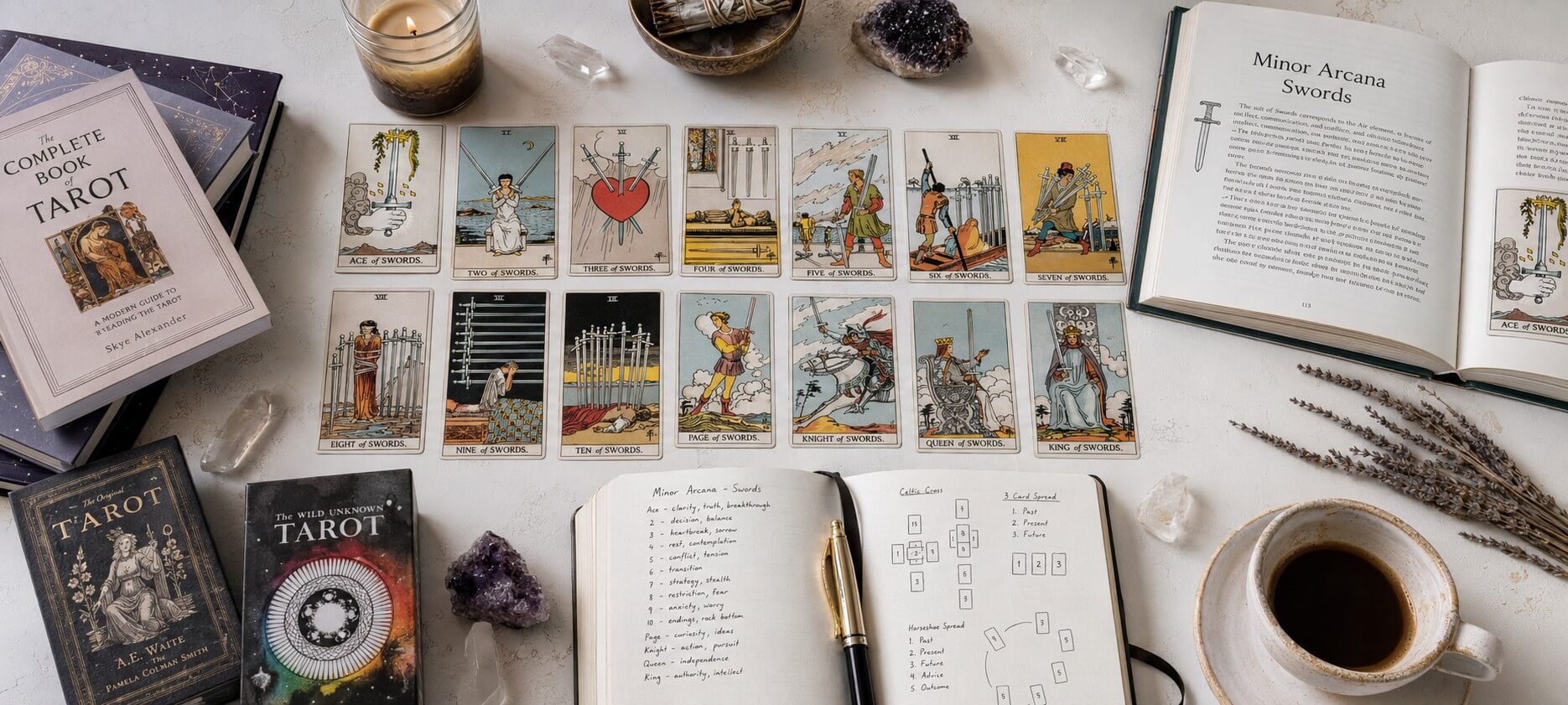
Below is a full description of all 14 cards of the suit of Swords: from the first flash of clarity in the Ace to the mature wisdom of the King. Symbolism, psychology, key meanings, and a look at each card through the prism of classic Tarot works.
What is the Suit of Swords in Tarot? ⚔️
Swords are one of the four suits of the Minor Arcana. If Wands speak of will and passion, Cups of feelings, and Pentacles of the material, then Swords represent the realm of the mind, words, and difficult decisions.Arthur Edward Waite, in his book "The Pictorial Key to the Tarot" (1910), describes the suit of Swords as being associated with "force, authority, ambition, and that which comes through mind and conflict, rather than feeling." According to his interpretation, Swords are the suit of those compelled to act in a world where not everything is friendly, and where honesty sometimes hurts.
The 14 cards of Swords — from Ace to King — encompass the entire path of mental life: from insight, then choice, conflict, betrayal, and anxiety, to the mature wisdom of one who has learned to use their mind as a tool rather than a weapon against themselves.
The Element of Air: The Energetic Foundation of the Suit of Swords 🌬️
Each Tarot suit is ruled by one of the four elements. Swords represent the element of Air. In Tarot symbolism, Air signifies thinking, communication, the ability to separate facts from illusions, and speaking the truth.Rachel Pollack, in "Seventy-Eight Degrees of Wisdom", describes air in the suit of Swords as "the ability to rise above emotional fog and see things as they are — even if that clarity is painful." It is precisely this ability — to think clearly where others drown in feelings — that defines the essence of all 14 cards of this suit.
In astrology, the element of Air corresponds to the signs of Gemini, Libra, and Aquarius. These archetypes — the communicator, the peacemaker, and the visionary — reflect the range of energies within the suit of Swords: from the sharp, not always comfortable mind of the Page to the mature intellectual honesty of the King. Read more about astrological correspondences in Tarot →
Key Themes of the Element of Air in Tarot:
✔ Thinking, analysis, clarity
✔ Conflicts and their resolution
✔ Honesty — even when painful
✔ Communication and the spoken word
✔ Making difficult decisions
✔ Liberation from illusions
Psychological Portrait of the Suit of Swords 🧠
Carl Gustav Jung viewed the element of Air as a symbol of the thinking function — that part of the psyche which separates, classifies, and judges, in contrast to the water of feelings, which connects and dissolves. In this sense, the suit of Swords represents a card of psychological differentiation: the capacity to separate truth from projection, and fact from fear. Read more about the connection between Tarot and psychology →From a psychological perspective, individuals with a predominance of Swords in readings are those for whom clarity is more vital than comfort. It is easier for them to speak an inconvenient truth than to live in a beautiful lie. They think in terms of logic and principles, and they suffer when forced to suppress their own honesty for the sake of another's peace of mind.
Rollo May, in his book "The Meaning of Anxiety" (1950), points out that anxiety is not an enemy, but a signal that a person stands before a real choice that requires courage. The Nine and Ten of Swords, with their imagery of anxious nights and hitting emotional rock bottom, are clear proof of this: even the darkest card of the suit carries the seed of an awakening.
The Shadow Side of the Suit of Swords:
➤ Cold cruelty disguised as honesty
➤ Chronic anxiety and catastrophizing
➤ Manipulation through words and information
➤ Isolation through excessive rationality
All 14 Cards of the Suit of Swords — List, Symbolism, and Key Meanings 📋
| Card | Key Word | Sphere of Influence |
|---|---|---|
| Ace of Swords | Clarity, truth, breakthrough | A moment of insight, the beginning of an honest conversation, a breakthrough in understanding |
| Two of Swords | Stalemate, avoiding choice | Indecision, a temporary truce between two truths |
| Three of Swords | Heartbreak, painful truth | A painful discovery, betrayal, a necessary truth |
| Four of Swords | Rest, recovery | A respite after mental tension, a pause for healing |
| Five of Swords | Conflict, Pyrrhic victory | A dispute with no winners, unfair struggle, the price of principles |
| Six of Swords | Transition to tranquility | Moving from conflict to peace, emotional relocation |
| Seven of Swords | Deception, hidden actions | Cunning, understatement, secret maneuvers |
| Eight of Swords | Trap, self-limitation | A feeling of helplessness, self-imposed restrictions |
| Nine of Swords | Anxiety, night terrors | Insomnia, catastrophizing, fears stronger than reality |
| Ten of Swords | End of cycle, rock bottom | A painful ending, the point after which only the sunrise begins |
| Page of Swords | Sharp mind, criticism | Curiosity, learning, sometimes excessive harshness of speech |
| Knight of Swords | Decisiveness, swiftness | Fast and sharp actions, fighting for an idea or principle |
| Queen of Swords | Independence, honesty | Directness, clear boundaries, rejection of illusions |
| King of Swords | Intellect, professionalism | Mature leadership through logic, justice, and strategy |
💡 Please note: court cards (Page, Knight, Queen, King) in a reading can signify either a real person from your environment or a certain mental quality or role you are currently playing in the situation.
Ace of Swords: Where Clarity Begins ✨
The Ace is pure mental energy in its sharpest form. Arthur Edward Waite describes the Ace of Swords as an image of breakthrough: a sword piercing the clouds, a crown on its tip — the victory of reason over the fog of illusions.In a reading, this card comes as a sign: it is time to see the truth, no matter how uncomfortable it may be. The Ace of Swords does not promise ease — it promises clarity. And with clarity comes the strength to act consciously.
Swords in Upright and Reversed Positions 🔄
Upright Swords represent the healthy functioning of the mind: honesty, clarity of thought, the ability to make difficult decisions, and viewing a situation objectively.Reversed Swords indicate a mind that is either stuck or has turned against the person themselves:
☑ Chronic anxiety and obsessive thoughts
☑ Manipulation or lies — one's own or another's
☑ Excessive cruelty hidden behind "just being honest"
☑ Inability to make a decision, paralysis of analysis
☑ A conflict that drags on without resolution
Rachel Pollack writes that reversed Swords often point to a state where the mind is "working against the person rather than for them" — constantly finding new reasons for anxiety instead of real solutions. This is not a bad sign — it is a call to stop the mental race and return to the facts. Read more about what to do if the result of a reading does not match your expectations →
When Swords Predominate in a Reading: What Does It Mean? 💨
If there are 3 or more cards of the suit of Swords in your reading, it is a signal that the situation requires clear thinking rather than an emotional reaction. Here is how to interpret it:✔ The situation demands honesty and sober analysis, not hopes and illusions
✔ Words, decisions, or a conflict of interest play a key role
✔ It is important to separate facts from fears — what is really happening, not what it seems
✔ Perhaps one of the key participants in the situation is a sharp-tongued, rational personality type
If there are no Swords at all, perhaps right now the situation requires not analysis, but feelings (Cups), action (Wands), or a practical solution (Pentacles).
Swords and Other Suits: Interaction in a Reading 🔗
▷ Swords + Wands — intellect meets passion. A decision is made quickly and decisively, sometimes too abruptly▷ Swords + Cups — the mind clashes with the heart. A conflict between what logic dictates and what the heart feels
▷ Swords + Pentacles — thought takes on a practical form. A strategic decision transforming into a concrete action plan
▷ Swords + Major Arcana — external circumstances or karmic lessons determine the conflict or decision through which the lesson manifests
Frequently Asked Questions About the Suit of Swords ❓
What do Swords mean in Tarot? Swords are the suit of the Air element. They symbolize thinking, honesty, conflict, and making difficult decisions. In a reading, they point to matters of clarity, communication, mental tension, and the need to face the truth.Are Tarot Swords good or bad? The cards themselves are neutral. Swords carry a powerful energy of clarity and honesty, but can also indicate conflict, anxiety, manipulation, or cruelty — depending on the context of the reading and the position of the card. Read more about different decks and traditions of interpretation →
Which element rules the Swords? The element of Air. It is responsible for thought, analysis, communication, and the capacity to view a situation objectively, separating facts from emotions and illusions.
Which zodiac signs correspond to the suit of Swords? The Air signs — Gemini, Libra, and Aquarius. Gemini is responsible for swift communication and intellectual curiosity, Libra for the ability to see both sides of a conflict and seek justice, and Aquarius for independent thinking and the ability to view a situation from an outside perspective. Read more about astrology and Tarot →
What do Swords mean in a love reading? In love readings, Swords rarely talk about ease — they talk about honesty. These cards bring up complex but necessary conversations regarding boundaries, mismatched views, and decisions that have been postponed. Their appearance often means the relationship needs clarity rather than romance.
What do Swords mean in a career and work reading? In the professional sphere, Swords indicate negotiations, competition, legal matters, and situations where you need to defend your position with words. They support analytical work, strategic planning, and honest communication with colleagues and management.
Which card in the suit of Swords is considered the most favorable? The Ace of Swords and the Six of Swords are traditionally considered among the brightest cards of the suit: the Ace represents a moment of breakthrough and clarity, while the Six represents a transition from conflict to tranquility. They show that even within the most challenging suit, there are cards of hope and forward movement.
Which card in the suit of Swords is considered the heaviest? The Nine and Ten of Swords are emotionally considered the heaviest cards of the suit: the Nine speaks of anxiety and insomnia, while the Ten indicates a painful ending and hitting rock bottom. It is important to remember: the Ten of Swords also means that it cannot get any worse — after rock bottom, the sunrise begins.
How many cards are in the suit of Swords and how are they divided? The suit of Swords consists of 14 cards: 10 numbered cards (from Ace to Ten), which describe the development of mental energy from the first flash of clarity to overload and the completion of the cycle, and 4 court cards (Page, Knight, Queen, King), describing different levels of maturity of the Air element. Read more about the structure of the Minor Arcana →
What does it mean if there are no Swords in a reading? The absence of Swords can mean that the current situation does not require analysis or rigid decisions — the focus is shifted to feelings (Cups), action (Wands), or the material side of life (Pentacles).
How do Swords differ from Wands? Wands represent the element of Fire: will, passion, and action driven by impulse. Swords represent the element of Air: thought, analysis, and action driven by logic. Wands ask 'what do I want', while Swords ask 'what is actually happening'.
How do Swords differ from Cups? Cups represent the element of Water: feelings, intuition, and emotional truth. Swords represent the element of Air: thoughts, facts, and rational truth. Cups ask 'what do I feel', while Swords ask 'what do I know'. Together, these suits often show a conflict between the heart and the mind.
How do Swords differ from Pentacles? Pentacles represent the element of Earth: material results, the physical body, and stability. Swords represent the element of Air: abstract thought, words, and principles. Pentacles manifest ideas into reality, while Swords formulate the ideas themselves and make decisions on which direction to take. What do the court cards of the suit of Swords mean? The Page, Knight, Queen, and King of Swords describe different levels of mental energy maturity: from the sharp, sometimes blunt intellect of the Page — through the swift decisiveness of the Knight — to the independent honesty of the Queen and the mature intellectual leadership of the King. Learn more during a consultation →
✑ Book an individual consultation — let's look into your situation with the cards together!
Minor Arcana of the Tarot