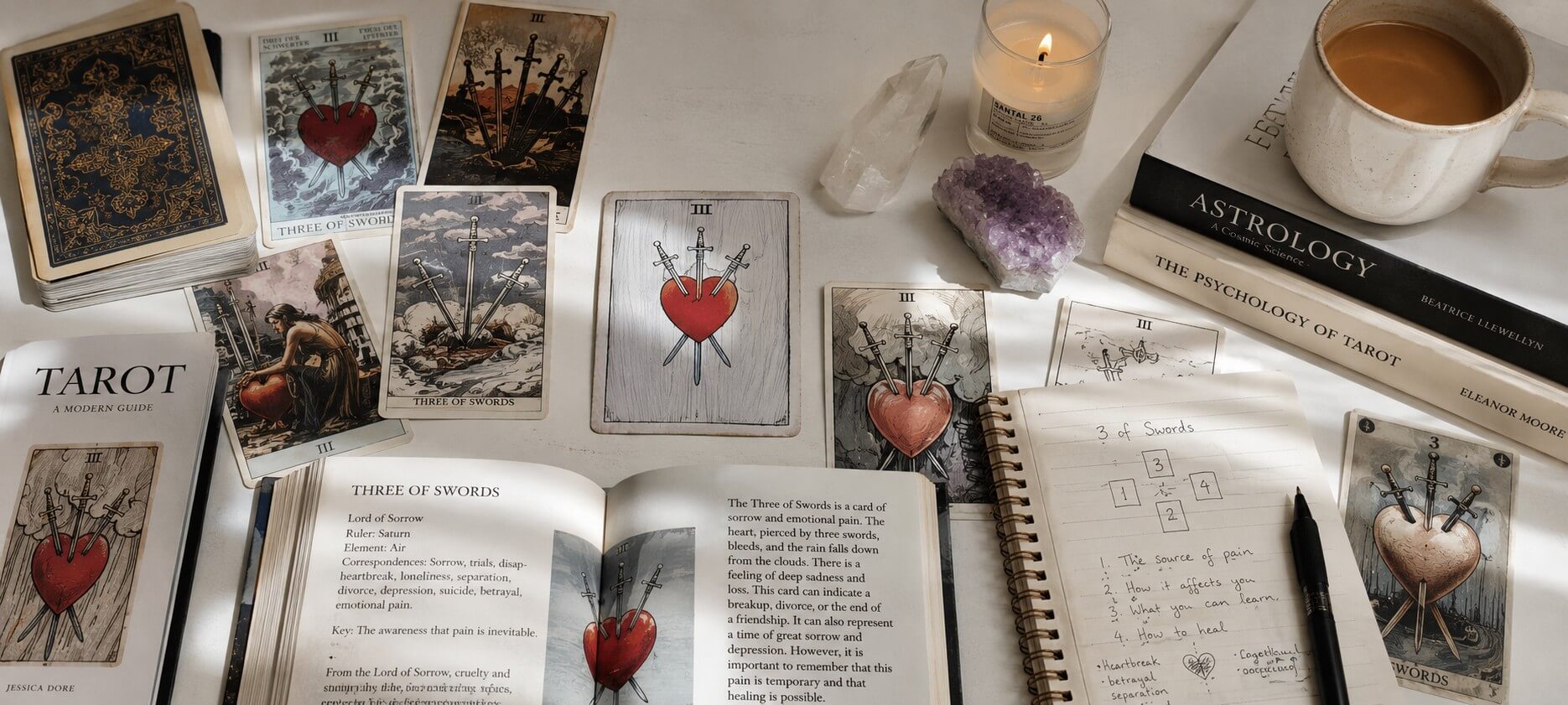
Three of Swords — a red heart, pierced by three blades, hangs in the air against a background of rain and storm clouds. There is no ground beneath it, no support. Only pain, frozen in the moment. The rain acts as a confirmation, and it also washes away the remnants of illusions.
The Three of Swords represents a painful truth, and the first thing to do with real pain is not to analyze it, but to acknowledge it.
The Card in Numbers 📋
| Parameter | Value |
|---|---|
| Name | Three of Swords / Lord of Sorrow / Grief |
| Group | Minor Arcana, Suit of Swords |
| Position | Third card of the Suit of Swords |
| Element | Air |
| Astrological Association | Saturn in Libra |
| Keywords (Upright) | Heartbreak, betrayal, grief, painful truth, breakup, emotional wound |
| Keywords (Reversed) | Release from pain, forgiveness, beginning of healing, ending prolonged suffering, talking through trauma |
Symbolism and Imagery of the Card 🖼️
On the card, a red heart floats against a backdrop of heavy rain clouds, pierced by three swords of equal length. The rain falls in a solid wall. There is not a single living figure — only the pain itself, depicted directly, without metaphorical softening. 🌧️Arthur Edward Waite ("Pictorial Key to the Tarot", 1910) described this card as one of the most direct and literal depictions in the entire deck: suffering is shown without allegories — as a heart physically pierced by a sharp object. Waite particularly noted the absence of a human figure: pain here is universal, it does not belong to a specific character — it is about anyone who goes through this state.
Mary K. Greer ("Tarot for Your Self", 1984) drew attention to the rain as a necessary element of the image: the water falling on the heart represents tears that must be released for the pain to begin to fade. According to Greer, trying to suppress the rain, "not allowing yourself to cry," only prolongs the torment. The Three of Swords is a card that permits mourning openly, without shame for the intensity of the experience. ☝🏽
Hajo Banzhaf ("Tarot and the Journey of the Hero", 2000) viewed this card as an inevitable stage of the emotional journey — the moment when the truth turns out to be so sharp that it hurts in a literal sense. According to Banzhaf, the three swords are not a random number: the pain of betrayal or loss rarely comes from one side, it strikes at several levels simultaneously — trust, identity, and the sense of security.
Upright Meaning of the Card ✨
The Three of Swords in an upright position is a card of genuine emotional pain. 🌟 Pain caused by: the truth, a breakup, betrayal, loss, a fight, a difficult decision, or acknowledging defeat. It also indicates physical pain from a needle prick, surgery, or other bodily interventions.This pain is often connected to the realm of relationships: someone else's words, or an action that revealed what was hidden. Or a harsh truth that shattered an illusion in which it was more comfortable to live. A betrayal that broke trust. The card does not offer a way around this experience. It acknowledges: yes, it hurts. Yes, it is real. And it needs to be lived through — giving yourself the opportunity to both cry and heal.
The Three of Swords reminds us: grief and pain are not signs of weakness. It is a natural reaction of the psyche to the severing of something that was important. 💫
In the upright position, the card says:
✔ What you feel is your truth
✔ The pain is real — do not devalue it or try to rush it
✔ Betrayal or a harsh truth requires time to process
✔ Tears are not a weakness, but a necessary part of healing
✔ Acknowledging the pain is the first step toward it starting to fade
✔ Justice sometimes unfolds through painful honesty
Reversed Meaning of the Card 🔄
The Reversed Three of Swords — the rain begins to subside. You are starting to recover, and the pain is passing. Devaluing, ignoring, or silencing pain or truth. Forgiveness and relief. 😌The first variation is the beginning of healing. The acute phase of pain has passed. A person begins to see what happened more clearly, without that blinding intensity present at the start. This is not forgetting — it is integrating the experience into wisdom.
The second variation is forgiveness becoming possible. Not necessarily forgiving the one who caused the pain — sometimes it is more important to forgive yourself for trusting, loving, or not foreseeing it. The reversed Three releases you from this internal guilt.
The third variation is prolonged suffering that is consciously held onto. The pain has become part of one's identity, and parting with it feels just as terrifying as the pain itself. 👀
In the reversed position, the card says:
☑ The acute phase of grief is passing — allow yourself to notice it
☑ Forgiveness is possible: of yourself, the other person, or both
☑ Speak about what hurts — silence keeps the wound open
☑ Check yourself: are you holding onto the pain because it feels scary without it?
Three of Swords in a Love and Relationship Reading ❤️
In a love reading, the Three of Swords is one of the heaviest yet most honest cards. 💖If you are in a relationship: something has happened or is happening that hurts deeply — words said in anger, a discovered lie, betrayal, or an uncomfortable truth. The card does not offer false comfort. It acknowledges: this truly hurts, and ignoring it is not the answer. This is not always about breaking up or leaving: perhaps acknowledging the facts is a step toward growth and reaching a new level in the relationship.
If you are searching: you might still be carrying the unreleased pain of past relationships. The Three of Swords asks you to give this pain space and time — before opening up to a new person with an unhealed wound. Your past resentments prevent you from trusting another person — process the past first and heal your heart.
If you came with a question about a breakup: yes, the card is about that too. But perhaps it is a release through pain, deserving the role of a valuable life experience. 🌹
Three of Swords in a Career and Work Reading 💼
In a career reading, the Three of Swords represents professional betrayal or painful criticism. 🌿 It can also signify an unpopular decision, a difficult but honest conversation, a rejection, or a strict regulation.It could mean a stolen idea, an unfair decision, or a harsh review of your work that hit harder than expected. A truth that must be taken into account. The card acknowledges the reality of this pain and does not rush you to "be professional" — sometimes you just need to give yourself time to recover.
It can also represent a painful but necessary formulation that is important to hear and accept as baseline data. Read more about frequent career inquiries to a tarot reader →
Three of Swords in a Finance Reading 💰
In a financial reading, the Three of Swords indicates financial betrayal or a painful revelation about money. Something will sting: a decision, the true state of affairs, or information. It could be a rejection or an undesirable response. 💸Deception in a deal, a partner's hidden debt, or the sudden exposure of a loved one's financial dishonesty. The card recognizes that such discoveries wound not only the wallet but also trust.
The reversed Three in finances signifies a gradual recovery after a financial blow: the situation is clearing up, and an opportunity arises to move forward with the lesson already learned.
Psychological Portrait of the Card 🧠
Elisabeth Kübler-Ross ("On Death and Dying", 1969) described the stages of grief — denial, anger, bargaining, depression, acceptance — as a universal process the psyche undergoes when facing any significant loss. The Three of Swords perfectly captures one of the most acute moments of this process — the moment when denial is no longer possible, but acceptance is still far away. The pain here is intensely real precisely because the psyche's defense mechanisms are temporarily offline. Read more about the connection between Tarot and psychology →Judith Herman ("Trauma and Recovery", 1992) wrote that healing from deep emotional trauma is impossible through avoidance — it requires direct, safe contact with the experienced event, and talking through what happened. In this sense, the Three of Swords is an invitation, not a sentence: the card shows pain so directly precisely to grant permission to acknowledge it, rather than hiding it behind a polite "everything is fine." 💡
Related Cards 🔗
This card resonates with:▷ Five of Cups — similar territory of grief, but the Three of Swords is the sharp pain of the moment, while the Five is its subsequent processing
▷ The Tower (XVI) — sudden destruction, followed by the pain of the Three of Swords
▷ Ten of Swords — the next, deeper point: when the pain leads to total exhaustion or the completion of a cycle
In difficult positions, pay attention to combinations with:
➤ The Moon (XVIII) — pain mixes with fear and illusions: it is hard to distinguish a real wound from an imaginary threat
➤ The Empress (III) — the presence of care and support alongside the pain
Card Advice 💬
«Accept the pain — not as weakness or defeat, but as a release and a new honest experience. This is what growing up and reaching a new level is truly about.»
Frequently Asked Questions about the Three of Swords ❓
What does the Three of Swords card mean in Tarot? The Three of Swords is the third card of the Suit of Swords, representing the element of Air. It symbolizes heartbreak, separation, betrayal, and painful truth. Arthur Edward Waite ("Pictorial Key to the Tarot", 1910) depicted a red heart pierced by three blades against a background of rain — one of the most direct images of suffering in the entire deck. It corresponds to Saturn in Libra.Is the Three of Swords a good or bad card? The Three of Swords is one of the heaviest cards in the deck in terms of feeling, but it is not inherently destructive. Upright, it honestly acknowledges real pain — from betrayal, a breakup, or a harsh truth. Reversed, it points to the beginning of healing, forgiveness, or, conversely, a prolonged suffering that needs to be let go.
Is the Three of Swords a "Yes" or "No"? It depends on the context and the nature of the question. The Three of Swords upright is a "Yes" if the situation involves a truth or pain that must be accepted and processed. A reversed Three is closer to a "Yes": the acute phase has passed, and moving forward becomes possible.
What does the reversed Three of Swords mean? The reversed Three of Swords has three meanings: 1) the beginning of healing — the sharp pain subsides, clarity emerges; 2) forgiveness — of oneself or another, releasing internal guilt; 3) prolonged suffering — pain has become part of one's identity, and letting it go feels scary.
What does the Three of Swords mean in a love reading? In a love layout, the Three of Swords is a heavy but honest card. For those in a relationship, it is an acknowledgment of real pain caused by hurtful words or actions. For singles, it represents unhealed pain from past relationships that requires attention before a new start. If the question is about breaking up, the pain is real, but the rain eventually stops.
What does the Three of Swords mean in a career reading? In a career reading, it signifies professional betrayal, painful criticism, rejection, a stolen idea, an unfair decision, or a harsh review. The card validates the reality of this pain and does not pressure you to bounce back immediately. It can also mean a necessary but difficult truth about your work.
What does the Three of Swords mean in a finance reading? In a financial reading, it signifies financial betrayal or a painful disclosure about money: deception in a deal, a hidden debt, or dishonesty from someone close. A reversed Three in finances indicates a gradual recovery after a financial setback.
Why is there a heart on the Three of Swords card? Arthur Edward Waite ("Pictorial Key to the Tarot", 1910) emphasizes the universality of pain by stripping the image of specific details and dramatization. It is not the heart of a specific person — it is pain itself, depicted abstractly, so that anyone looking at the card can recognize their own experience within it. Read more about Tarot card symbolism →
How does the Three of Swords differ from the Five of Cups? Both cards speak of pain, but at different stages. The Three of Swords is a sharp, fresh wound: the betrayal or loss has just occurred, and the pain still pierces deeply. The Five of Cups represents grief that has settled a bit: the person is processing the loss and learning to see what remains. The Three is the moment of impact. The Five is the moment after, when choices begin. Read more about the structure of the Tarot deck →
What psychological process corresponds to the Three of Swords? Elisabeth Kübler-Ross ("On Death and Dying", 1969) described the stages of grief, and the Three of Swords captures the exact moment when denial is impossible but acceptance is far off. Judith Herman ("Trauma and Recovery", 1992) added that healing requires direct contact with pain, not avoidance. The card permits you to grieve openly, without shame for the intensity of your feelings.
Want to know what the Three of Swords says about your situation? ⚔️
If this card appeared in your reading, there is a pain inside waiting to be acknowledged. What exactly lies behind it and how to move through it gently is something we can explore together during a live consultation. 🤗✑ Book a personal consultation and let's discover together what the Three of Swords says about your situation!

Minor Arcana of the Tarot