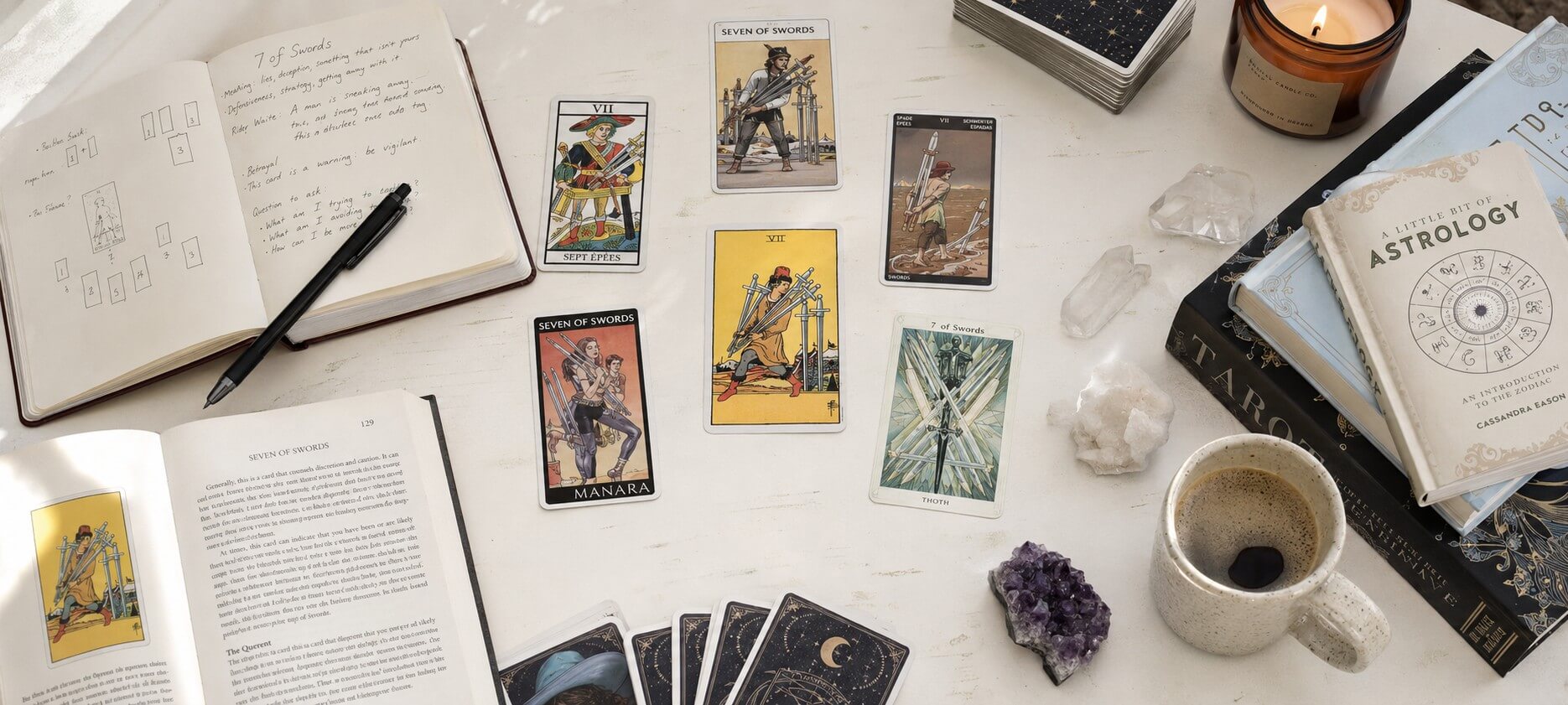
The Seven of Swords — a man sneaks away from a military camp, carrying five swords while looking back over his shoulder. Two swords remain stuck in the ground behind him — uncaptured, left intentionally or in a hurry. In the distance, near the tents, figures of people are oblivious to what is happening. He moves quietly, quickly, turning around mid-run to check if he has been noticed.
The Seven of Swords represents a moment when a cunning path is chosen over an honest one. Sometimes it is a necessary strategy. Sometimes, it is something you might feel ashamed to remember later.
The Card in Digits 📋
| Parameter | Value |
|---|---|
| Name | Seven of Swords / Seven of Blades |
| Group | Minor Arcana, Suit of Swords |
| Position | The Seventh Card of the Suit of Swords |
| Element | Air |
| Astrological Link | Moon in Aquarius |
| Keywords (Upright) | Cunning, diplomacy, agility, sharp mind, strategy, conflict avoidance, secrecy, deception, evasion |
| Keywords (Reversed) | Exposing deception, remorse, returning to honesty, unmasking hidden motives |
Symbolism and Imagery 🖼️
On the card, a man carries five swords that clearly do not belong to him, quietly slipping away from a military camp. Two swords are left behind, stuck in the ground. In the distance, near the tents, figures of people go about their business, unaware of what is happening. The man looks satisfied, his movements swift yet controlled. ⚔️Arthur Edward Waite («Pictorial Key to the Tarot», 1910) described this scene evasively, noting only "stealth and enterprise" as key qualities of the figure, avoiding a direct moral judgment of his actions. Waite intentionally left the card morally ambiguous: succeeding by avoiding a direct confrontation is neither entirely bad nor entirely good; it all depends on what is at stake and the methods used to achieve it.
Aleister Crowley («The Book of Thoth», 1944) titled this card «Futility» and interpreted it more harshly: cunning without a genuine purpose, energy wasted on maneuvers that ultimately settle nothing. According to Crowley, the danger of the Seven of Swords lies not in the strategy itself, but in how easily it turns into self-deception: a person expends effort on detours and forgets why they started in the first place. ☝🏽
Hajo Banzhaf («Tarot and the Journey of the Hero», 2000) offered a more compassionate view: sometimes a direct path is truly unsafe, and a tactical retreat is the only sensible course of action. According to Banzhaf, the card's core question is not "to trick or not to trick," but rather "why am I choosing this path, and am I ready to take responsibility for the consequences of this choice." 🏛️
Upright Meaning ✨
The Seven of Swords in an upright position is a card of cunning, agility, and a strategy that avoids direct confrontation. 🌟 This can represent a wise tactic such as diplomacy or deflecting a direct answer: not every battle is worth fighting openly. Sometimes, the necessary information is gathered carefully rather than through a direct demand. Sometimes a retreat preserves more than an attack.However, the same card warns of the shadow side of such a strategy: when cleverness replaces honesty not because it is necessary, but because it is easier. When a person avoids a conversation out of cowardice rather than wisdom — and calls it "tactics."
The card can also speak of a literal partial truth: something left unsaid, concealed, or bypassed — perhaps for perfectly understandable reasons, or perhaps without them. 💫
The card shows evasion, escaping, running away, maneuvering — physically or verbally, hiding facts or being dishonest (motives need clarification). It can confirm a departure without explanation or under a fabricated pretext.
Attention: The Seven of Swords is a card of deception, fraud, and theft. But it is also a card of diplomacy, intricate plans, and negotiations.
In the upright position, the card says:
✔ A strategic retreat might be a wise decision right now
✔ Not all truth is needed this very moment — choose your timing consciously
✔ Check honestly: are you being deceptive out of necessity — or cowardice?
✔ Someone nearby is not acting completely openly — stay alert
✔ A detached, rational perspective helps you avoid unnecessary conflict
Reversed Meaning 🔄
The reversed Seven of Swords is a moment when the hidden becomes visible. Or a voluntary confession of deceit. 😔First scenario — the exposure of deception. What was concealed comes to the surface: the lie is discovered, the hidden information leaks out, and the maneuver becomes apparent to everyone. This can be painful, but it often brings relief — the truth is better than keeping up the charade.
Second scenario — remorse. A person begins to realize the true cost of their own cunning: relationships that suffered, trust that was undermined for short-term gain. The reversed card here is not a punishment, but an opportunity to honestly admit a mistake.
Third scenario — a conscious return to honesty. After a period of maneuvering and dodging, a person decides to choose the direct path, even if it is harder. 👀
In the reversed position, the card says:
☑ The hidden comes to light — prepare for this honestly, not defensively
☑ Remorse is a signal to return to a more direct path
☑ If someone has deceived you, the truth is already near
☑ It is time to choose honesty, even if it is more difficult than trickery
The Seven of Swords in a Love Reading ❤️
In a love reading, the Seven of Swords is a card that demands attention to what is left unsaid. The card can reveal that someone is acting dishonestly with you, hiding their true plan, wanting more than they admit aloud, or "planning an escape." That person could also be you. 💖If you are in a relationship: perhaps someone — you or your partner — is avoiding a direct conversation about important matters, choosing detours over honesty. You or the other person might be planning to leave without warning — either from the relationship or from responsibility, check the entire spread.
If you are single: be cautious with people who are too skilled at dodging direct questions about themselves. Not all mystery is romantic; sometimes it is just an unwillingness to be upfront. Watch out, someone who is not entirely sincere with you is on the horizon.
If you came with a question about your partner's feelings: there is something they are hiding, keeping to themselves, "pulling the blanket over to their side," or being tricky about — not necessarily out of malice, but out of fear or to avoid conflict or pain. It is worth creating a space where a direct conversation feels safe. 🌹
The Seven of Swords in a Career Reading 💼
In a career reading, the Seven of Swords represents a strategy that requires caution in its execution. 🌿It can mean the necessity to act tactfully, diplomatically, without showing all your cards at once — for example, in negotiations. But it can also warn of unfair competition, the theft of ideas, or workplace manipulation.
The card advises: if you choose a strategic, indirect approach — make sure it is ethical. A victory built on deception sooner or later demands a heavy price. Read more about common career-related questions for a Tarot reader →
The Seven of Swords in a Finance Reading 💰
In a financial reading, the Seven of Swords is a warning about hidden clauses or dishonest schemes. 💸The card advises reading the fine print carefully, vetting business partners, and not trusting overly smooth promises. It can also point to your own temptation to conceal part of the information in a financial matter for short-term benefit.
A reversed Seven in finances means the exposure of a financial fraud or an dishonest scheme that a person was involved in, consciously or not. Find out about profitable price packages →
Psychological Portrait of the Card 🧠
Paul Ekman («Telling Lies», 1985) researched the mechanisms of deception as a universal part of human behavior: lies are rarely purely malicious — more often they serve as protection, conflict avoidance, or to preserve relationships that seem too fragile for the blunt truth. The Seven of Swords perfectly reflects this complexity: the figure on the card is not a villain in the pure sense, but a person who chose the path of least resistance at a moment when the direct path felt too risky. Read more about the connection between Tarot and psychology →Sissela Bok («Lying: Moral Choice in Public and Private Life», 1978) wrote about how even an "innocent" lie has a cumulative effect: each instance of dodging the truth slightly lowers the threshold for the next time, gradually altering how a person perceives their own honesty. According to Bok, the key question is not whether a specific trick was justified, but what kind of habit it forms over time. The Seven of Swords invites us to pause at this exact question before tactics harden into character. 💡
Related Cards 🔗
This card resonates with:▷ Two of Swords — both cards are about avoiding direct confrontation, but the Two is passive defense, while the Seven is active, tactical action
▷ The Magician (I) — the same theme of skill and mastery of tools, but the Magician applies them openly, whereas the Seven acts covertly
▷ The Devil (XV) — a similar theme of hidden motives and deception, taken to a deeper, more destructive degree
In difficult positions, pay attention to combinations with:
➤ The Tower (XVI) — deception is revealed suddenly and destructively, with no time to prepare
➤ Ten of Swords — accumulated trickery and evasion lead to a complete collapse of trust
Card Advice 💬
«Your behavior might not be so simple or direct. If it serves a good purpose — go ahead and be that slippery eel on a frying pan.»
Frequently Asked Questions about the Seven of Swords Card ❓
What does the Seven of Swords card mean in Tarot? The Seven of Swords is the seventh card of the Suit of Swords, representing the element of Air. It symbolizes cunning, strategic avoidance of conflict, and partial honesty or a quiet departure. Arthur Edward Waite («Pictorial Key to the Tarot», 1910) depicted a man quietly carrying away five swords from a camp, leaving two behind — an image of a morally ambiguous strategy. It corresponds to the Moon in Aquarius.Is the Seven of Swords a good or bad card? The Seven of Swords is a morally ambiguous card without a definitive judgment. In the upright position, it can indicate a wise strategic retreat as well as cowardice masquerading as tactics. In the reversed position, it points to the exposure of deception or, conversely, a conscious return to honesty.
Is the Seven of Swords a 'Yes' or 'No'? In 'Yes/No' readings, the Seven of Swords in the upright position means 'Yes, but not via a direct path': the goal is achievable through a workaround strategy. The reversed Seven means 'No' or 'The truth is already close': what is hidden will soon become clear.
What does the reversed Seven of Swords mean? The reversed Seven of Swords has three main meanings: 1) exposure of deception — the hidden comes to the surface; 2) remorse — a person realizes the price of their own cunning; 3) a conscious return to honesty — choosing a straight path instead of maneuvers.
What does the Seven of Swords mean in a love reading? In a love reading, the Seven of Swords demands alertness to what is left unsaid. For those in relationships, someone is avoiding a direct conversation about important things. For those searching, it warns to be careful with people who too skillfully dodge direct questions about themselves. If the question is about a partner's feelings, they might not be completely honest, often out of fear rather than malice.
What does the Seven of Swords mean in a career reading? In a career reading, the Seven of Swords indicates the need for a tactful, indirect approach in negotiations, or a warning about unfair competition or the theft of ideas in the workplace. The card advises: if you choose a strategy, make sure it is ethical.
What does the Seven of Swords mean in a finance reading? In a financial layout, the Seven of Swords is a warning about hidden terms in a deal, fraudulent financial schemes, or theft. The card advises checking details carefully and not trusting overly smooth promises. The reversed Seven signifies the exposure of financial fraud.
Why does the man on the card leave two swords instead of all seven? This is an intentional detail that leaves the card morally open to interpretation. Arthur Edward Waite («Pictorial Key to the Tarot», 1910) gave no direct explanation, intentionally preserving ambiguity: perhaps it was physically impossible to carry all seven swords, or perhaps it is a symbol that even in cunning, there are boundaries that a person establishes for themselves. Read more about Tarot card symbolism →
How does the Seven of Swords differ from The Devil (XV)? Both cards speak of hidden motives and deception, but on different levels. The Seven of Swords is a specific tactical trick in a particular situation, often temporary. The Devil (XV) is a deep, stable structure of self-deception in which a person is stuck for a long time, often without realizing it. The Seven is a maneuver. The Devil is a trap that has become a way of life. Learn more about Tarot deck composition →
Which psychological process corresponds to the Seven of Swords? Paul Ekman («Telling Lies», 1985) investigated lying as a universal defense mechanism, a way to avoid conflict or preserve fragile relationships. Sissela Bok («Lying: Moral Choice in Public and Private Life», 1978) added that even a small lie has a cumulative effect, gradually changing a person's attitude toward their own honesty. The Seven of Swords invites us to stop and ask: what kind of habit is this tactic forming?
Want to know what the Seven of Swords says about your situation? 💨
If this card has appeared in your layout — somewhere nearby a strategy is unfolding that is not completely open to view. What exactly is hidden and whether it is worth continuing on this path — we will figure out together during a live consultation. 🤗✑ Book a personal consultation and we will see together what the Seven of Swords says about your situation!

Minor Arcana of the Tarot