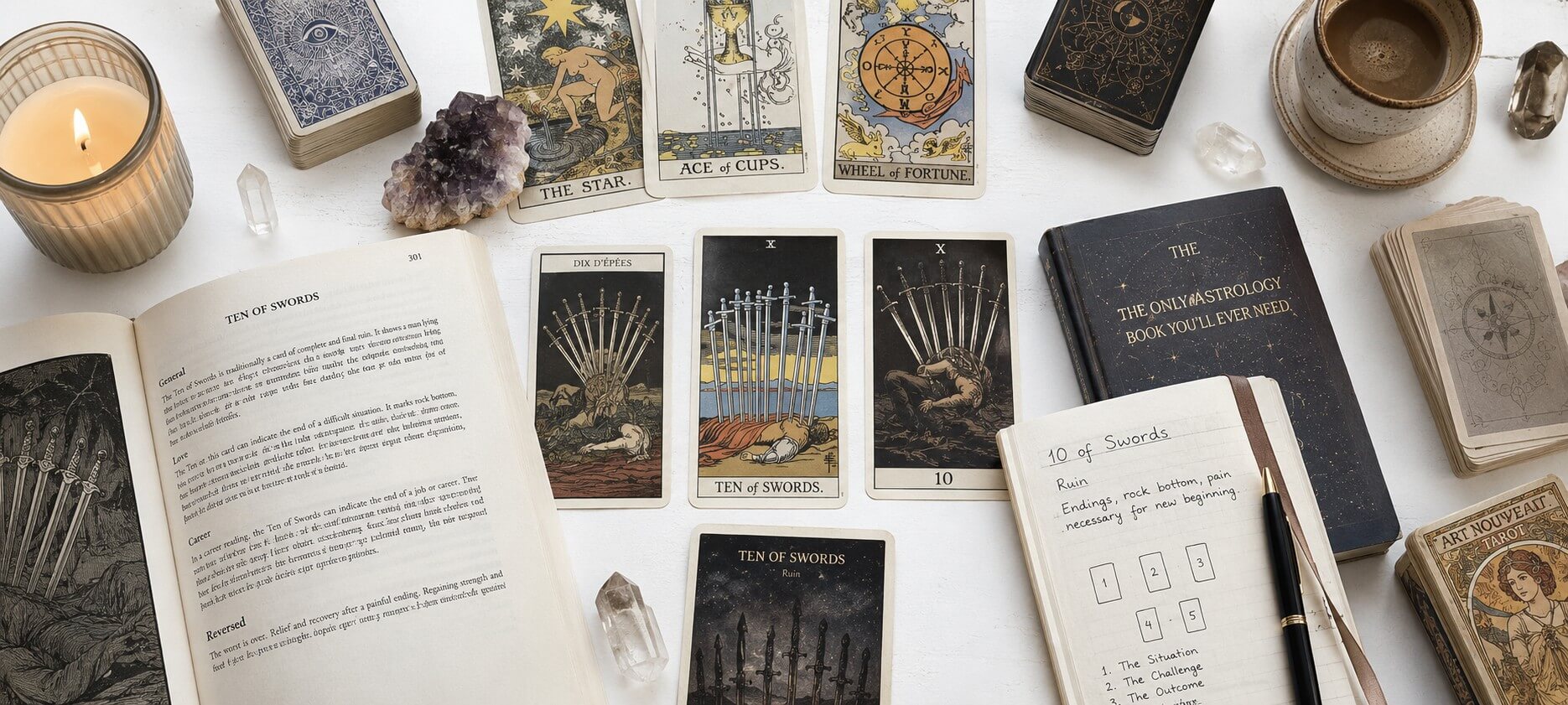
Ten of Swords — a figure lies face down on the ground, ten swords pierce the back, arranged in a fan shape. The sky is dark, stormy, almost black near the horizon. But further away, at the very edge, a narrow opening is visible — a light strip between the sea and the clouds. The dawn is already beginning. And it is already approaching the place where the body lies.
The Ten of Swords is the peak of the suit, its full manifestation. The meaning of the card is that it won't get any worse — which means things can only get better from here.
The Card in Numbers 📋
| Parameter | Value |
|---|---|
| Name | Ten of Swords / Lord of Ruin |
| Group | Minor Arcana, Suit of Swords |
| Position | Tenth card of the Suit of Swords |
| Element | Air |
| Astrological Connection | Sun in Gemini |
| Keywords (Upright) | Total completion, surrender, painful end, exhaustion, inevitable collapse, cycle completed and finished, full stop |
| Keywords (Reversed) | Recovery after collapse, slow return to life, refusal to accept the end, prolonged suffering |
Symbolism and Imagery of the Card 🖼️
On the card, a figure lies face down, ten swords piercing the back in a fan-like manner, from the neck to the lower back. The posture is completely motionless. The sky above the scene is dark and heavy, but at the very horizon, there is a narrow light strip separating the sea and the sky. The dawn begins far away, but it is beginning. ⚔️Arthur Edward Waite («Pictorial Key to the Tarot», 1910) described this card as an image of ultimate completion — a point beyond which it is impossible to fall any further. Waite drew particular attention to the light strip on the horizon: it is not accidental. This is the only card in the Suit of Swords where a clear, albeit distant, sign of a new beginning appears after a total collapse. The pain here is definitive, but not eternal.
Aleister Crowley («The Book of Thoth», 1944) gave this card the name «Ruin» and interpreted it strictly: the mind, brought to complete exhaustion by excessive analysis and anxiety, finally suffers a collapse of the structure that could no longer hold it. According to Crowley, there is a certain logic in this ruin: sometimes a system must be completely destroyed before something new and more stable can appear in its place. ☝🏽
Juliet Sharman-Burke and Liz Greene («The Mythic Tarot», 1986) associated the imagery of the card with the archetypal motif of death as a necessary predecessor of rebirth, found in the myths of many cultures. According to their interpretation, the ten swords are not a punishment, but the completion of a certain stage of a psychological cycle, after which a completely different period begins, free from those specific anxieties and conflicts that brought the situation to this point. 🏛️
Upright Meaning of the Card ✨
The Ten of Swords in an upright position is a card of complete, unconditional closure. 🌟 This is not a slight difficulty or a temporary setback — it is the exact point after which you cannot fall any further, continue, or drag things out.It could mean the end of a relationship, a project, a lifestyle, or an internal belief that can no longer be sustained. The pain is ultimate, the feeling is final. But the card carries an important paradox: precisely because things cannot get any worse, the only direction from here is up.
The card also speaks of exhaustion from prolonged struggle, anxiety, or analysis: the mind that has tried to solve the unsolvable for too long finally surrenders, not out of weakness, but out of honesty before reality. 💫
The card indicates: an ending, completion as a result. As well as the state of "that's all," "I did everything I could," "I can't do this anymore," "it's over with this."
In the upright position, the card says:
✔ The end of this stage is the finale of another chapter in your book of life
✔ This is indeed rock bottom — but hitting bottom means you can only go up from here
✔ Total completion is painful, but it frees you from what was no longer working
✔ Surrender here is not a defeat, but an honest recognition of reality
✔ The light strip on the horizon exists, even if it is not visible yet
✔ Even from the heaviest experience, a new understanding can be born
Reversed Meaning of the Card 🔄
The reversed Ten of Swords is the moment when the dawn finally reaches the place where the body lies. Or a refusal to perceive the finale as the ultimate result. 😌The first option is recovery after a collapse or a breakup. The darkest hour has passed, and although the way back to life is slow, it has already begun. This is not an instantaneous healing, but a gradual, real return of strength.
The second option is a refusal to acknowledge that the end has truly arrived. A person continues to fight a situation that is objectively already finished, not allowing themselves to go through the necessary grief and move on.
The third option is prolonged suffering, where a person remains longer than necessary, turning rock bottom into a permanent place of residence rather than a temporary milestone of passage. 👀
In the reversed position, the card says:
☑ The hardest part is over — allow yourself to notice the first signs of recovery
☑ Check yourself: have you acknowledged the end honestly, or are you still fighting what is already over?
☑ Recovery won't be fast, but it is real
☑ Do not linger at rock bottom longer than needed for honest grieving
The Ten of Swords in a Love and Relationship Reading ❤️
In a love reading, the Ten of Swords is a card of final closure: of a relationship, a conflict, or a difficult period, and this demands recognition. 💖If you are in a relationship: it is possible that something important has truly ended — a specific chapter, a form of intimacy that no longer works. The card offers no false comfort. It says: acknowledging this honestly is the only way to whatever comes next.
If you are searching: past relationships must be fully processed and concluded before opening up to someone new. The Ten of Swords reminds us: you cannot build something new in a place that has not yet been cleared of old debris.
If you came with a question about a breakup: this ending is real and definitive. But the dawn on the horizon of this card is a promise that after the darkest moment, a new, different period of life begins. 🌹
The Ten of Swords in a Career and Work Reading 💼
In a career spread, the Ten of Swords indicates the complete collapse of a project, a position, or a professional direction. 🌿This is a card of termination, failure, or the bankruptcy of an idea into which too much was invested. The pain is real and deserves acknowledgment. But the card also reminds us: sometimes a structure must completely fall apart before space opens up for something more sustainable.
It can also signify the need to completely let go of a professional strategy that objectively no longer works, no matter how hard it is to accept. Read more about frequent career queries to a Tarot reader →
The Ten of Swords in a Finance Reading 💰
In a financial spread, the Ten of Swords represents a financial crash or the utter exhaustion of resources within the current model. 💸Bankruptcy, loss of a large sum of money, a situation in which it is impossible to drag the previous strategy any further. The card acknowledges the weight of this reality but points out: it is precisely from here that a true, sustainable recovery often begins, because the old, non-working structure has finally collapsed.
The reversed Ten in finance indicates a slow but real recovery after hitting financial rock bottom, the first steps toward a new, healthier model. Learn about advantageous pricing packages →
Psychological Profile of the Card 🧠
Elisabeth Kübler-Ross («On Death and Dying», 1969) described the stage of acceptance as the final point of the grieving process — the moment when resistance to reality finally ceases, opening the way to genuine movement forward. The Ten of Swords captures exactly this point: not the moment of the blow itself, but the place of total surrender to a fact that cannot be changed, only lived through. Read more about the connection between Tarot and psychology →Viktor Frankl («Man's Search for Meaning», 1946) wrote that even in the most destructive circumstances, a person retains the last freedom — the freedom to choose their own attitude toward suffering. According to Frankl, it is precisely at the point of complete collapse that the deepest meaning is often born: not because suffering is justified, but because how a person goes through it shapes who they become next. The light strip on the horizon of the Ten of Swords is a symbol of exactly this possibility. 💡
Related Cards 🔗
This card resonates with:▷ Nine of Swords — prolonged anxiety, which reaches its ultimate peak in the Ten and is finally resolved through total completion
▷ Death (XIII) — the same theme of an inevitable end leading to transformation, but Death is an archetypal cycle, while the Ten of Swords is a specific, personal rock bottom
▷ Wheel of Fortune (X) — after the lowest position of the wheel, an ascent always follows: the same logic of cycles as in the light strip of the horizon
In difficult positions, pay attention to the combination with:
➤ The Tower (XVI) — the collapse happens suddenly and destructively, without preparation, intensifying the shock of the situation
➤ Ace of Cups — after complete closure, space appears for a new, open feeling, unburdened by previous experience
Card Advice 💬
«This is the finale. But it is always followed by something new. Dawn. Relief. A beginning.»
Frequently Asked Questions about the Ten of Swords ❓
What does the Ten of Swords card mean in Tarot? The Ten of Swords is the tenth and final numbered card of the Suit of Swords, associated with the element of Air. It symbolizes total completion, hitting bottom, and an inevitable collapse, after which recovery begins. Arthur Edward Waite («Pictorial Key to the Tarot», 1910) depicted a figure pierced by ten swords with a narrow light strip of dawn on the horizon — an image of the ultimate boundary point, followed only by an ascent. It corresponds to the Sun in Gemini.Is the Ten of Swords a good or bad card? The Ten of Swords is one of the heaviest cards in the deck in terms of imagery, but it contains a hidden hope. In the upright position, it speaks of a total, painful completion, after which it is impossible to fall any further. In the reversed position, it indicates recovery after a collapse or, conversely, a refusal to acknowledge that the end has truly arrived.
Is the Ten of Swords a "Yes" or "No"? In "Yes/No" spreads, the upright Ten of Swords means "Yes, it is indeed the end": the situation is exhausted and requires an honest closure. If the question is about the beginning of something new, ease, or comfort, then it is a "No". The reversed Ten means "Yes, but after recovery": the way forward has already begun, though slowly.
What does the reversed Ten of Swords mean? The reversed Ten of Swords has three meanings: 1) recovery after a collapse — the darkest point has been passed, a slow return of strength begins; 2) refusal to accept the end — a person continues to fight an already completed situation; 3) prolonged suffering — rock bottom turns into a permanent place rather than a temporary milestone.
What does the Ten of Swords mean in a love reading? In a love reading, the Ten of Swords is a definitive closure requiring honest recognition. For those in a relationship, a specific chapter or form of intimacy has genuinely ended. For those searching, the past must be fully grieved before a new beginning. If the question is about a breakup, the completion is real and final, but a new period of life lies ahead.
What does the Ten of Swords mean in a career reading? In a career layout, the Ten of Swords indicates the complete collapse of a project, position, or professional path: termination, failure, bankruptcy of an idea. The card acknowledges the pain but reminds us: sometimes a structure must collapse entirely before space appears for something more stable.
What does the Ten of Swords mean in a finance reading? In a financial spread, the Ten of Swords means a financial crash or the total exhaustion of the previous model: bankruptcy, a serious loss, the impossibility of continuing the old strategy. A reversed Ten in finance indicates a slow but real recovery after hitting bottom.
Why is there a light strip on the horizon of this card, unlike other dark cards of the Suit of Swords? This is a fundamental detail to which Arthur Edward Waite drew particular attention («Pictorial Key to the Tarot», 1910). The Ten of Swords is the only card of the suit where a sign of a new beginning is clearly present after a complete collapse. The pain here is final in intensity, but not in duration. Read more about Tarot card symbolism →
How does the Ten of Swords differ from Death (XIII)? Both cards speak of an inevitable end leading to transformation, but on different levels. Death (XIII) is an archetypal, universal cycle of change, applicable to almost any sphere of life. The Ten of Swords is a specific, personal rock bottom in a particular situation, narrower and more painful in feeling. Read more about the structure of a Tarot deck →
Which psychological process corresponds to the Ten of Swords? Elisabeth Kübler-Ross («On Death and Dying», 1969) described acceptance as the final stage of grief, when resistance to reality stops. Viktor Frankl («Man's Search for Meaning», 1946) added: even at the point of complete collapse, a person retains the freedom to choose their own attitude toward suffering — it is precisely here that the deepest meaning is often born.
Want to know what the Ten of Swords says about your situation? 💨
If this card appeared in your reading — something has truly reached its limit. What exactly has ended and how to go through it honestly — we will figure it out together during a live consultation. 🤗✑ Book an individual consultation, and we will look together at what the Ten of Swords says about your situation!
Minor Arcana of the Tarot