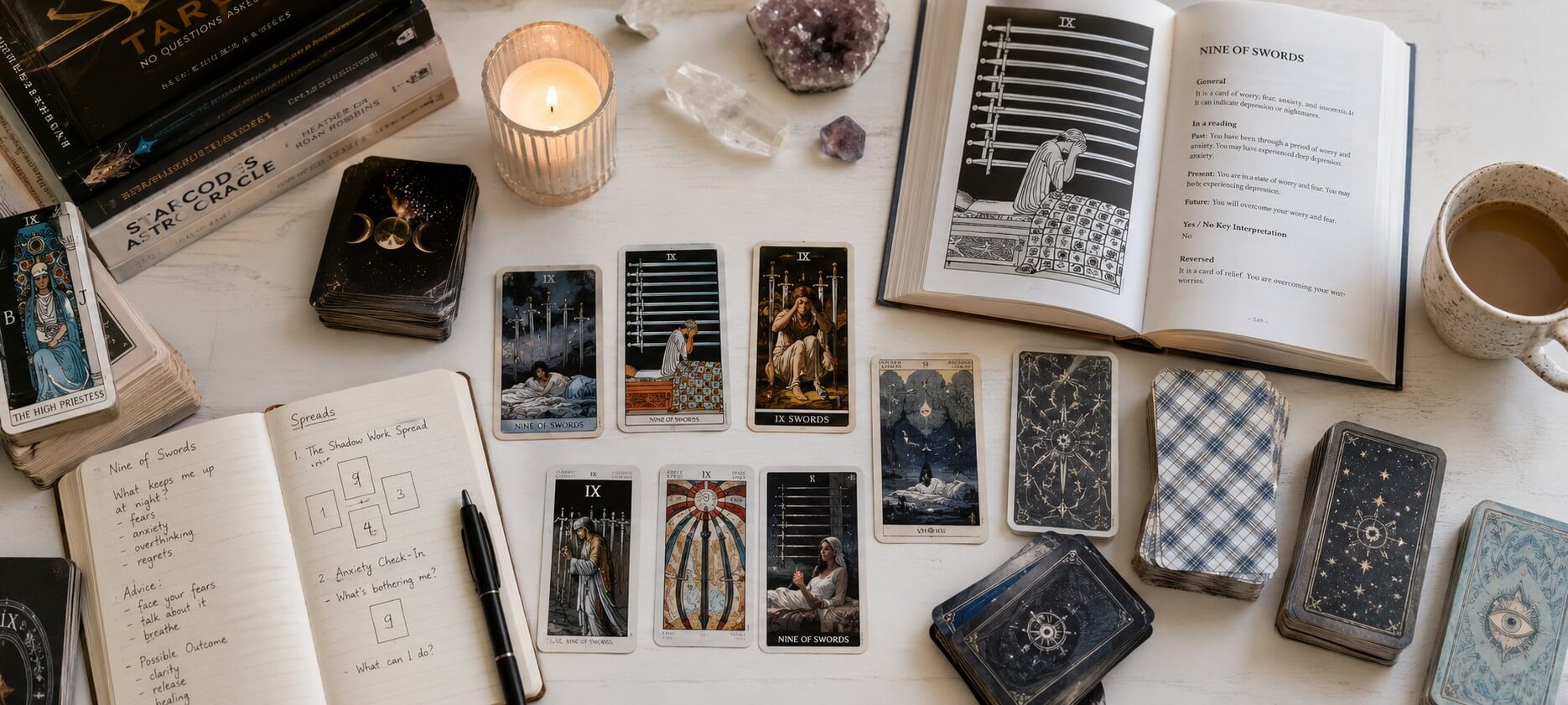
Nine of Swords — a woman sits in bed in the middle of the night, covering her face with her hands. Nine swords hang horizontally on a dark wall behind her, menacingly. Scenes of struggle and sorrow are carved onto the bedspread. Outside the window is pitch blackness, without a single glimmer of dawn. The woman is awake; she is clearly anxious or thinking intensely about something.
The Nine of Swords is the 3 a.m. of the mind. Nightmares here do not predict the future — they show how much anxiety can distort and magnify what is scary to face in the light of day.
The Card in Digits 📋
| Parameter | Value |
|---|---|
| Name | Nine of Swords / Card of Anxiety |
| Group | Minor Arcana, Suit of Swords |
| Position | Ninth card of the Suit of Swords |
| Element | Air |
| Astrological Association | Mars in Gemini |
| Keywords (Upright) | Anxiety, insomnia, nightmares, guilt, obsessive thoughts, mental anguish, fears about the future |
| Keywords (Reversed) | Relief from anxiety, seeking help, separating thoughts from reality, breaking the obsessive cycle |
Symbolism and Imagery of the Card 🖼️
On the card, a woman sits in bed, covering her face with her hands in a posture of deep despair. Nine swords are arranged horizontally on a dark wall behind her back. Scenes depicting battle and suffering are embroidered or carved into the bedspread. The room is dark and nocturnal, with no signs of an approaching dawn. ⚔️Arthur Edward Waite («Pictorial Key to the Tarot», 1910) described this card as an image of nighttime mental torment — a state in which suffering feels utterly real, even though it mostly exists only in thoughts. Waite emphasized the contrast between the static swords on the wall and the active torment of the figure: the weapons do not move, the threat is stationary — yet the mind perceives it as a looming catastrophe.
Mary K. Greer («Tarot for Your Self», 1984) pointed out the scenes of struggle depicted on the bedspread: even in sleep, even at the most vulnerable moment of rest, the anxious mind continues to re-enact conflict. According to Greer, the Nine of Swords captures that exact hour many know too well from the inside — the moment when the body is exhausted, but the mind refuses to stop. ☝🏽
Anthony Louis («Tarot Plain and Simple», 1996) linked this card to the phenomenon of rumination — the obsessive, cyclic replay of the same anxious thoughts without any progress toward a solution. According to Louis, the nine swords are not nine different problems, but the exact same anxiety viewed from nine distorting angles, each multiplying fear instead of offering clarity. 🏛️
Upright Meaning of the Card ✨
The Nine of Swords in an upright position is a card of true mental suffering. 🌟 Anxiety here is not metaphorical — it is felt physically: in the chest, in the stomach, in the inability to fall asleep or stop looping the same thought.This is a card of guilt, fear, and intrusive thoughts that strike precisely at night, when there are no daytime activities to block them. Often, these thoughts distort and exaggerate the actual threat: a situation rarely looks as catastrophic in the light of day as it feels at three in the morning.
The card does not invalidate the suffering — it is real and deserves attention. But it insistently reminds us: what feels like an inevitable disaster often turns out to be much more manageable than it seems in a moment of panic. 💫
In the upright position, the card says:
✔ The anxiety is real, but it distorts the scale of the problem — check it in the morning, not at night
✔ Looping obsessive thoughts do not bring a solution; they only drain you
✔ Feelings of guilt may be exaggerated — look at the facts, not the fear
✔ Right now, it is crucial to care for the basic peace of your body before looking for answers
✔ The energy of worry seeks an outlet through action — guide it gently
Reversed Meaning of the Card 🔄
The reversed Nine of Swords is the first glimmer of light after a long sleepless night. 😔The first variation is the relief of anxiety. The acute phase of panic begins to recede. The individual finds a way to quiet the mind — through conversation, through action, or through the simple realization that the catastrophe they imagined is not happening.
The second variation is reaching out for help. Acknowledging that you cannot handle this state alone and seeking support — from loved ones or a specialist. This is not weakness, but a necessary step toward recovery.
The third variation is a prolonged cycle of anxiety that continues despite attempts to break out of it. In this case, the reversed card is a warning: the condition requires more serious attention than just "waiting out the night." 👀
In the reversed position, the card says:
☑ Anxiety is beginning to recede — allow yourself to notice this relief
☑ It is time to seek support: from loved ones or a professional
☑ Check yourself: is the anxious cycle truly ending, or is it just temporarily numbed?
☑ Light does not just appear — sometimes you need to take a step toward it
Nine of Swords in Love and Relationship Readings ❤️
In a love layout, the Nine of Swords is a card of anxious thoughts regarding close relationships. 💖If you are in a relationship: nighttime doubts about your partner, the couple's future, or your own worth are often stronger than the real situation warrants. The card advises: before making decisions based on late-night thoughts, allow yourself to wait until morning.
If you are searching: the fear of being left alone or repeating past mistakes can grow to proportions that prevent you from seeing actual prospects. It is worth honestly separating facts from anxious projections.
If you are asking about a partner's feelings: it is possible that anxiety about their feelings stems more from your own insecurity than from actual signals. A direct conversation will clarify much more than late-night brooding. 🌹
Nine of Swords in Career and Work Readings 💼
In a career reading, the Nine of Swords indicates anxiety regarding professional instability or errors. 🌿This could manifest as a fear of termination, obsessive thoughts over a mistake made, or anxiety before an important meeting or decision. The card acknowledges the reality of stress but firmly reminds you: the scale of the catastrophe in your head is almost always larger than the actual scope of the problem.
The card can also point to burnout, where anxious thoughts about work do not let go even outside of working hours. Read more about frequent career-related inquiries to a Tarot reader →
Nine of Swords in Financial Readings 💰
In a financial spread, the Nine of Swords represents money-related anxiety that clouds clear thinking and decision-making. 💸Worry about debts, instability, or future expenses can escalate to panic proportions, especially at night. The card advises: before falling into despair, honestly count the numbers in the light of day — reality often turns out to be more manageable than an anxious imagination.
A reversed Nine of Swords in finance marks a moment when financial anxiety begins to subside thanks to concrete steps or an honest conversation with someone who can help. Learn about valuable price packages →
Psychological Portrait of the Card 🧠
Aaron Beck («Cognitive Therapy and the Emotional Disorders», 1976) described catastrophizing as one of the key cognitive distortions: the tendency to automatically assume the worst possible outcome, even when objective data does not support it. The Nine of Swords is a literal illustration of this mechanism: at night, the mind is stripped of the grounding factors of daytime reality and freely constructs frightening scenarios without testing their plausibility. Read more about the connection between Tarot and psychology →Edna Foa (studies on exposure therapy, 1980s) researched the phenomenon of intrusive thoughts and confirmed that attempting to suppress or avoid an anxious thought almost always amplifies it, whereas mindfully observing the thought without fighting it reduces its intensity. The Nine of Swords offers exactly this path: do not fight the swords on the wall, but notice that they are motionless — and that morning will come regardless. 💡
Related Cards 🔗
This card resonates with:▷ Three of Swords — acute pain which, if not processed honestly, flows into the prolonged anxiety of the Nine
▷ The Moon (XVIII) — the same territory of fear and distorted perception, but on a more archetypal, collective level
▷ Ten of Swords — the next, deeper point: when the anxiety of the Nine reaches absolute exhaustion and capitulation
In challenging positions, pay attention to combinations with:
➤ The Devil (XV) — anxiety turns into an addiction to anxious thinking as a default state
➤ The Star (XVII) — even in the middle of the darkest night, a source of quiet hope remains, if you allow yourself to notice it
Card Advice 💬
«The swords on the wall do not move. They hang there all night — motionless, heavy, but static. Morning will arrive regardless of how many times you count them.»
Frequently Asked Questions about the Nine of Swords Card ❓
What does the Nine of Swords card mean in Tarot? The Nine of Swords is the ninth card of the Suit of Swords, belonging to the Air element. It symbolizes anxiety, insomnia, obsessive thoughts, and mental suffering. Arthur Edward Waite («Pictorial Key to the Tarot», 1910) depicted a woman covering her face with her hands in bed, with nine swords on the wall behind her — an image of the mind's nighttime torments that feel more real than they actually are. It corresponds to Mars in Gemini.Is the Nine of Swords a good or bad card? The Nine of Swords is one of the heaviest cards in the deck in terms of its emotional impact, but it is not hopeless. In its upright position, it honestly acknowledges real anxiety, guilt, and intrusive thoughts. In reverse, it points to relief, seeking support, or conversely, a prolonged cycle of anxiety that requires serious attention.
Is the Nine of Swords a "Yes" or "No"? In "Yes/No" readings, an upright Nine of Swords is generally a "No, but not due to real obstacles": anxiety distorts the perception of the situation much more than the circumstances themselves do. A reversed Nine is closer to a "Yes": relief and clarity are becoming achievable.
What does the reversed Nine of Swords mean? The reversed Nine of Swords has three meanings: 1) relief from anxiety — acute panic begins to fade; 2) seeking help — recognizing the need for support from loved ones or a specialist; 3) a prolonged cycle of anxiety — the state requires more serious attention than simply waiting it out.
What does the Nine of Swords mean in a love reading? In a love reading, the Nine of Swords indicates anxious thoughts about intimate relationships. For those in a relationship, it signifies nighttime doubts, which are often more intense than reality warrants. For those searching, it is a fear of loneliness that magnifies out of proportion, blocking actual prospects. If the question is about a partner's feelings, the anxiety might stem more from one's own insecurity.
What does the Nine of Swords mean in a career reading? In a career layout, the Nine of Swords represents anxiety about professional instability or mistakes: fear of being fired, obsessive looping thoughts about a slip-up. The card acknowledges the reality of stress but reminds us that the scale of the catastrophe in our mind is almost always larger than the real scale of the issue.
What does the Nine of Swords mean in a financial reading? In a financial spread, the Nine of Swords represents money-related anxiety that prevents clear thinking. Worry about debts or instability amplifies especially at night. A reversed Nine in finance indicates a moment when anxiety begins to drop thanks to concrete steps or an honest talk.
Why are the swords on this card placed horizontally rather than driven into the ground? This is a meaningful detail. Unlike other cards of the suit where swords are driven vertically, here they hang horizontally on the wall — static and motionless. According to Arthur Edward Waite («Pictorial Key to the Tarot», 1910), this highlights the contrast between a real (static) threat and the active internal torment of the figure: the weapons do not move, yet the mind perceives them as an impending catastrophe. Learn more about Tarot card symbolism →
How does the Nine of Swords differ from the Three of Swords? Both cards speak of emotional pain, but at different stages. The Three of Swords is a sharp, specific wound: a betrayal or loss that has just occurred. The Nine of Swords is prolonged anxiety and rumination, often without a specific trigger, looping thoughts without getting closer to a solution. The Three is the moment of impact. The Nine is the sleepless night that follows. Learn more about the Tarot deck structure →
Which psychological mechanism corresponds to the Nine of Swords? Aaron Beck («Cognitive Therapy and the Emotional Disorders», 1976) described catastrophizing — the automatic assumption of the worst outcome without checking its plausibility. The Nine of Swords is a precise representation of this mechanism: the mind at night freely constructs frightening scenarios. Exposure therapy research shows that mindfully observing an anxious thought without fighting it reduces its intensity more effectively than trying to suppress it.
Want to know what the Nine of Swords says about your situation? 💨
If this card appeared in your layout, there is anxiety inside that requires gentle attention rather than being ignored. What exactly it is trying to tell you and how to separate fear from reality — we will figure out together during a live online consultation. 😌✑ Book an individual consultation and we will see together what the Nine of Swords says about your situation!
Minor Arcana of the Tarot