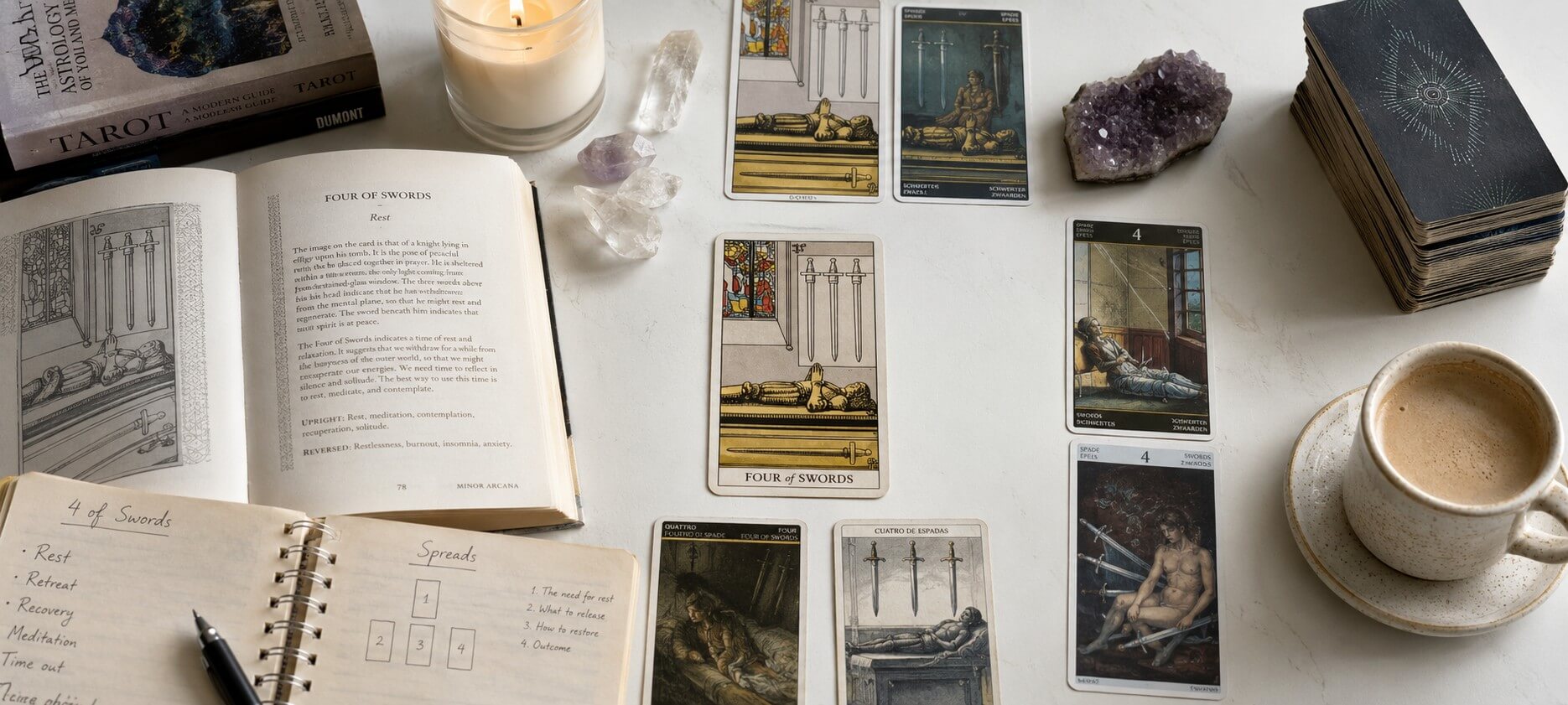
Four of Swords — a knight lies upon a stone tomb in a chapel, his hands folded in a prayerful gesture. Three swords hang on the wall above him — motionless, sheathed in the scabbards of silence. The fourth sword lies beneath the tomb, right under his body — set aside, but not discarded. A stained-glass window overhead depicts a figure blessing the scene with light.
The Four of Swords is neither an end nor a defeat. It is a pause that the mind takes on its own, because it is a necessity at this moment.
The Card in Digits 📋
| Parameter | Value |
|---|---|
| Name | Four of Swords / Four of Blades / Warning of the Universe |
| Group | Minor Arcana, Suit of Swords |
| Position | The Fourth Card of the Suit of Swords |
| Element | Air |
| Astrological Connection | Jupiter in Libra |
| Keywords (Upright) | Pause, mental silence, rest, recovery, breathing space, meditation, temporary retreat from conflict, solitude |
| Keywords (Reversed) | Forced rest, emotional exhaustion, exiting isolation, returning after a pause |
Symbolism and Imagery of the Card 🖼️
On the card, a knight is depicted in the posture of a tomb effigy: he lies motionless, his palms joined as if in prayer. Above him on the wall hang three swords, neatly arranged. The fourth sword lies horizontally beneath the body, on the tomb itself. A stained-glass window depicts a figure in a pose of blessing. ⚔️Arthur Edward Waite («Pictorial Key to the Tarot», 1910) described this card as an image of a temporary retreat from the world — not death, but the solitude required after a period of tension. Waite emphasized that the knight's posture intentionally mimics the sepulchral effigies of medieval churches — yet it is not a final sentence, but an invitation to a peace that sometimes looks like death only because modern humans have forgotten how to distinguish rest from inaction.
Rachel Pollack («Seventy-Eight Degrees of Wisdom», 1980) drew attention to the arrangement of the swords: three are hanging, while one lies beside the body. According to Pollack, this is not a permanent abandonment of the fight — it is its temporary storage. The sword is close at hand, not locked away in a distant closet: the knight hasn't fully disarmed, he has simply allowed himself not to hold the weapon in his hands right now. ☝🏽
Hajo Banzhaf («Tarot and the Journey of the Hero», 2000) viewed the Four of Swords as a necessary stop on the hero's path — a moment without which the continuation of the story is impossible. According to Banzhaf, the stained-glass blessing at the top of the card indicates that this pause is neither a punishment nor a weakness, but part of the sacred rhythm of any true journey — action is replaced by rest, and rest yields once more to action. 🏛️
Upright Meaning of the Card ✨
The Four of Swords in an upright position is a card of intentional rest. 🌟 It signifies not a flight from problems, but a conscious pause taken precisely because the mind has depleted its resources to continue fighting or analyzing.This is a card of meditation, silence, and recovery after a period of intense mental or emotional strain. The three swords on the wall — conflicts, arguments, anxious thoughts — are temporarily set aside. They haven't vanished into thin air, but right now they do not require your attention.
The card can also speak of literal necessity: sick leave, vacation, a retreat, time alone, or a seclusion required not for escaping reality, but for regaining strength before the next step. 💫
In the upright position, the card says:
✔ Mental silence is the best detox for your nervous system
✔ A pause right now is not a weakness, but a prerequisite for recovery
✔ Conflicts and anxieties can wait: give your mind a rest
✔ A time for silence, meditation, or simply doing nothing without feeling guilty
✔ Decisions reached during this period are best postponed until your strength returns
✔ Expansion comes through balance, not through non-stop effort
Reversed Meaning of the Card 🔄
The reversed Four of Swords marks the moment when the pause ends, whether voluntarily or by force. 😔The first variant is returning after recovery. Strength has been accumulated, the mind has cleared, and the individual is ready to pick up the sword again and return to an active life. This is a good sign: the pause has fulfilled its purpose.
The second variant is exhaustion that has been ignored for too long. The body and psyche are demanding rest more and more urgently, yet the person continues to suppress them. The reversed Four here serves as a warning, not a consolation.
The third variant is forced rest: illness, isolation, or circumstances that have halted a person against their will. Embracing this pause honestly is the only way to get through it with minimal losses. 👀
In the reversed position, the card says:
☑ It is time to act again — the rest has served its purpose
☑ Double check: are you actually resting, or just putting off inevitable burnout?
☑ Peace imposed by circumstances can still be beneficial if you accept it
☑ The isolation has dragged on longer than necessary: it's time to step back out
Four of Swords in Love and Relationship Readings ❤️
In a love reading, the Four of Swords is a card of emotional breathing space within a relationship. 💖 A moment or state of mental pause, solitude, or internal distance following a conflict, dynamic events, or before making an important commitment.If you are in a relationship: perhaps both of you need a break — not from each other, but from the intensity of recent events. The card does not mean a breakup. It speaks of the need for quiet, where you can catch your breath and gather your thoughts before continuing the conversation.
If you are searching: now is not the time to force new acquaintances. Give yourself time to recover from past experiences, illness, or depression — openness will return naturally once your inner resources are restored.
If you asked about your partner's feelings: they are currently in a state of internal retreat and distance — not from you personally, but from emotional pressure as a whole. Offering them space and time right now is far more important than demanding immediate closeness. 🌹
Four of Swords in Career and Work Readings 💼
In a career layout, the Four of Swords signifies the necessity of taking a break after an intensive period. A temporary lull to map out your next move. 🌿This could mean a literal vacation, a day off, sick leave, or just a day without emails and meetings. The card states directly: productivity is currently impossible without recovery — trying to forge ahead on an empty tank will only lead to mistakes, not results.
The card can also indicate a strategic pause before an important decision: do not rush your response to an offer or a conflict — let your thoughts settle down. Read more about frequent career requests to a tarot reader →
Four of Swords in Financial Readings 💰
In a financial layout, the Four of Swords represents a pause in making financial decisions that actually works to your advantage. A temporary financial quiet or mapping out a plan, a strategy, or your next move regarding money. 💸The card advises against making major monetary decisions right now — put off investments, large purchases, or loan negotiations. Not because they are inherently bad, but because your current emotional or mental exhaustion prevents you from evaluating the situation objectively.
A reversed Four in finance indicates it is time to return to active budget management after a period of forced or voluntary inactivity in money matters.
Psychological Portrait of the Card 🧠
Herbert Benson («The Relaxation Response», 1975) described a physiological mechanism opposite to the \"fight or flight\" response: a state of deep rest in which the nervous system restores the resources depleted during stress. The Four of Swords is the image of exactly this state, taken to its symbolic limit: the body is still, respiration is slowed, and the mind is temporarily disconnected from external stimuli. Read more about the connection between Tarot and psychology →Anthony Storr («Solitude: A Return to the Self», 1988) wrote that the capacity for productive solitude is not a pathology, but a necessary psychological resource that modern culture systematically undervalues. According to Storr, periods of seclusion and apparent inaction are often the very times when the deepest internal integration of experience takes place. The Four of Swords in this sense is not emptiness, but hidden work: the sword set aside remains necessary — just not at this very second. 💡
Related Cards 🔗
This card resonates with:▷ Three of Swords — the pain that triggers the need for recovery: the Four is the natural and necessary continuation of this process
▷ The Hermit (IX) — the same theme of intentional solitude, but the Hermit chooses it as a way of life, while the Four uses it as a temporary measure
▷ Four of Cups — a similar theme of a pause, but the Cups represent emotional satiation, whereas the Swords represent mental exhaustion
In complex positions, pay attention to combinations with:
➤ Nine of Swords — a temporary pause leads to anxiety that refuses to let go, even at night
➤ Wheel of Fortune (X) — the pause drags on longer than planned due to external circumstances beyond the individual's control
Card's Advice 💬
«The sword is close at hand — not forgotten. It is simply waiting until you restore your strength to hold it once more. Give yourself this time.»
Frequently Asked Questions About the Four of Swords Card ❓
What does the Four of Swords card mean in Tarot? The Four of Swords is the fourth card of the Suit of Swords, element of Air. It symbolizes intentional rest, recovery, and a temporary retreat from conflict or mental tension. Arthur Edward Waite («Pictorial Key to the Tarot», 1910) depicted a knight in the posture of a tomb effigy with three swords on the wall and one under his body — an image of a necessary pause, not a defeat. It corresponds to Jupiter in Libra.Is the Four of Swords a good or bad card? The Four of Swords is an inherently favorable card, even though it can look concerning visually. In the upright position, it speaks of a healthy, necessary rest after a period of tension. In the reversed position, it indicates either the completion of this pause and the return of strength, or a prolonged exhaustion that has been ignored for far too long.
Is the Four of Swords a \"Yes\" or \"No\"? In \"Yes/No\" layouts, the Four of Swords in the upright position means \"Wait\": now is not the time for active steps, a pause is required before a decision. A reversed Four is closer to a \"Yes\": strength is restored, and you can move forward.
What does the reversed Four of Swords mean? The reversed Four of Swords has three meanings: 1) returning after recovery — strength is accumulated, it's time to act again; 2) exhaustion that was ignored for too long — the body and mind demand rest more urgently; 3) forced rest — illness or circumstances have halted the person against their will.
What does the Four of Swords mean in a love reading? In a love reading, the Four of Swords represents an emotional breather or distance in the relationship. For those in a relationship, it is the need for a break from the intensity, not from the partner. For those searching, it is a time to restore oneself before a new opening. If the question is about a partner's feelings, they are in a state of internal retreat from the overall pressure.
What does the Four of Swords mean in a career reading? In a career layout, the Four of Swords means the need for a break after an intensive period: a vacation, sick leave, or simply a day without a heavy workload. The card explicitly states that productivity is impossible without recovery. It can also mean a strategic pause before an important decision.
What does the Four of Swords mean in a finance reading? In a financial reading, the Four of Swords is a recommendation not to make major financial decisions right now: current exhaustion prevents you from seeing the situation objectively. The reversed Four in finance is the time to return to active budget management after a pause. Learn more about beneficial consultation packages →
Why is the knight on the card depicted as a tomb effigy? This is an intentional artistic device. According to Arthur Edward Waite («Pictorial Key to the Tarot», 1910), the posture mimics medieval sepulchral sculptures, but the card speaks of solitude and repose, not death. The outward resemblance to the peace of the deceased emphasizes the depth of the required rest — so complete that from the outside it may look like life has stopped, whereas in reality, it is being restored. Find out more about Tarot card symbolism →
How does the Four of Swords differ from The Hermit (IX)? Both cards speak of solitude, but with a different nature and duration. The Hermit (IX) chooses isolation as an intentional way of life, seeking meaning through a long journey inward. The Four of Swords is a temporary measure: a pause taken after specific exhaustion, with a clear intention to return to activity. The Hermit walks. The Four of Swords stops in order to walk again later. Learn more about the structure of a Tarot deck →
What psychological process corresponds to the Four of Swords? Herbert Benson («The Relaxation Response», 1975) described a physiological relaxation response opposite to stress mobilization — a state where the nervous system restores spent resources. Anthony Storr («Solitude: A Return to the Self», 1988) added that the capacity for productive solitude is a necessary psychological resource, undervalued by modern culture. The Four of Swords is a symbolic image of this exact process: visible immobility as hidden internal work.
Want to Know What the Four of Swords Says About Your Situation? 💨
If this card appeared in your reading — you or the situation need a pause right now. What exactly it means and how much time should be allocated to it — we will figure out together during a live consultation. 🤗✑ Book an individual consultation and we will look together at what the Four of Swords says about your situation!
Minor Arcana of the Tarot