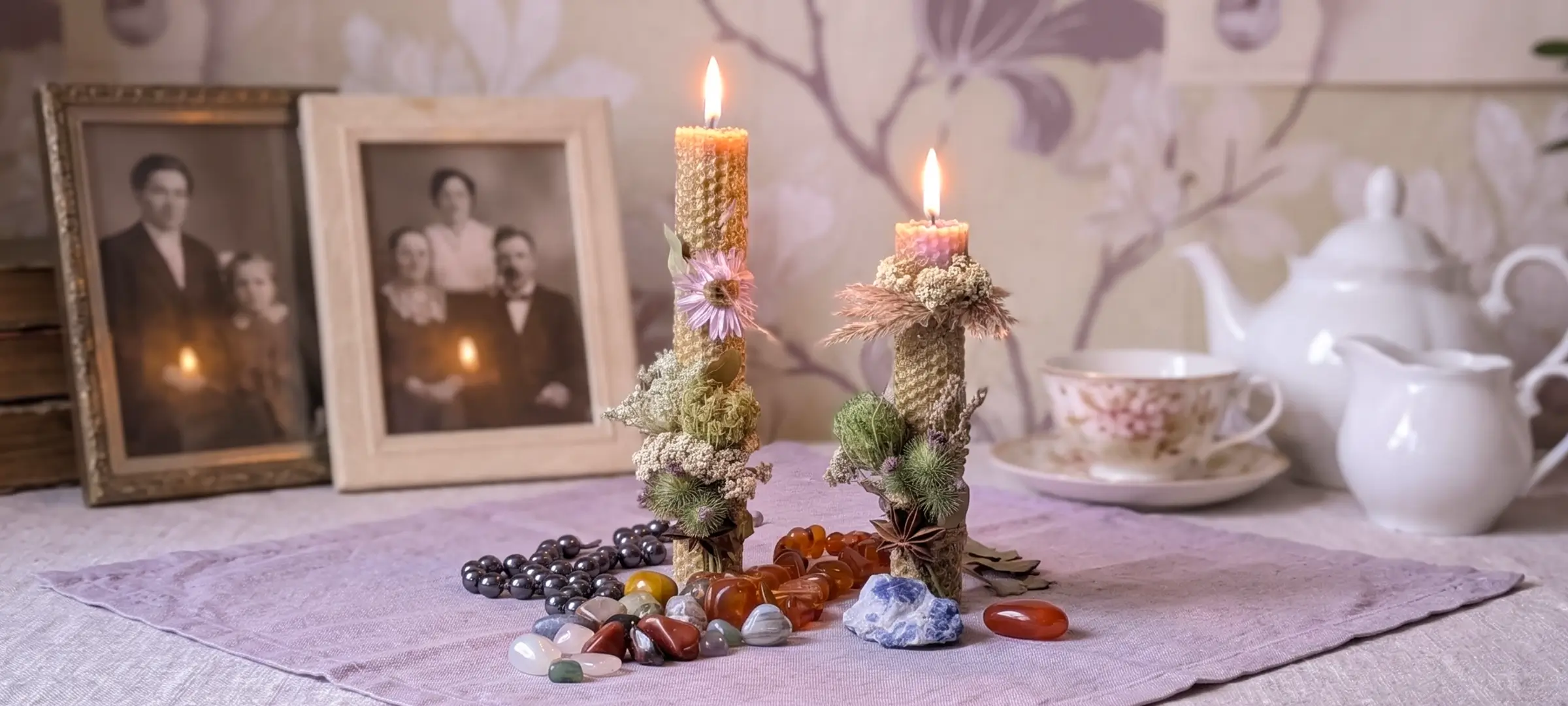
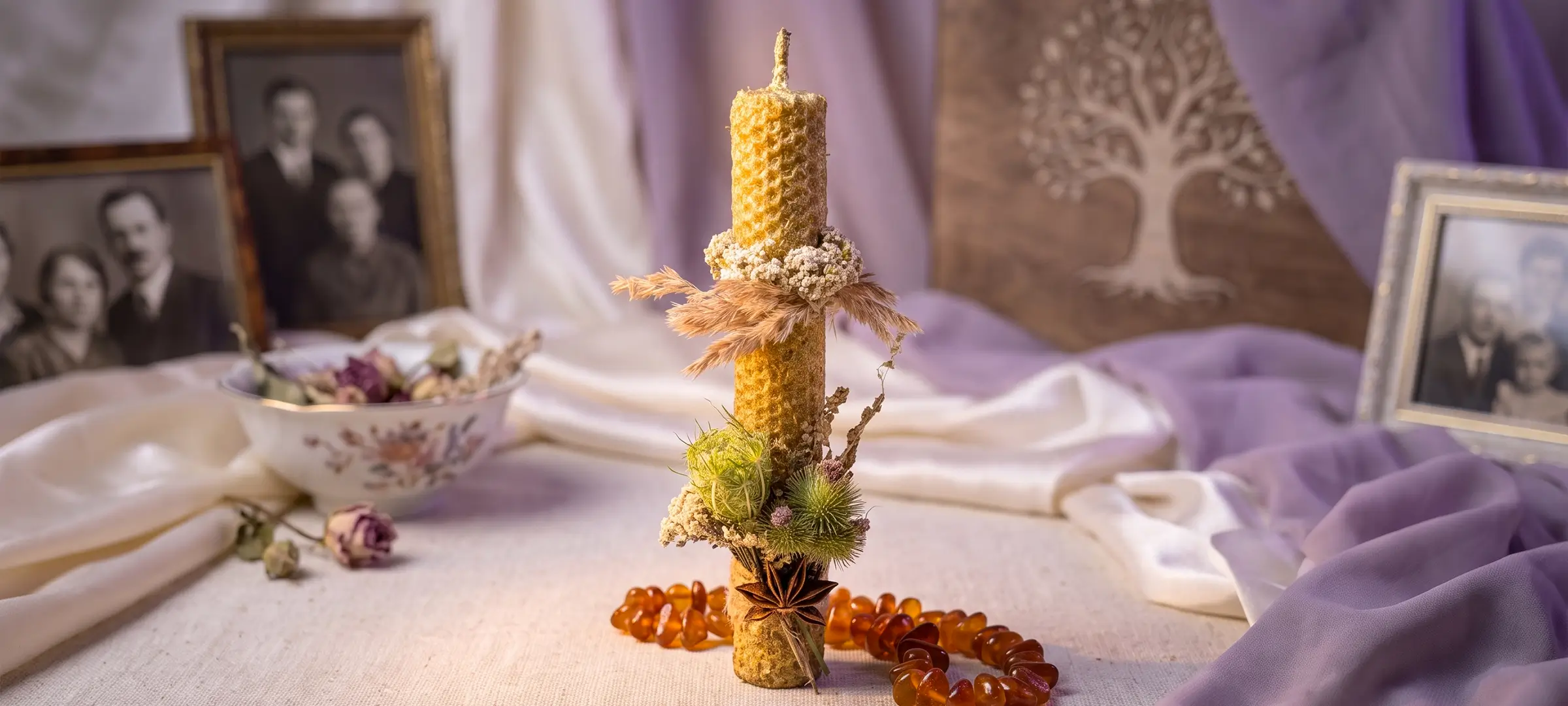
This is one of the directions in the Beeswax Sheet Candles section — the deepest practice that requires mindfulness. In tradition, working with memory and the departed is built on strict laws. Fire in such rituals acts not merely as a tool for experiencing emotions, but as a powerful transformer. It cleanses the information field of generational memory from emotional distortions and unresolved blocks, helping to transform grief into a resource and restore connection with the power of ancestors standing in the ancestral line behind your back — those who came before you, those from whom you were born.
Therefore, an Ancestral and Remembrance candle is not just decor or a way to distract yourself, but a powerful sacred tuning tool. It requires mindfulness, respect for system laws, and a clear understanding of why you are turning to your roots.
What's Inside the Ancestral Candle 🕊️
The composition of herbal components, herbs, essential oils, and spices for Ancestral and Remembrance candles is selected not by aroma, but by energy-information properties and centuries-old tradition of working with the boundaries between worlds and ancestral bonds:| Herb | Symbolic Meaning |
|---|---|
| Immortelle | Traditional guide between the world of the living and the departed |
| Black elderberry | Associated with the mystery of transition, life and death cycle |
| Horsetail | Anchoring energy in the physical world |
| Yarrow | Strengthening and stability of the lineage |
| Wormwood | Cleansing the ancestral channel from external noise |
| St. John's wort, juniper, sage | Removing alien blocks, freeing the connection channel |
All components are layered into beeswax sheets not for decoration: as they smolder, they release dense smoke that in tradition is viewed as a space-structuring element (smoke builds the boundaries of the ritual field and cuts off external interference). Meanwhile, live fire serves as the main active transformer, while pure wax, as a natural accumulator and matrix, holds the form and conducts the energy-information signal.
💡 Important: the fixation itself through formulation — address, gratitude, invocation of roots — reflects the order of interaction with the Lineage system, where respect and a clear vector of intent are key, rather than a simple request.
👉 View and select Family and Memory candles on shop online →
Tradition: Specific Remembrance Days in Slavic Culture 📅
Addressing the Lineage through fire is not an abstract idea, but part of a real ritual tradition. In Slavic culture, honoring ancestors is strictly tied to key turning points in the Wheel of the Year. As a systemic approach shows, remembering ancestors is embedded in all major holidays of the annual cycle:🍂 Mabon (Autumn Equinox) — September 21–23: Slavic Tausen (OVSEN). The point of summarizing the year's cycle, direct gratitude to ancestors for the harvested crop, and setting results.
🕯️ Samhain — October 31 – November 1: Slavic Autumn Dziady. A time of maximum convergence of worlds and close remembrance of departed kin, when lineage protection is set for the dark half of the year.
❄️ Yule (Winter Solstice) — December 20–22: Slavic Kolyada (Svyatki). The turning of the annual wheel, birth of new light, honoring ancestor memory, and revising lineage programs for the next cycle.
🌨️ Imbolc — February 1–2: Slavic Gromnice (Sreteniye). A turning point of winter and cleansing, where work is done through ancestral connections to release inner energy and purge destructive programs.
🌱 Ostara (Spring Equinox) — March 20–22: Slavic Komoeditsa (Maslenitsa). Awakening of nature, turning to ancestor power for blessing new beginnings and updating links within the Lineage structure.
🌸 Spring Remembrance Cycle — Tuesday of Saint Thomas Week (9th day after Easter): Slavic Radonitsa. A traditional day for general spring ancestor remembrance, when the living «rejoice» together with the departed, sharing news of awakening life and strengthening lineage roots.
🌷 Beltane — April 30 – May 1: Slavic Zhiva's Day (Krasnaya Gorka). Peak period of nature and elemental power, when a resource for creation and active realization is grounded through the ancestral vertical.
🔥 Kupala / Litha (Summer Solstice) — June 20–22: Slavic Ivan Kupala holiday. Peak annual activity, maximum concentration of fire energy, cleansing of structure, and unification with the power and tradition of the Lineage.
🌾 Lammas / Lughnasadh — August 1–2: Slavic Sposhinki (First Spas). Time of first fruits, expressing gratitude to ancestors for material support and daily bread.
An Ancestral and Remembrance candle fits naturally into these key moments of the Wheel of the Year. Furthermore, it is appropriate and proper to light it on personal memorial days established by family tradition or personal necessity: at 9 days, 40 days, six months, one year after the loss of a loved one, on their birthday, or any other personal memory days when a need arises to restore the vertical and organize ancestral ties.
Ritual Meal and Commemoration 🍽️
On ancestor veneration days — whether key points of the Wheel of the Year or personal memorial dates — tradition prescribes a special format for interacting with the ancestral structure. The meal table for the departed is set separately from the living: treats are traditionally placed on a windowsill or a small separate table.Before beginning the meal, windows or doors are opened, the head of the family lights a candle and invites the souls of the lineage to the table. Some food and drink are always left on the windowsill overnight for the ancestors. At the family table during this time, it is customary to remember departed relatives with kind words, speak about their deeds and history, consciously strengthening the vertical of generations.
Tradition and Meaning of Memorial Practice 🕯️
According to tradition, an Ancestral candle is not just memory, but an active bridge: a way to address ancestors, thank them, ask for support, or root a broken connection with origins.Here it is worth mentioning how modern grief psychology views this topic. For a long time, it was believed that healthy grieving meant «letting go and moving on», severing ties with the deceased.
💡 Important: however, researchers Dennis Klass, Phyllis Silverman, and Steven Nickman in their fundamental work «Continuing Bonds: New Understandings of Grief» (1996) proved otherwise: stable, healthy grief processing more often involves not severing the connection, but redefining and preserving it in a new form. The Ancestral candle operates precisely on this logic — not a «farewell forever», but maintaining a living, continuing connection.
Additionally, one can draw support from Carl Gustav Jung's concept of the collective unconscious: ancestral memory lives not only in specific facts and names, but is passed between generations on a deeper, symbolic level of the psyche. Thus, reaching out to the Lineage works even when you don't know specific names and histories of your ancestors.From a neutral scientific perspective on rituals, the same effect is confirmed by research by Norton & Gino (Journal of Experimental Psychology: General, 2014): symbolic farewell and memory rituals decrease grief intensity, even when a person rationally understands that the ritual changes nothing in the external world.
When They Are Used 🕯️
🕯️ On the anniversary of a loved one's departure — as a moment of conscious memory;📅 on ancestor veneration days according to the Wheel of the Year (Tausen, Autumn Dziady, Kolyada, Gromnice, Komoeditsa, Radonitsa, Zhiva's Day, Ivan Kupala, Sposhinki) or on personal memorial days (9 and 40 days, six months, one year, birthday of a departed ancestor or loved one);
🧬 when a severed connection with the Lineage is felt — knowing little about ancestors and lacking a sense of grounding in roots;
🙏 during challenging life situations — as an appeal to the Lineage for support.
The practice is well complemented by a genuine interest in your family tree — attempting to learn names, stories, and places where your family comes from. This is not a mandatory requirement for working with candles, but a natural and pleasant continuation for those who feel called to it.
How to Light Correctly ✅
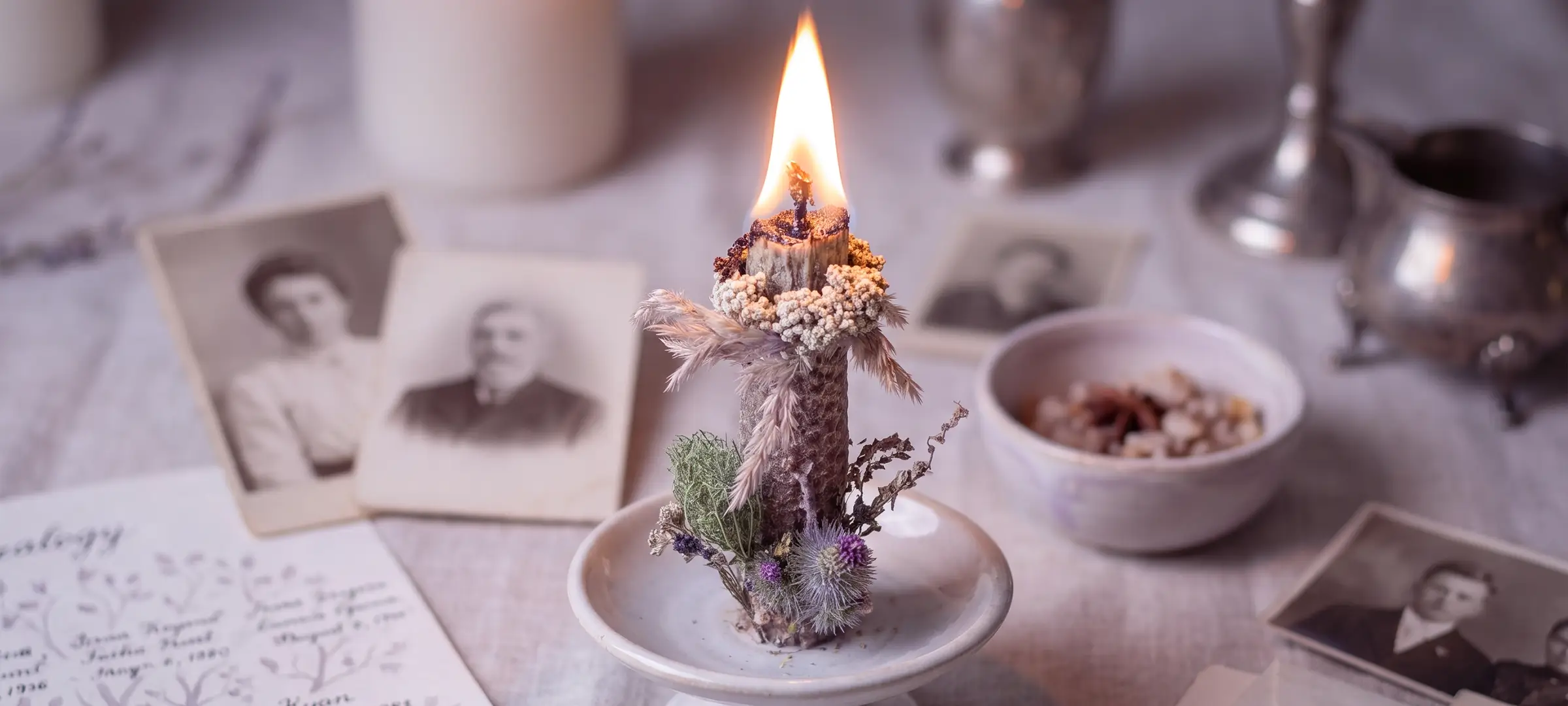
Working with the Lineage is not a mechanical recitation from a piece of paper, but restoring a lost vertical of memory. The power of the Lineage relies on the mindfulness of the living. Reaching out to ancestors requires sincerity, understanding your connection with roots, and responsibility to future generations, rather than repeating memorized formulas without understanding their essence.Candles with dense herbal coating, programmed and ancestral, burn brightly and hot, similar to a torch. Such a process must not be interrupted halfway through. The program initiated by fire must burn out completely; it is not forcibly extinguished or put out. Therefore, you should light such a candle only when you are certain you have time to remain present from the first spark to the last.
💡 Important: safety rules: due to abundant herbs and active burning, always use a wide heat-resistant container with raised edges, lined with multiple layers of foil, and a heat-proof stand underneath. Full guidelines on dishware and stands can be found in a separate article Safety and Dishware →
Respect for elements and space: tradition requires complete burning of the candle. For Ancestral candles, the rule is firm — this is open work with fire from beginning to end.
Proper disposal and return to Earth: remnants of wax and herbs left after the ritual must never be thrown into household trash. Since work was performed with elemental energy and ancestral forces, material remnants are returned to the Earth element — buried under a tree, in a garden, or in a forest with gratitude to the Earth, symbolically closing the circle.
Ancestral or Cleansing Candle: What's the Difference ⚖️
Both burn with a torch-like flame and both belong to strong, intent-driven practices — but their purpose and tasks differ. A cleansing candle always works to remove negativity, sever destructive programs, and purge alien influences from a person's energy contour or space. An Ancestral candle works for connection and strengthening: to restore, support, and root the bond with ancestors and the Lineage system.If you are unsure which matches your request better, use this guideline: if you want to eliminate negativity and cleanse space or your energy field — cleansing candle; if you want to strengthen connection with your Lineage, honor ancestors, or receive support — Ancestral candle.
Myths About Ancestral Candles ❌
⛌ Myth: You can only address the Lineage on remembrance days.Reality: Tradition allows reaching out at any moment when an internal need matures — not only on calendar dates like Radonitsa or Dziady.
⛌ Myth: If you know little about your ancestors, this practice isn't for you.
Reality: Working with Lineage does not require exact names or dates — tradition addresses the Lineage as a whole, rather than only specific known figures.
⛌ Myth: An Ancestral candle is a sad, heavy practice.
Reality: It is a very beautiful, uplifting practice that includes gratitude and requests for support — not just remembering loss, but strengthening connection with the resource that Lineage offers to those living today.
Read more common misconceptions about ritual candles in our general article Candle Myths →
Frequently Asked Questions ❓
Is it okay to light an Ancestral candle if acute grief is still very fresh? The candle can be part of processing this state, but it does not replace the support of loved ones or a specialist — use it as a supplement, especially in the early days after a loss. If grief persists for a long time, it is a reason to seek professional support.Is it necessary to know specific names and history of ancestors? No, connecting with your Lineage does not require exact data — tradition allows addressing the Ancestors as a whole, and from Jung's perspective, ancestral memory lives in the psyche at a symbolic level, beyond specific facts.
Isn't it believed that after a loss one should «let go and forget»? This is an outdated view. The study by Klass, Silverman & Nickman (1996) «Continuing Bonds» showed that healthy grief processing more often involves preserving and redefining the bond with the deceased rather than severing it — this is the exact principle behind the Ancestral candle.
Are there specific traditional days for this practice? Yes, in Slavic tradition, these are ancestor veneration days according to the Wheel of the Year (Tausen, Autumn Dziady, Kolyada, Gromnice, Komoeditsa, Radonitsa, Zhiva's Day, Ivan Kupala, Sposhinki) or personal memorial days (9 and 40 days, six months, one year, birthday of the deceased ancestor). However, you can light an Ancestral candle at any moment when an inner need arises.
How does an Ancestral candle differ from a cleansing candle? Both burn with a torch-like flame, but a cleansing candle works to sever negativity, while an Ancestral candle works for connection and strengthening the Lineage.
What should be done with the candle remnants after it burns out? By tradition, the candle stub and herb remnants are buried in the ground — near a tree, in a garden, or in a forest, rather than thrown into regular trash.
Is it safe to light such a candle at home? Yes, when following torch-burning safety rules: wide heat-resistant dishware, a heat-proof stand, and constant supervision of the flame. Read more in the section Safety and Dishware →
Can an Ancestral candle be used alongside a Tarot spread? Yes, this is a common practice — for example, after a reading regarding ancestral patterns or family heritage, to physically ground the intention to change a repeating pattern. You can try a reading at Online Tarot Reading →
Choose Your Candle 🕯️
Ancestral and Remembrance candles from this section are hand-rolled from pure beeswax sheets with immortelle, black elderberry, wormwood, and other herbs for ancestral connection. If the themes of lineage, memory, or grounding resonate with you right now — start with them.👉 View Ancestral and Remembrance candles in the store →
If you feel that your situation requires a deeper conversation and analysis of an ancestral scenario — I invite you to a Tarot consultation, where we will explore the situation together, while our article How to Choose a Candle → will help you decide on your selection.
All about designer, ritual candles →