Myth: A candle solves the problem on its own, without human involvement ❌
Reality: A candle is not an autonomous wish-fulfiller, but a conduit and a focus point for your will. Wax and fire channel and concentrate energy, linking your will to the result. However, triggering the process, making the internal decision, and taking action depend entirely on you. Not being a magic wand, but serving as a powerful tool, a candle amplifies your intention, while you do all the core work.Myth: The more expensive the candle — the «stronger» it is ❌
Reality: The price of a candle primarily depends on the practitioner’s invested life energy and hours of manual labor, as well as the cost of natural raw materials (beeswax foundation, wick, herbs, essential oils, spices, roots, jute, hemp, wool, burlap).A harmonizing candle and a programmed candle cost differently not because one is stronger than the other, nor because one is larger and the other smaller, but due to different tasks and varying energy demands in crafting.
Myth: Any handmade candle works the same way, regardless of the practitioner ❌
Reality: Every practitioner has their own unique handwriting, individuality, and author style. The composition, proportions of herbs, incantations, intentions, and goals are not an impersonal assembly line, but a deep creative process.💡 Important: Such work fundamentally cannot be mass-produced, as it is crafted by a single person, and human potential does not work like a stamp. The practitioner invests a part of their life and soul into the work, creating a unique energy footprint that, much like human DNA, cannot be copied or replicated identically — every candle is unique.
Myth: If a candle wasn't bought directly from the practitioner, it «doesn't work» ❌
Reality: Physical presence during purchase is not a prerequisite for a candle to work. During the crafting stage, the practitioner embeds the foundation into the product — the core theme, pure intention, and program vector.This can be compared to how an author sets the main theme of a future book, but you write the story and text of your own life in the process. The delivery method — hand-to-hand, by mail, or through the website showcase — makes no difference, as the embedded potential is activated by your own action and intention.

Myth: An extinguished candle can be relit, and it’s the exact same as a new one ❌
Reality: It all depends on the circumstances. If you intentionally extinguished the candle and put it aside, the program resets, and going forward, such a candle can only be used as a regular one, as interrupting ritual work is not recommended.However, if the candle went out on its own right during the ritual while your intention was engaged — it is a direct signal from space: there is resistance in the field, and you touched upon the very trigger that needs to be worked through. In that case, you need to relight the candle, reinforce your intention, continue the work, and make sure to bring it to completion. Read more about this in the article Candles for Cleansing and Protection.
Myth: Natural beeswax candles are a modern trendy fad ❌
Reality: It is quite the opposite. Paraffin — the most common material for store-bought candles — was discovered by chemist Karl Reichenbach only in 1830. Beeswax candles existed thousands of years prior: in medieval Europe, due to the high cost of wax, they were used predominantly in church services and in homes of the wealthy, whereas poorer populations burned cheap tallow candles.💡 Important: Historically, paraffin turned out to be the «trendy fad» for the mass market, not beeswax — wax is, on the contrary, the most ancient and original candle material. Today's surge of interest in it is linked to the fact that a massive flow of deep knowledge has entered the public domain, leading people to consciously return to the age-old traditions of their ancestors, rooted deep in pre-Christian times.
Myth: A black candle is always about evil and curses ❌
Reality: The color black in candle work is a powerful tool for absorption, cleansing, and transformation, not a symbol of evil. In the tradition of proper wax work, a black candle acts like an energetic «vacuum cleaner» or shield: it absorbs negativity, draws out destructive programs, helps break old unnecessary attachments, cuts off foreign influences, and protects the space. Equating black strictly with harm is a superficial view of those far from actual practice and the laws of elemental magic.
Myth: You need to know special magical words, otherwise the candle won't work ❌
Reality: The point is, it is not about blindly memorizing foreign or dead formulas without understanding their meaning, and a candle does not work like a magic wand from random «abracadabra». Meaningless mechanical reading of someone else's texts yields no results.What is needed is not a set of empty magic terms, but your personal working algorithm grounded in your inner essence, where you construct the formula yourself. The power of a candle and ritual is driven by a proper sequence of actions combined with your personal intention and awareness.
Why herbs or colors «mean» anything at all 🌿
It is worth explaining the very principle upon which component selection is built. British anthropologist James George Frazer, in his classic work «The Golden Bough» (1890), described the principle of sympathetic magic — the idea that an object or plant possessing a certain quality (a soothing scent, a sharp leaf shape, a distinct color) is symbolically linked to a result resembling that quality.💡 Important: In East Slavic and Northern traditions, this law of similarity has always been foundational: herbs, resins, and colors were selected based on centuries of ancestral experience and natural laws. This exact principle underlies the traditional selection of components for various candle practices — not as an arbitrary decision, but as a stable cultural mechanism found across diverse traditions worldwide.
Myth: Only women or «initiates» can work with candles ❌
Reality: In no serious tradition of candle practice is gender or practitioner status a requirement. It is a tool for focusing attention and intention, accessible to anyone who approaches the practice mindfully.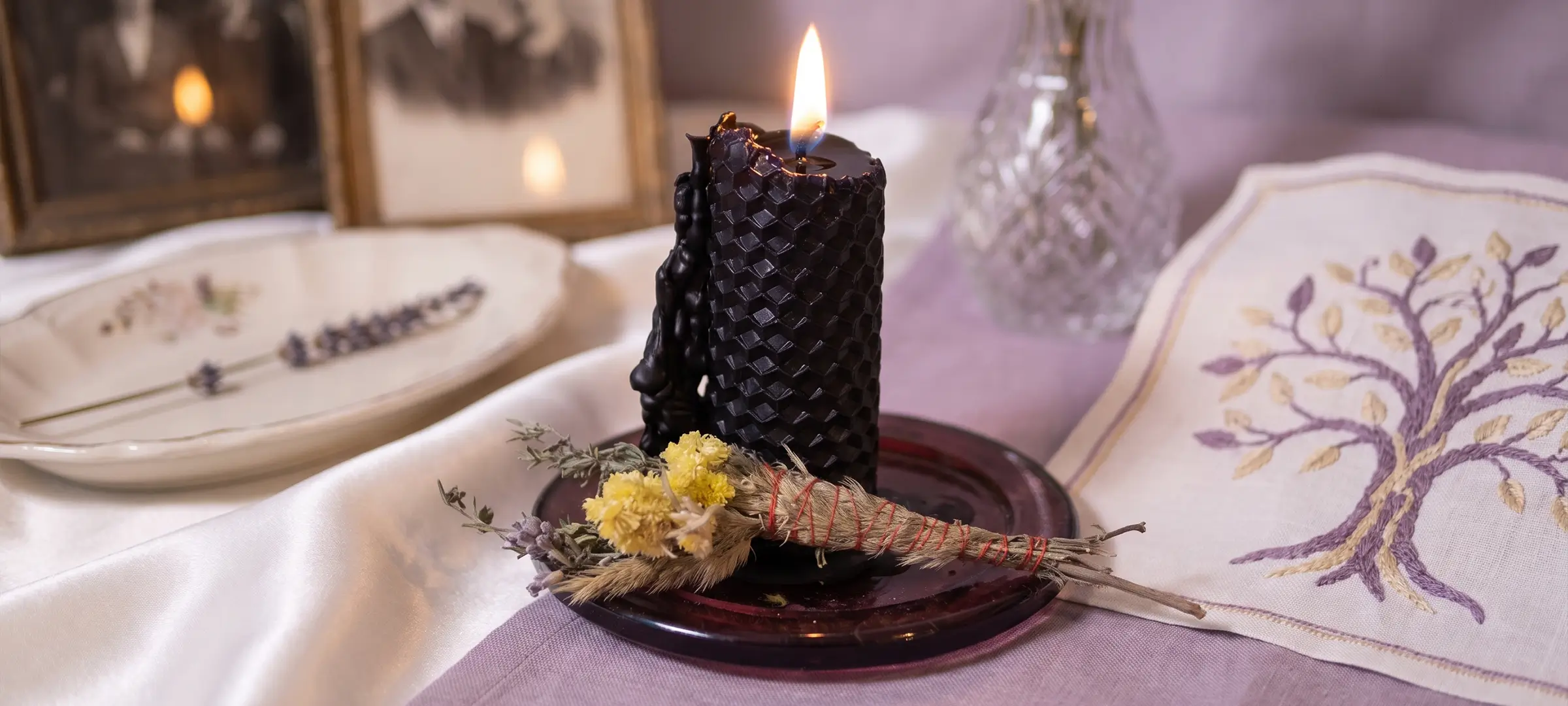
Frequently Asked Questions ❓
Does a candle work if I don't believe in the tradition it originates from? It is not about belief, but about the laws of energy exchange and process mechanics. In proper candle work, there is no abstract blind belief — there is a working algorithm where your intention connects with the element of fire and properties of wax. The tool engages your focus, will, and physical action. If you clearly understand the objective and follow the sequence, the process activates and produces results regardless of your initial beliefs.Is an expensive candle truly more effective than a cheap one? No. The price reflects material quality and practitioner labor, not the «power» of the candle. What matters more is how well the composition and direction align with your specific task.
Can I relight a candle that has partially burned and gone out? If the candle extinguished spontaneously during practice with an already set intention, it must be relit to continue the practice all the way to the end. In tradition, a candle should burn down completely, as it represents a unified and finished process. Consciously interrupting and extinguishing it is acceptable only in specific cases — such as during prolonged meditative work or multi-session harmonizing courses, but for one-off tasks, a new candle should be used, as the used one has already completed its cycle.
Are beeswax candles truly a new-fashioned alternative to regular ones? No, quite the opposite: paraffin was discovered only in 1830, while beeswax candles were used thousands of years prior — in the Middle Ages, they were an even higher-status and more expensive material than mass-produced tallow candles.
Does the color black in a candle signify something bad? No, in classic candle magic, black is more commonly linked to protection and completion rather than an intent to harm — the color carries no inherently «evil» meaning.
Do I need to recite special incantations for the candle to «work»? No. Clarity of intention and focus matter far more than an exact formula of words.
Why are specific herbs or colors linked to specific tasks? This is the principle of sympathetic magic described by anthropologist James Frazer in «The Golden Bough»: an object with a specific quality is traditionally linked symbolically to a similar outcome — it is a established cultural mechanism, not a random choice.
Is it mandatory to be a woman or an «initiate» to work with candles? No, gender and practitioner status are not prerequisites in any serious tradition — it is a tool accessible to anyone.
Are ritual candles strictly an esoteric practice? No, the use of fire in a ritual context is found across virtually all religious and cultural traditions — it is not an isolated esoteric idea, but a universal human practice.
Are there myths specific to particular directions? Yes, each page in this section breaks down myths related to its own specific focus — harmonization, cleansing, chakras, Ancestral candles, decor.
Is there a safety myth about working with candles that should be addressed separately? Yes, the most common one is that open fire can be left unattended for a short while. We break this down and address other safety questions in a dedicated article Safety and Dishware →
Choose Your Candle 🕯️
Now that the main misconceptions have been addressed, you can proceed to choose the direction and ingredients suited to your goal.🛍️ Go to showcase to select candles →
If you're unsure which direction suits you best — check out the article How to Choose a Candle →, and if you'd like to first explore your situation through Tarot cards, Astrology, and Numerology — book an online consultation with Nika Vision →

All about designer, ritual candles →