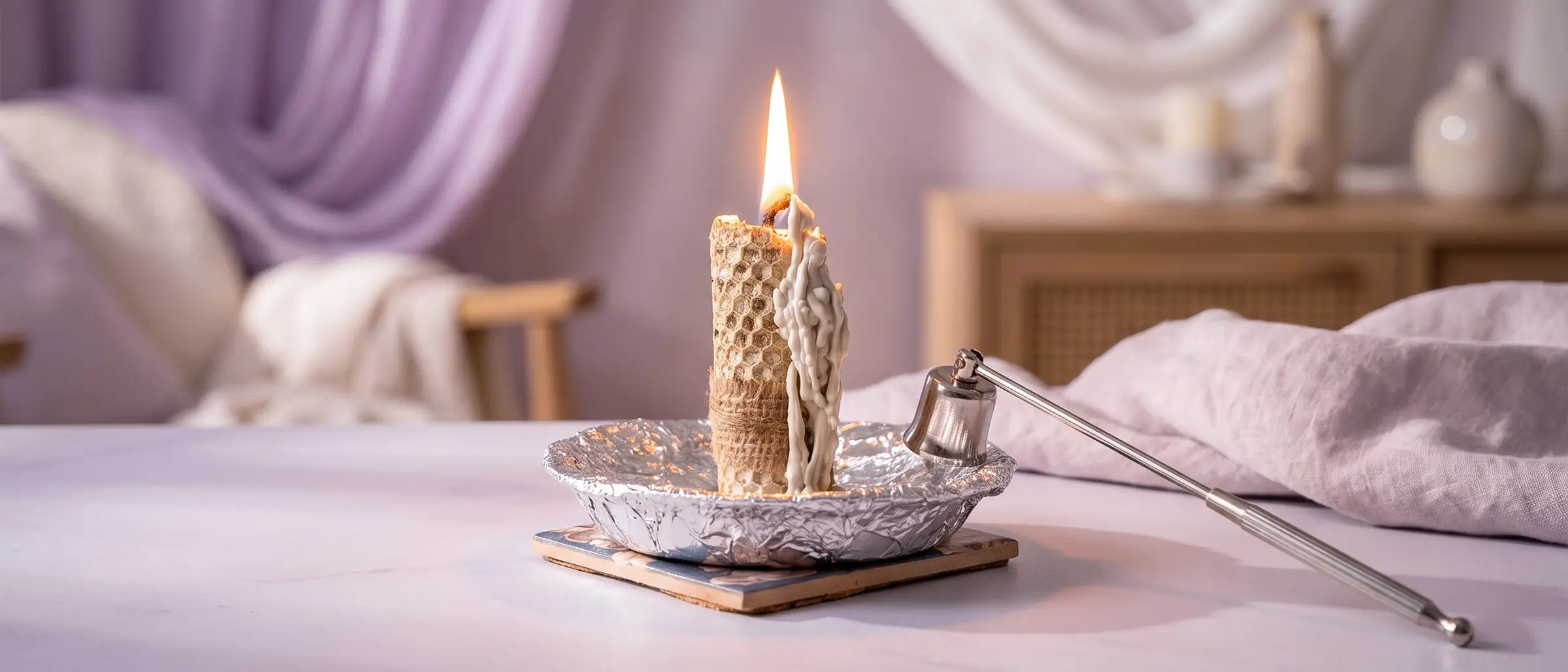
According to statistics from the US National Fire Protection Association (NFPA), about a third of home fires involving candles occur precisely because the candle was left unattended. This is not an abstract precaution — most of the rules below exist precisely to eliminate this single most common scenario.
First understand what type of burning you are working with 🔥
All beeswax foundation candles burn in one of two ways, and preparation depends on exactly this.🕯️ Wick burning:
🔸 Which candles: harmonizing, chakra, decorative.
🔸 How it burns: smoothly, along the central wick.
🔸 Dishes: candle holder with raised edges.
🔥 Torch burning:
🔸 Which candles: cleansing (program), Ancestral candles.
🔸 How it burns: brightly, over the entire surface, with sparks.
🔸 Dishes: wide heat-resistant dishware.
💡 Important: if you are not sure which candle is in front of you, look at the composition: a dense coating of dry herbs almost always means torch burning.
Wick: what it is made of and why it matters 🧵
It is worth mentioning the wick itself separately. Handmade candles use pure cotton wicks — without a metal core.💡 Important: in 2003, the US Consumer Product Safety Commission (CPSC) completely banned the manufacture and sale of candles with lead-core wicks after studies showed that when burned, such wicks could release dangerous concentrations of lead into the air — especially harmful to children. A cotton wick does not create this problem in principle.
How to choose candle holders and dishes 🏺
The main rule is that the wax must have room to spread. In a narrow, tight container, melted wax cannot spread sideways: it collects in a deep layer, floods the herbs, begins to boil and rise. Because of this, the candle burns abnormally long, the fire is held in an enclosed space, high temperatures are created — and even ceramics or glass can crack from overheating.Any heat-resistant container with rims is suitable: ceramic, stone, clay, cast iron, metal. For torch candles — a wide dish, deep bowl, or skillet. For wick candles — an ordinary saucer- or bowl-shaped candle holder with low edges is quite sufficient.
If you light several candles at once (for example, during chakra practice or on a holiday), leave enough free space between them — candles placed too close together feed off each other's heat, and the flame can behave unpredictably.
Protection with foil and surface shields 🛡️
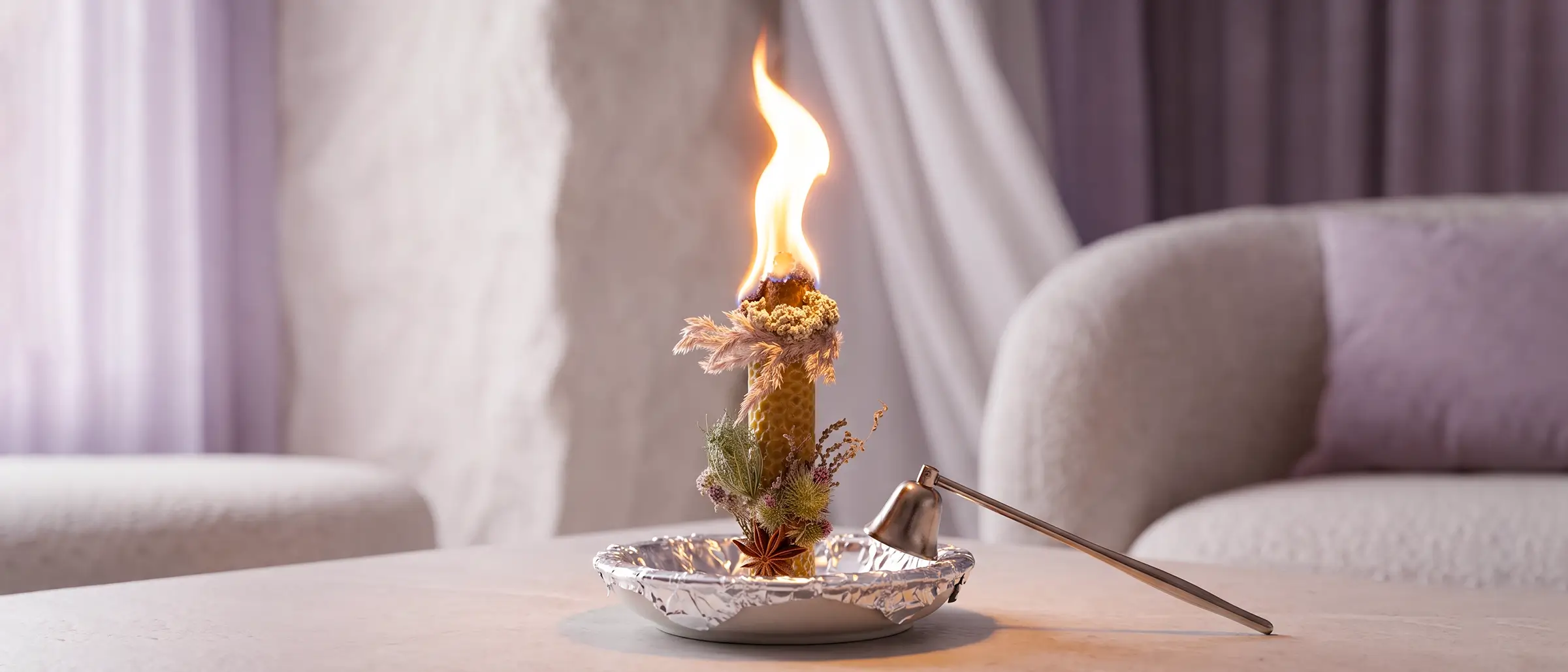
The bottom of any container — stone, ceramic, metal — is lined with food foil in 2–3 layers. This is a purely practical step: after the candle burns out, the foil with melted wax and stubs is simply rolled up and disposed of, while the dishware remains clean.Separately — protecting the table or dresser. Any container heats up significantly during prolonged burning of a torch candle, so a heat-resistant base must be placed under the candle holder or bowl: a thick wooden board, cork coaster, or ceramic tile.
💡 Important: if during the burning process the container itself becomes too hot to touch with your hand, this is a signal that the thermal protection underneath is insufficient and needs to be reinforced.
If you have dry river sand or small pebbles at hand, you can pour them onto the bottom of the container. Sand helps to securely stabilize the candle and gently extinguishes drips. But if there is no sand, a wide heat-resistant dish lined with foil is sufficient.
Where to place the candle 📍
Besides the container itself, location is important. Place the candle away from drafts, curtains, paper, dried flowers, and other flammable materials — and not on the very edge of a table or shelf where it can easily be brushed by a hand, a pet's tail, or dropped by a child.🐱 Pets require extra attention: cats often jump onto the exact surfaces where a candle is burning, and a dog can hit the container with its tail while running — it is better to physically prevent access to the area rather than simply «keeping an eye on it».
💨 Torch candles with dense herbal coatings produce noticeable smoke, so the room should be ventilated in advance or a window left open — especially if there are people with asthma, allergies, or pregnant women in the house.
🍂 During the heating season, indoor air is drier, which means fabrics, paper, and dry plants nearby ignite more easily — in winter, when candles are lit most often for comfort, pay special attention to what is located nearby.
🔥 On the first lighting, let the candle burn long enough so that the top layer of wax melts evenly across the entire surface.
🚫 Never move a burning candle around the room — hot wax can spill. Relocate the candle only when it is unlit.
Live supervision 👁️
Torch candles must be monitored from the first to the very last spark — do not leave them unattended for even a minute. As NFPA statistics show, an unattended candle is the single most common cause of candle-related home fires, so this rule is not a formality, but the most vital part of safety in the entire practice.⚠️ Important: a separate rule — never light a candle before sleep or leave it burning if you feel you might doze off. According to the same NFPA statistics, 41% of home candle fires start in the bedroom, and 11% occur after a person has fallen asleep. If you light a harmonizing candle in the evening before bed, extinguish it before lying down rather than leaving it to burn in the background.
How to extinguish properly 🔥
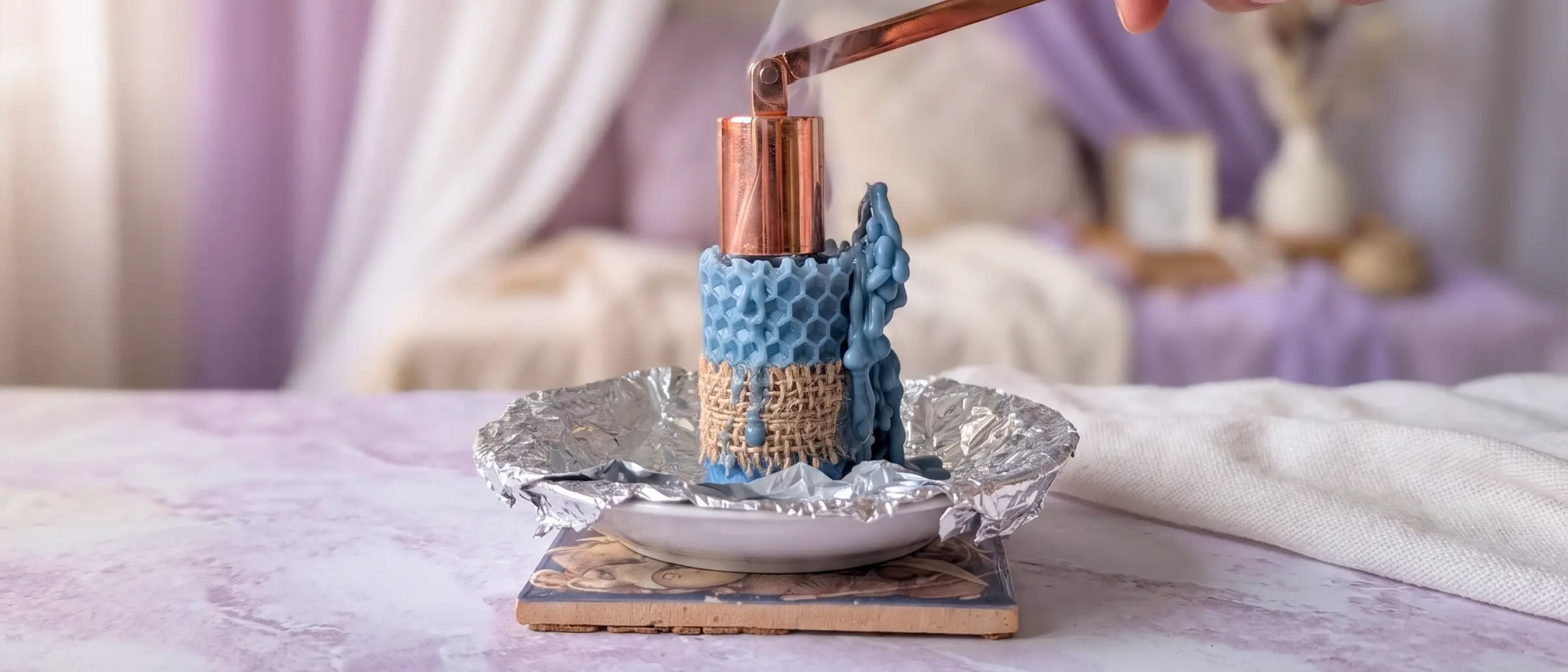
There is a fundamental difference between candle types here:🕯️ Wick candles are extinguished with a snuffer — a special cap that simply cuts off the oxygen supply. Blowing out the flame with breath or extinguishing it with fingers (especially moistened with saliva) is forbidden: a harsh draft of air disrespects the element of Fire and destroys the smooth structure of wick burning.
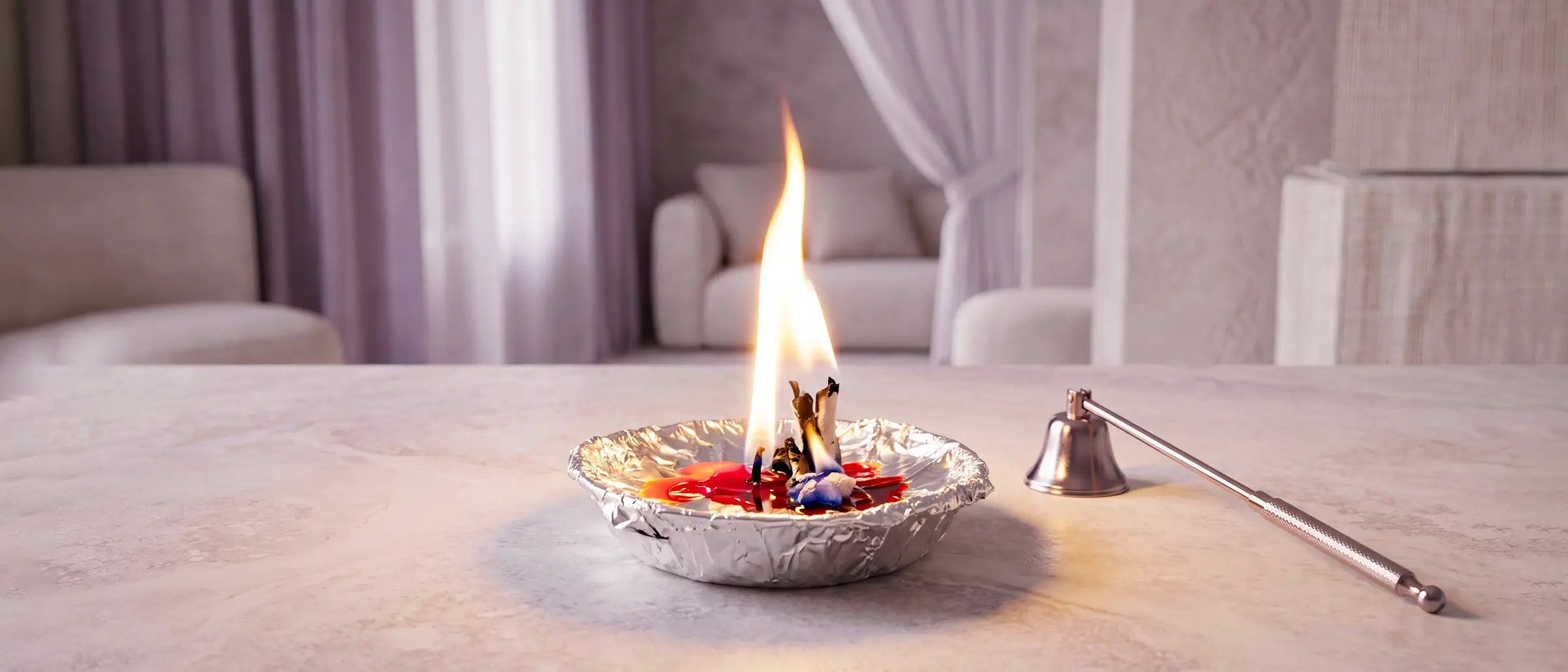
🔥 Torch candles are not extinguished or put off for later — this is a complete process that burns out on its own. Physically, such candles with dense herbal coatings cannot be extinguished with a snuffer — their task is to burn out completely.
After the torch candle flame appears to go out, do not rush to clean up the container: smoldering herb particles and embers in the ash can remain hot for some time. Allow everything to cool completely before rolling up the foil with leftovers.
If something goes wrong ⚠️
A candle is not merely an interior item or a cold chemical element, but a living conductor of the element of Fire. That is why the flame can sometimes behave unpredictably. To feel confident in any turn of events, it is important to learn simple safety rules in advance: the main ones are never pour water on burning wax (this causes a violent splash of scalding substance) and never blow out the flame with a sharp breath (this not only destroys the practice and purity of the element, but is also dangerous: the airflow can spread sparks onto curtains, napkins, or other items).🧺 Keep a thick cloth or a piece of natural fabric nearby. If the flame needs to be stopped, you simply drape it over the candle or bowl, gently and securely cutting off the oxygen supply.
🧂 If fabric is not at hand, a small fire can be carefully sprinkled with baking soda — it gently and quickly smothers the fire.
🚪 If the fire gets out of control and usual measures do not help, simply trust outer-world safety guidelines: leave the premises and call emergency services.
If a drop of hot wax gets on your skin:
💧 Gently place the area under cool (not ice-cold) water.
🚫 Do not try to tear off solidified wax by force — let it cool and leave the skin naturally.
🩺 If you feel the burn is deep or causes severe discomfort, be sure to show it to a doctor.
Traditions, ethics, and respect for the Fire 🙏
Working with program, ritual, ceremonial, or ancestral candles is always more than just a process. It is a dialogue with the element and an interaction with a living tool created from natural materials (beeswax or foundation). The ethics of handling it are built on absolute respect:🕯️ Light with intention: The Fire of the candle responds to your internal state. Approach the process in a focused and calm mindset, without rush.
👁️ Respect the element and tool: do not leave a burning candle unattended and do not place it in drafts or near flammable objects — the element demands attention, not carelessness.
✅ Proper completion: extinguish the candle with respect for the Fire — exclusively with a snuffer (a special candle-extinguishing cap), gently cutting off oxygen. Under no circumstances blow out the flame with a sharp breath or extinguish it with fingers to avoid dangerous sparks, burns, and to preserve the purity of your practice.
Candle safety myths ❌
✖ Myth: the smaller the dish, the neater and safer it is.Reality: it is quite the opposite — tight containers create the risk of overheating and cracking because the wax has nowhere to flow.
✖ Myth: a torch candle can be left for a while and returned to later.
Reality: unattended open flame is the leading cause of home candle fires, according to NFPA statistics. Torch candles burn especially actively, and leaving them even for a short time is unacceptable.
✖ Myth: if a candle goes out by itself, something went wrong with the dish or wick, and you should panic immediately.
Reality: self-extinguishing does not pose a safety threat on its own if there are no flammable objects nearby. However, in practice, this is an important signal. On one hand, physically the candle might have been cramped in the container or airflow was restricted. On the other hand, in traditional work, self-extinguishing often indicates strong resistance from the negativity being worked on, or heavy energetic clutter in the space. This is a sign to stop, analyze the situation, and, if necessary, repeat the practice considering purification. Read more about this in the Candles for Cleansing and Protection article.
💡 More common misconceptions about ritual candles — in the general article Candle Myths →
Frequently asked questions ❓
Can glass containers be used for a torch candle? Using glass is strictly not recommended. A torch candle is a powerful, intense tool with a large burning surface, high and active flame, which emits very strong localized heat. Using regular glassware for a torch candle carries a direct risk of the glass shattering from heat. Such candles require special heat-resistant containers (or non-combustible metal/ceramic stands) capable of withstanding the high intensity of Fire.What is the wick made of in handmade candles and is it safe? Pure cotton wicks without metal cores are used. Lead wicks have been completely banned in the US since 2003 due to the risk of lead emissions during burning — handmade candles do not contain them from the start.
What should be done with wax and foil after the candle burns out? First allow everything to cool completely — smoldering herb particles in the ash can stay hot for some time after the flame visually goes out. Then the foil with melted wax and stubs is simply rolled up and discarded (for Ancestral candles — with the note that remnants are better buried, as described in the Ancestral and Memory Candles article).
Can a candle be lit before bed and left to burn out? No. According to NFPA statistics, 41% of candle fires in homes start in the bedroom, and 11% occur after a person has fallen asleep. Extinguish the candle before going to sleep.
Is sand required at the bottom of the container? No, it is an optional element for stability and extra heat protection — you can do without it if the container is wide and placed on a heat-resistant stand.
Is it necessary to ventilate the room during torch candle burning? Yes, especially if there are people with asthma, allergies, or pregnant women in the home — dense herbal coating creates noticeable smoke when burning, and fresh air in the room will help.
Is it safe to light a torch candle in an apartment with children or pets? Absolutely not. Working with a torch candle requires complete space isolation and absolute operator concentration. In a room where such a powerful tool burns, there should be neither children nor pets. A child's sudden run, a cat's sudden jump, or an accidental movement can lead to the candle tipping over or severe burns. Practice with Fire always requires conscious preparation and a closed, safe space where nobody will disturb you.
Can several candles be lit simultaneously? Yes, you can, but leave enough space between them so they do not stand right next to each other and their flames do not affect one another. Placing them too close together increases overall heating and makes fire behavior less predictable.
What to do if a drop of wax gets on the skin? Place the spot under cool running water, do not pull off hardened wax by force. In case of a severe burn, consult a doctor.
What to do if thick fabric is not available for emergency extinguishing? A small fire can be covered with baking soda — it cuts off oxygen supply just like fabric does.
Why shouldn't a ritual candle be blown out with breath? This contradicts both safety rules and tradition. From an energetic perspective, blowing out sharply is a display of disrespect toward the tradition and the element of Fire, breaking the set program and purity of practice. From a physical perspective, a sharp draft is also dangerous: it can spread hot sparks or wax drops onto surrounding objects. To complete the work correctly, a snuffer (a special cap) is used to gently cut off oxygen access.
Can a torch candle be placed directly on a wooden table? No, a heat-resistant stand between the container and the surface is strictly necessary — the table can heat up and be damaged even through the container.
What if the candle container becomes too hot? This signals that the heat protection underneath is insufficient — reinforce the stand (add another layer of wood, cork, or tile) and choose a thicker container next time.
Choose your candle 🕯️
Now that you know how to safely work with fire, you can choose a candle for a specific goal — harmonization, cleansing, chakra work, honoring Ancestors, or simply home coziness.🛍️ View all candles on the online showcase →
If you are still not sure which candle will suit you best, read the article How to Choose a Candle → or consult with master Ksana, who will be happy to assist and create a candle specifically for your request:

All about designer, ritual candles →